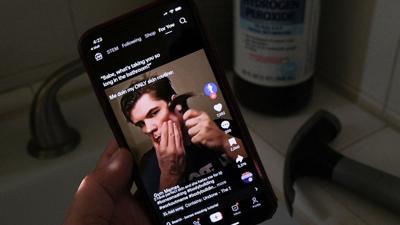


What is looksmaxxing? A therapist explains the TikTok trend and what it means for young men's mental health
A teenage boy stares at his reflection, measuring the angle of his jaw against an algorithm’s ideal. He skips meals, hits a face-massage tool against his cheekbones, and scrolls a forum where strangers grade his face on a numerical scale. He calls it self-improvement. His parents call it concerning. Underneath both interpretations sits a quieter fear: without the right face, he will be invisible.
Looksmaxxing has moved from fringe message boards to mainstream TikTok and Instagram, where many young men seemingly have made it a daily ritual. Most start with what looks like ordinary grooming advice. Some end up somewhere clinicians are increasingly worried about, where appearance becomes the only measure of personal worth, and the line between motivation and self-harm gets thin.
LifeStance Health explains how this trend works and what young men are actually trying to solve by looksmaxxing.
What is looksmaxxing?
Looksmaxxing is the practice of trying to maximize physical attractiveness through behavioral, cosmetic, or surgical changes. The term is widely understood to have originated on male incel forums in the early 2010s, where men who self-identified as involuntarily celibate theorized that facial structure determined social and romantic worth. It has since spread to mainstream platforms where content creators rate facial features like canthal tilt, zygomatic projection, and jawline definition using arbitrary scoring systems.
According to a 2025 review in Facial Plastic Surgery & Aesthetic Medicine, looksmaxxing content often reduces beauty to mathematical symmetry and can cultivate a distorted body schema that closely resembles body dysmorphic disorder.
Inside looksmaxxing communities, members talk about “ascension,” a term meaning the belief that improving one’s appearance will improve one’s entire life, from career success to romantic prospects. The promise is straightforward and powerful: change your face, change your future. The reality is more complicated and often more harmful.
Softmaxxing vs. hardmaxxing
Looksmaxxing falls along a spectrum, and not every practice carries the same risk. Researchers and clinicians generally divide the trend into two categories.
Softmaxxing
Softmaxxing covers low-risk practices, including skincare, fitness, dental hygiene, posture work, sleep, and nutrition. On its own, this category looks like ordinary self-care, and many of these habits do support physical and mental health. The risk is not in the activity, but in the motivation behind it. When a young man brushes his teeth because he wants healthy gums, that is hygiene. When he brushes them while compulsively rating his smile against forum posts, the same behavior begins to function differently.
Hardmaxxing
Hardmaxxing involves more invasive interventions, such as cosmetic surgery, jaw implants, leg-lengthening procedures, anabolic steroid use, or extreme dieting. A 2025 qualitative study published in Sociology of Health & Illness, which analyzed more than 8,000 comments from a major looksmaxxing forum, documented users discussing leg-lengthening surgery, black-market hormone purchases, and bone-smashing, the practice of repeatedly striking the face to attempt structural change.
A particularly extreme subcategory has emerged around mewing, a tongue-posture technique users practice for hours at a time. Some adolescent boys remain silent throughout the school day or consume only liquids to maintain the position continuously. These behaviors are increasingly reported in middle schools and high schools, and they are often framed by participants as discipline rather than distress.
Why young men are vulnerable to looksmaxxing
The pull of looksmaxxing is not random. It lands on a generation of young men who are, by several measurable indicators, among the loneliest cohorts in recent memory. According to a Gallup analysis of 2023–2024 polling data, roughly 25% of American men aged 15 to 34 said they felt lonely a lot of the previous day, compared with 18% of young women. That backdrop of isolation is part of why a community organized around appearance can feel like belonging.
Two emotional needs tend to drive young men toward looksmaxxing more than any others: a sense of powerlessness and a hunger for belonging. Many of these young men want to feel some control over a future that looks economically uncertain and socially confusing. They have absorbed a narrative that says if they can control how they look, they can control everything else, from purpose and relationships to destiny.
Underneath the powerlessness sits a more specific fear: the fear of being invisible. Many young men in these communities are not chasing beauty for its own sake. They are trying to make sure they are seen, heard, and valued by someone, and looksmaxxing is the path that has been handed to them. The communities themselves reinforce this need by offering exactly what is missing elsewhere. Inside these forums, young men find other men pursuing the same ideology and the same goal of “ascension.” For someone who has felt unseen, the experience of being acknowledged, even by anonymous strangers grading a face, can be a powerful pull. The painful irony is that the same community offering visibility also conditions worth on appearance, which is the opposite of being known.
This is also where anxiety enters the picture. Anytime someone is fixating on a feared future or on something they cannot control, anxiety is rarely far behind. For many young men, looksmaxxing functions as an attempt to manage the underlying fear that they are not enough, that nothing about who they are will be valued unless they look a particular way. The trouble is that social media, with its algorithmic amplification, keeps moving the bar. Each new comparison raises the standard. Each new filter narrows the ideal. The young man who started out trying to feel adequate finds the goalpost has moved again.
Looksmaxxing and mental health risks
Clinicians who work with adolescents and young adults are seeing a clear pattern of harm linked to immersion in these communities. A 2025 narrative review in The Lancet Child & Adolescent Health identified adolescent boys and young men as developmentally vulnerable to muscle dysmorphia and other body image disorders, particularly as appearance-focused content saturates their feeds.






A core principle in clinical work is that all behavior is purposeful. Even behaviors that look irrational or self-destructive serve a function for the person doing them. The challenge with looksmaxxing is that the harmful behaviors are often justified through cognitive distortions, or patterns of thinking that distort how someone perceives themselves, others, and the world. A young man who is starving himself to sharpen his jawline may genuinely believe he is being disciplined rather than disordered. Recognizing this is what allows parents and clinicians to look past the behavior and ask: What is this trying to fix?
Body dysmorphia and disordered eating
Looksmaxxing promotes a hyperfocus on perceived flaws, which is the central feature of body dysmorphic disorder. Filters and rating tools that quantify deviation from an “ideal” face often serve as a gateway. What starts as curiosity can turn into hours of mirror-checking, photo analysis, and disordered eating patterns aimed at sharpening features. Restriction is often reframed as discipline, which can make it especially difficult for parents and partners to recognize early.
Depression, shame, and suicidal ideation
The 2025 Sociology of Health & Illness study found that in nearly every rating thread reviewed in that sample, users were insulted, unfavorably compared to other men, or encouraged to harm themselves by at least one other participant. This is the inverse of self-improvement. It is a feedback loop of shame.
As shame compounds, depression often follows. Young men who measure their worth by their face stop feeling like they have a self underneath the face that matters. In severe cases, this can escalate into suicidal ideation, especially when communities promote a worldview known as the “black pill,” the belief that physical traits are immutable and that anyone who falls short is destined to be alone. For loved ones who are concerned, working through a suicide safety plan can be a practical first step.
Exposure to misogynistic belief systems
Looksmaxxing communities are entangled with the broader manosphere, including incel-aligned spaces. As young men move deeper into the content, algorithms tend to surface increasingly extreme material. Many begin with grooming videos and end up reading posts that frame women as the enemy and other men as competitors to be defeated. This shift from insecurity to ideology is one of the most concerning patterns clinicians describe.
How to help a young man who’s looksmaxxing
If you are a parent, partner, or close friend worried about someone caught up in this content, the first task is to create a safer place than the algorithm. Looksmaxxing communities run on judgment, comparison, and shame. The most useful thing a loved one can offer is a space where there is no judgment and no shaming, where a young man can ask questions and talk about what he is afraid of. Curiosity and kindness are two qualities that can make that space possible.
Lead with questions, not lectures
Defensiveness is often the first response when a young man feels his identity is being attacked. Asking what draws him to looksmaxxing, what he is hoping it will give him, and what he likes about the community is more useful than telling him it is unhealthy. A common goal in early conversations is to understand his motivation, not to win the argument.
Shift the focus from appearance to capability
One therapeutic approach clinicians often use is redirecting attention from how a body looks to what a body can do. Rock climbing, team sports, hiking, and other physical pursuits give young men a way to feel competent and connected without measuring their worth in millimeters. This reframe is not about replacing one obsession with another but about widening identity beyond appearance.
Build social intelligence and real-world belonging
Many young men in looksmaxxing communities are searching for the skills that actually drive connection and career success: the ability to read a room, hold a conversation, and repair a conflict. Helping them invest in social intelligence, mentorship, and shared activities can be more impactful than cosmetic interventions. The stigma surrounding men’s mental health often keeps these conversations from happening at all, which is part of why isolation deepens in the first place.
Model a healthier relationship with social media
Lecturing teenagers about screen time rarely changes behavior. Modeling does. Loved ones who set their own boundaries, like deleting social media apps, capping daily phone use, or doing a digital detox, give young men permission to do the same without making them feel singled out or shamed. The implicit message is that being known by people who love you matters more than being rated by people who do not.
Bring in professional support when needed
If a young man is showing signs of body dysmorphia, disordered eating, social withdrawal, persistent shame, or suicidal thoughts, professional help is often the right next step. Therapists who work with adolescents and young men can help untangle the beliefs underneath the behavior, including the fear of being invisible and the conviction of not being enough, and offer tools that the algorithm cannot. For parents unsure where to begin, teen counseling can be a useful entry point.
The factors driving trends like looksmaxxing, including anxiety, low self-worth, and shame, are commonly addressed in mental healthcare. Recent 2026 LifeStance outcomes data found that, among 140,000 patients with at least moderate anxiety, 79% showed improvement in anxiety symptoms with evidence-based care, suggesting that when young men are given appropriate support, meaningful change is possible.
Looksmaxxing at its core is a young man asking a real question about whether he is enough and reaching for the answer in the wrong place. Recovery focuses on helping him step off the hamster wheel of comparison and into the experience of being known on the inside, where his value is not measured in jawline angles or numerical attractiveness scores but through relationships, capability, and a sense of self that does not depend on a camera.
This story was published by LifeStance Health and reviewed and distributed by Stacker.

(0) comments
Welcome to the discussion.
Log In
Keep it Clean. Please avoid obscene, vulgar, lewd, racist or sexually-oriented language.
PLEASE TURN OFF YOUR CAPS LOCK.
Don't Threaten. Threats of harming another person will not be tolerated.
Be Truthful. Don't knowingly lie about anyone or anything.
Be Nice. No racism, sexism or any sort of -ism that is degrading to another person.
Be Proactive. Use the 'Report' link on each comment to let us know of abusive posts.
Share with Us. We'd love to hear eyewitness accounts, the history behind an article.