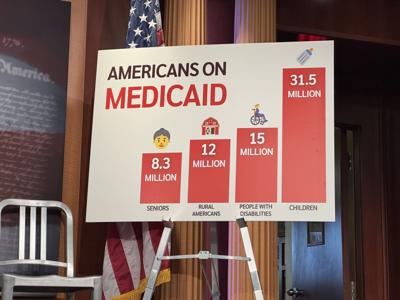
A new $50 billion rural health fund, part of the federal budget reconciliation law known as the One Big Beautiful Bill Act (OBBBA), could help soften the impacts of upcoming Medicaid budget cuts if used strategically, state officials said Friday at the Alabama Department of Mental Health (ADMH) board meeting.
The law, signed by President Donald Trump on July 4, includes a new “rural health transformation program” that provides $50 billion in grants for states over five years, from fiscal year 2026 through 2030. According to a brief from KFF, a national health policy research organization, the fund could partially offset just over a third (37%) of the estimated federal Medicaid spending cuts in rural areas, which are projected to be $137 billion over ten years.
David White, senior policy advisor to Gov. Kay Ivey and a representative for the governor at the meeting, said that with rural population continuing to decline, a focus for the grant should be on how rural communities can use consolidation and technology, such as telehealth, to provide efficient and quality care. The goal, he said, should be to invest in sustainable solutions that make rural health care more accessible in the long term, rather than simply delaying financial struggles with temporary funding.
“If you don’t invest in something to make yourself more viable down the road, why are we spending the money? You’re delaying doomsday, which is something but isn’t enough,” White said.
The fund is divided into two parts. Half ($25 billion) will be distributed equally among states that apply for the grant and are approved. The other half ($25 billion) will be distributed at the discretion of the Centers for Medicare and Medicaid Services (CMS) administrator, a post currently held by Dr. Mehmet Oz.
States are required to apply. Funds awarded must be used for at least three specific purposes from a list of options, including providing payments to health care providers; recruiting and retaining clinical workforce talent; assisting rural communities in right-sizing their health care delivery systems and supporting access to mental health and substance use disorder treatment.





The fund is temporary, while many of the broader cuts to health spending in the new law are not, raising concerns about long-term sustainability. The KFF brief states that “new legislation would be required to provide additional support to rural areas after the funds dry up.”
Kimberly Boswell, ADMH commissioner, after saying at the board meeting that the program outlines in the bill are “one of the more well-written sections of the bill, that is clear about what the expectations are,” said the temporary nature of the program is also a concern.
“The big concern to me … is just what happens after five years,” Boswell said.
The KFF brief notes that the law does not define “rural” and that non-rural areas could potentially receive funding. The law also does not require CMS to publish information about how the funds are distributed, although it could choose to do so.
This story is from alabamareflector.com.
(0) comments
Welcome to the discussion.
Log In
Keep it Clean. Please avoid obscene, vulgar, lewd, racist or sexually-oriented language.
PLEASE TURN OFF YOUR CAPS LOCK.
Don't Threaten. Threats of harming another person will not be tolerated.
Be Truthful. Don't knowingly lie about anyone or anything.
Be Nice. No racism, sexism or any sort of -ism that is degrading to another person.
Be Proactive. Use the 'Report' link on each comment to let us know of abusive posts.
Share with Us. We'd love to hear eyewitness accounts, the history behind an article.