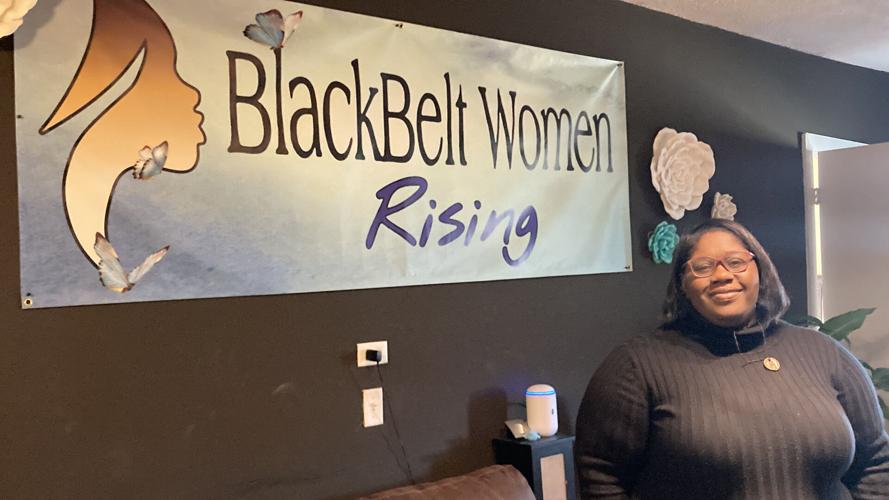

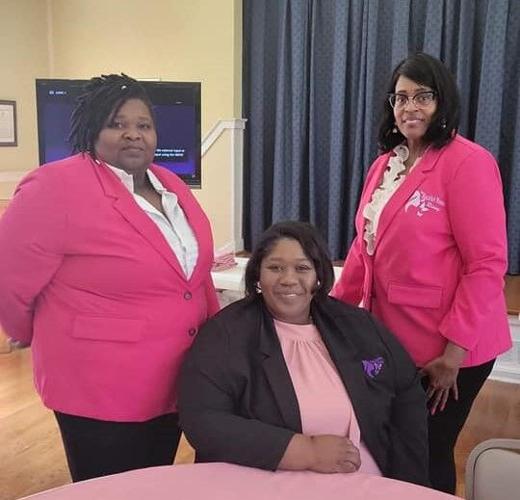


Portia Shepherd has taken her passions and what she learned in larger counties to form a nonprofit making a difference in the Black Belt.
Shepherd, originally from Marengo County, created Black Belt Women Rising that focuses on domestic and sexual violence, gender advocacy and environmental advocacy serving seven Black Belt counties, Choctaw, Hale, Marengo, Sumter, Greene, Wilcox and Perry.
“I kept writing grants in two areas – domestic violence and environmental – and I got them,” Shepherd said. “But I don’t consider it work, because it’s my passion.”
Shepherd started her career at SafeHouse of Shelby County as a weekend coordinator, then moved to Turning Point as a prevention educator. She traveled nine counties speaking out against domestic and sexual violence at schools and churches.
Shepherd later became the prevention education director of family services at Family Services of North Alabama, where she opened two rape crisis centers and thought,“We need to do this at home.”
She began the process of getting her nonprofit started, scored a small grant, but the pandemic hit and closed down in-person counseling.It was during this time she got a call from a law enforcement officer who knew of her work with Turning Point who had a domestic violence survivor who needed a place to stay.
Because of the pandemic, shelters were taking a minimum of people, but hotels were starting to reopen. Shepherd made some calls and was able put the victim up for a few days. A colleague helped the survivor find long-term housing. “So, we did that for a while,” Shepherd said.
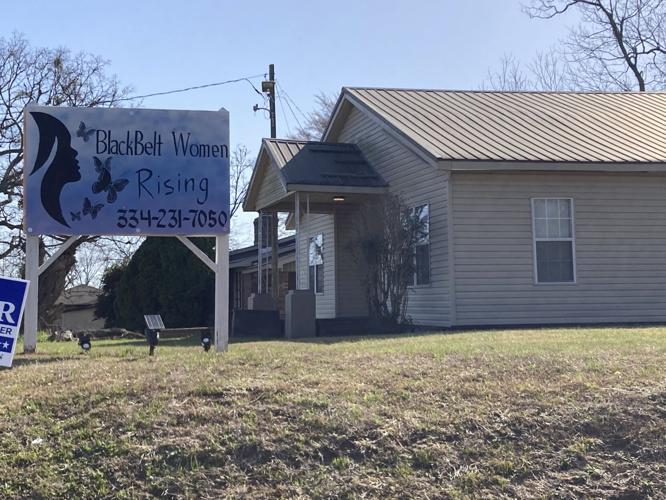
One of the Black Belt Women Rising board members told Shepherd about a grant called a Startup Stipend. Shepherd applied and was awarded a $30,000 grant, and on Oct. 31, 2021, she used that funding to get into her current building on Highway 80 in Uniontown.
“We’ve been working hard to get to where we are now,” Shepherd said. She said that Black Belt Women Rising got a contract with Turning Point to provide $4,000 per month to domestic violence victims. They also got a contract with the Alabama Coalition Against Rape to help with awareness of sexually transmitted diseases and HIV.
“We had a grant at that time through the Alabama Department of Public Health to go into schools in Marengo and Choctaw counties to teach a course called Personal Responsibility,” Shepherd said. Shepherd said working through those grants, Black Belt Women Rising gained a reputation for “getting the job done.”
As the organization and its reputation grew, Shepherd said they attained one of their main goals. They formed a task force made up of law enforcement, DHR, food systems, counselors and other organizations to give police officers the tools they need to help victims of domestic and sexual violence.






The task force makes it easier for victims to get into shelters and get counseling and other support they need as they go “from victim to survivor,” she said.
Through the Task Force, Black Belt Women Rising also trains people who deal with domestic violence victims. In February, they held a training session at Whitfield Regional Hospital in Demopolis for nurses to learn how to properly complete a rape kit. The evidence collected through these kits is instrumental in convicting rapists.
Black Belt Women Rising is also working to educate and prevent teens from becoming victims or perpetrators of domestic violence. During the month of February, which is Teen Dating Violence Awareness Month, Black Belt Women Rising went into high schools to teach a class on dating violence.
“We taught what dating violence is, highlighting things like red flags,” Shepherd said. “It’s the prevention education part of what we do.”
Environmental advocacy is another focus for Shepherd through Black Belt Citizens Fighting for Health and Justice. Shepherd helped organize a meeting about illnesses in the Uniontown area and helped sue the cheese plant, which she said ultimately led to its closure and the removal of the stench that plagued the community for years.
She added many heavyweights got involved with the wastewater issue, resulting in the Water Resource Development Act of 2016.
Even when she was working for other organizations advocating and helping domestic violence victims, Shepherd was researching environmental issues and advocating for the people of Uniontown and surrounding areas.
One of the next big events on the environmental advocacy side of Black Belt Women Rising is the Black Belt Utility Conference. This is designed for water boards across the Black Belt to get information and learn more about providing good, clean water to citizens.
“We think you can always learn to do things better,” she said. The conference will be held May 24 at the Demopolis campus of Wallace Community College.
Engineers from different communities will share ideas on how to better run water systems. Representatives from the Alabama Department of Environmental Management will talk about regulation and why water systems must comply. Shepherd said there will also be people that can help the water boards with funding sources for various projects.
For more information about Black Belt Women Rising and the events they are hosting, you can go to their website, www.blackbeltwomenrising.org.

(0) comments
Welcome to the discussion.
Log In
Keep it Clean. Please avoid obscene, vulgar, lewd, racist or sexually-oriented language.
PLEASE TURN OFF YOUR CAPS LOCK.
Don't Threaten. Threats of harming another person will not be tolerated.
Be Truthful. Don't knowingly lie about anyone or anything.
Be Nice. No racism, sexism or any sort of -ism that is degrading to another person.
Be Proactive. Use the 'Report' link on each comment to let us know of abusive posts.
Share with Us. We'd love to hear eyewitness accounts, the history behind an article.