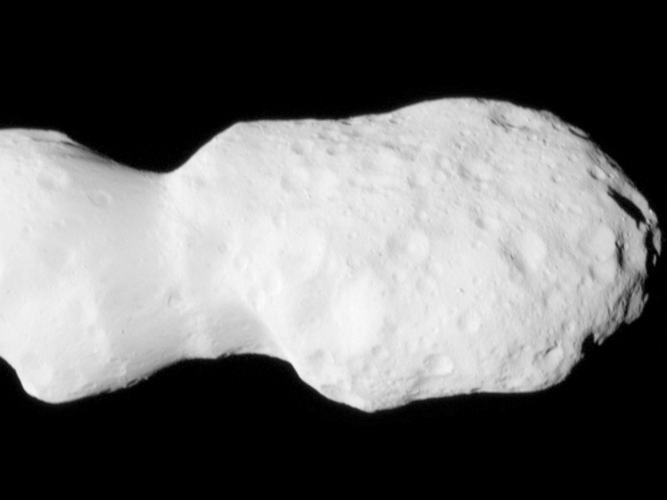
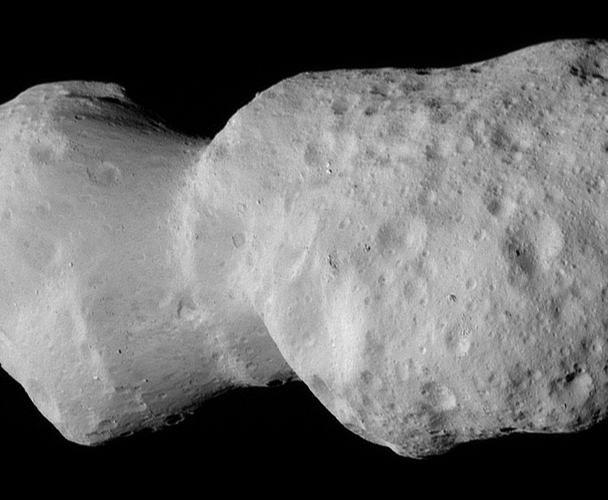


The "oddball" asteroid is shaped like a peanut and wobbles in space. (NASA/Goddard/SwRI/Johns Hopkins via SWNS)
By Dean Murray
Scientists have revealed a peanut-shaped 155 million-year-old asteroid wobbles in space - and once held water.
NASA's new findings from last year's fly-by of rock Donaldjohanson were published on June 18.
The agency's Lucy spacecraft collected the first close-up images and other data as it passed 650 miles away from the asteroid.
The distinctive "peanut" shape is believed to have formed as fragments came together after a violent collision.

(NASA/Goddard/SwRI/Johns Hopkins via SWNS)
NASA said the asteroid was transformed by the small but inexorable force of the Sun’s radiation, all while retaining signs of the brief presence of liquid water in its distant past.






The data revealed that, instead of spinning simply around one axis like most other asteroids and planets, Donaldjohanson has a more complicated two-axis rotation, or "wobble."
Donaldjohanson likely rotated at least 10 times faster when it formed, having slowed to its current rate in the last 20 to 60 million years, the team estimates.
Lucy’s encounter with the asteroid was planned as a dress rehearsal for the spacecraft and mission team before its primary asteroid encounters, which begin with its flyby of the Jupiter Trojan asteroid Eurybates on August 12, 2027.

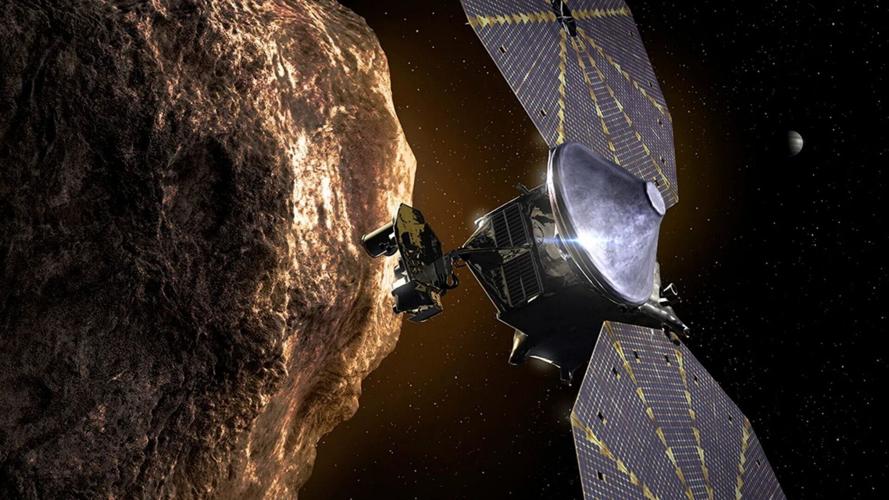
An illustration of NASA's Lucy space probe. (NASA via SWNS)
Simone Marchi, Lucy deputy principal investigator and lead author of the study at the Southwest Research Institute, said: "It’s helpful for scientists to compare Donaldjohanson with asteroids like Bennu and Ryugu, which are seemingly similar asteroids, because every subtle difference is another clue to our origin story.
"Once we start learning more about the Trojans, a completely different population of space rocks with very different histories, our understanding of solar system formation is destined to be challenged."
Lucy’s science team report was published in the journal Science.

(0) comments
Welcome to the discussion.
Log In
Keep it Clean. Please avoid obscene, vulgar, lewd, racist or sexually-oriented language.
PLEASE TURN OFF YOUR CAPS LOCK.
Don't Threaten. Threats of harming another person will not be tolerated.
Be Truthful. Don't knowingly lie about anyone or anything.
Be Nice. No racism, sexism or any sort of -ism that is degrading to another person.
Be Proactive. Use the 'Report' link on each comment to let us know of abusive posts.
Share with Us. We'd love to hear eyewitness accounts, the history behind an article.