
Innovators who are working on ways to pull carbon dioxide out of the atmosphere to fight climate change are having a tough time lately.
Their biggest supporter, Microsoft, recently began telling partners that it is pausing its carbon removal purchases. To get a sense of how big of a deal this is, look at the numbers: The tech company alone has purchased approximately 80% of the contracted cumulative volume of carbon removals to date. Its retrenchment is viewed as potentially a major blow to the sector.
However, there may be a bright spot for this industry, and it comes from an unexpected source: The U.S. Environmental Protection Agency quietly decided in March to grant a research permit under the Marine Protection, Research, and Sanctuaries Act to a Houston-based carbon removal startup.
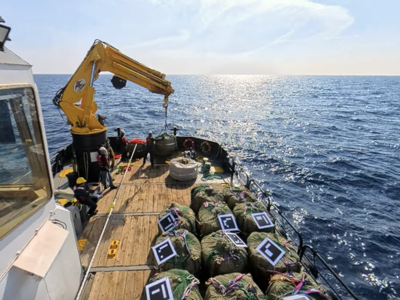
The company, Carboniferous, aims to assess the potential to durably lock up greenhouse gases by harvesting plants that took in carbon dioxide on land and sinking them to the bottom of the ocean.
This approach is often called “ocean biomass sinking,” or marine anoxic carbon storage.
Ocean biomass sinking is one of several carbon removal approaches involving the ocean known as “marine carbon dioxide removal.” Other marine approaches include adding alkaline materials that react with seawater to increase the uptake of carbon dioxide, seeding oceans with iron to stimulate the growth of phytoplankton that can take up carbon dioxide, and farming seaweed to also take up carbon dioxide and sink it.
The Intergovernmental Panel on Climate Change, which compiles research on climate change from scientists around the world, calls carbon dioxide removal “unavoidable” if the world hopes to keep rising temperatures in check and achieving the targets of the Paris climate agreement.
But is sinking biomass in the ocean the answer?
I am the co-founding director of the Institute for Responsible Carbon Removal at American University, and I have reviewed several of these projects. I see both pros and cons to ocean carbon removal techniques.
How ocean biomass sinking works
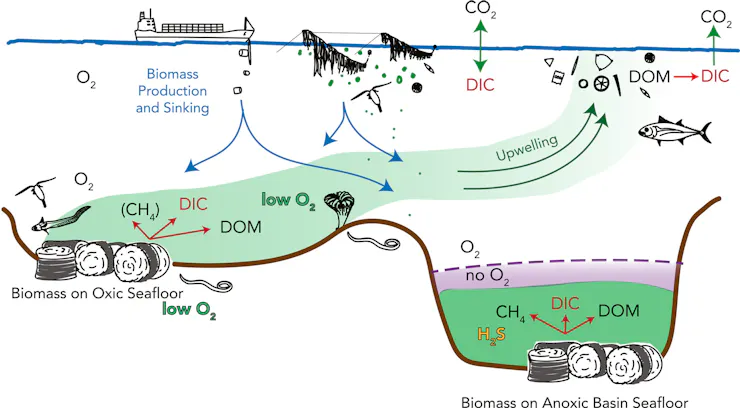
Carboniferous plans to carry out its field experiment in the Orca Basin off the coast of Louisiana. The basin is anoxic, meaning devoid of oxygen, and has a higher concentration of salt that most seawater. The EPA permit lets the company sink 20 burlap sacks containing sugarcane residue and monitoring equipment to the bottom of the sea there to study what happens.
Globally, land vegetation, including trees and crops, sequesters approximately 60 billion tons of carbon per year. However, a large portion of this carbon is quickly released back into the atmosphere – often within months to years – when the vegetation dies and decomposes, or is burned.
Ocean biomass sinking aims to lock up that carbon on the ocean floor in low-oxygen areas, where decomposition is much slower. Anaerobic processes, such as fermentation, may leave the biomass largely intact for centuries or millennia. Colder water environments can also slow the rate of biomass decay.
The concerns
Two questions that arise are whether this approach would be effective at the scale needed and what risks it might pose to ocean ecosystems.
Recent studies have estimated that ocean biomass storage projects could durably store somewhere between 0.1 and 1 gigatons of carbon dioxide annually. That sounds like a lot, but humanity may need to remove 7 to 9 gigatons of carbon dioxide each year from the atmosphere by the middle of the century and up to 20 gigatons per year by 2100 to meet global climate goals and avoid dangerously high temperatures.






A bigger concern is that substantially increasing organic matter in deep ocean environments might stimulate the growth of anaerobic bacteria, which can produce methane, a potent greenhouse gas that could offset much of the benefits of this approach.
Proponents of ocean biomass storage counter that the absence of vertical mixing among the water layers in ocean ecosystems would prevent any additional methane releases from ultimately escaping to the atmosphere. Further research is clearly required to know the risks.
Ocean biomass storage might also pose environmental and economic risks. As biomass descends in the water column, it has the potential to release particulates or organic matter, which could alter the activities of microbes as well as the food supply and oxygen in the ocean mesopelagic zone. The zone is a busy region of high productivity and home to a million undescribed species. The result could harm commercial fisheries and other species.
It’s also unclear how seafloor communities, such as bacteria, other microbes and fungi, might respond to the introduction of massive amounts of biomass.
And the introduction of large amounts of additional biomass in deep-ocean regions might attract species that feed on dead plant material, or their predators, which could alter species interactions in ecosystems that scientists know very little about. Those effects could be further exacerbated by decaying biomass reducing oxygen in seafloor environments and potentially increasing the release of hydrogen sulfide, methane, nitrous oxide and nitrogen and phosphorus compounds.
Other ways to store carbon in the oceans
Carboniferous is not the only company focused on ocean biomass storage. Israel-based Rewind is currently experimenting with burying waste plant matter from farms and cities in an anoxic Black Sea region off the coast of Romania, as well as beneath seabed sediments in the Mediterranean Sea off the coast of Haifa in Israel. The company believes that it could sink 1 million tons of biomass residue annually by 2030.
Another Israeli company, BlueGreen Water Technologies, takes a very different approach. Instead of collecting biomass from terrestrial sources, it uses a solution of hydrogen peroxide to kill, and ultimately sink, toxic harmful algal blooms made up of cyanobacteria, also known as blue-green algae. This approach may also eliminate blooms that can devastate aquatic environments by creating low-oxygen dead zones. And because algae sequester substantial amounts of carbon, the company claims that this approach could also remove billions of tons of carbon from the atmosphere in ocean and freshwater ecosystems.
The world’s oceans are by far Earth’s largest carbon sink, storing roughly 50 times more carbon than the atmosphere and 20 times more than terrestrial forests and soils combined. This provides a compelling case to explore marine carbon removal options.
However, as is the case with all marine-based approaches, ocean biomass storage raises an array of questions that need to be resolved before the world can consider deploying it on a large scale. Carboniferous’ research program is one piece of this puzzle.
This article is republished from The Conversation, a nonprofit, independent news organization bringing you facts and trustworthy analysis to help you make sense of our complex world. It was written by: Wil Burns, American University School of International Service
Read more:
- Climate engineering would alter the oceans, reshaping marine life – new study examines each method’s risks
- Scientists envision an ‘internet of the ocean,’ with sensors and autonomous vehicles that can explore the deep sea and monitor its vital signs
- Geoengineering the ocean to fight climate change raises serious environmental justice questions
Wil Burns does not work for, consult, own shares in or receive funding from any company or organization that would benefit from this article, and has disclosed no relevant affiliations beyond their academic appointment.


(0) comments
Welcome to the discussion.
Log In
Keep it Clean. Please avoid obscene, vulgar, lewd, racist or sexually-oriented language.
PLEASE TURN OFF YOUR CAPS LOCK.
Don't Threaten. Threats of harming another person will not be tolerated.
Be Truthful. Don't knowingly lie about anyone or anything.
Be Nice. No racism, sexism or any sort of -ism that is degrading to another person.
Be Proactive. Use the 'Report' link on each comment to let us know of abusive posts.
Share with Us. We'd love to hear eyewitness accounts, the history behind an article.