Tourism in Belize is projected to top pre-COVID tourism numbers by more than 10%. That record-breaking tourism, driven by expanding U.S. air service and a major airport modernization, has transformed Belize into one of the Caribbean’s fastest-growing destinations for American travelers.
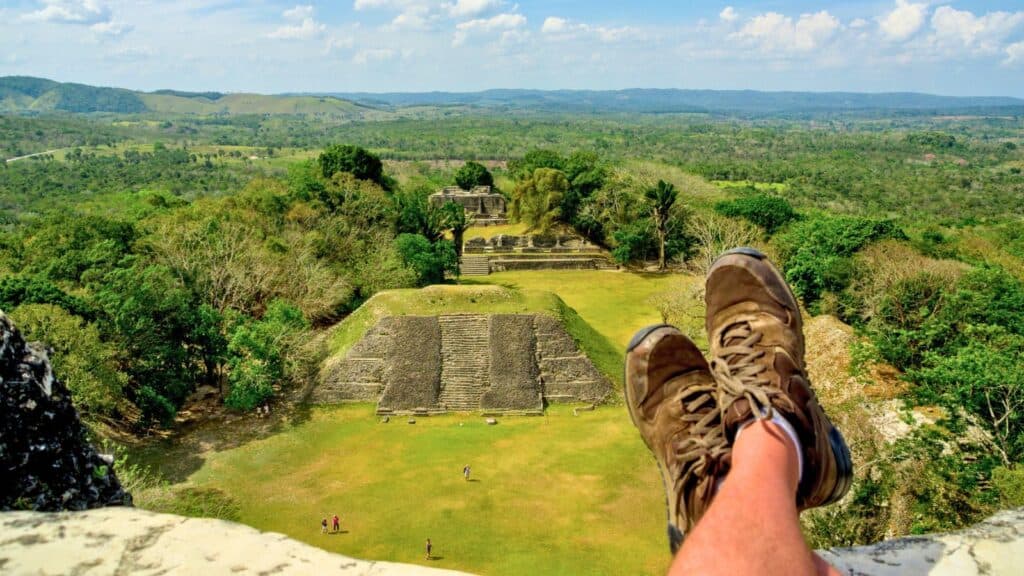
For American tourists, Belize offers something few Caribbean destinations can: a vacation that combines rainforest adventure with an easy beach escape. Visitors can explore ancient Mayan ruins, hike through tropical forests or venture into caves before trading hiking boots for sandals the following day. Along the Caribbean coast, travelers can snorkel the world’s second-largest barrier reef, hop between secluded cayes or simply unwind on the beach.
Belize welcomed more than 1.4 million visitors in 2024, the highest number in the country’s history, as overnight tourism surged and new nonstop flights from the United States made the Central American nation more accessible than ever. The record-breaking year comes a year after officials announced an investment of roughly $250 million to expand the country’s main international airport and accommodate continued growth.
A small country outpacing the Caribbean
Belize is, by Caribbean standards, tiny. It has a population of roughly 420,000 and a land area smaller than New Hampshire. Yet it has become one of the region’s fastest-growing tourism markets.
The Belize Tourism Board reported overnight visitor growth of 21% in 2024, outpacing the Caribbean average and surpassing the country’s pre-pandemic tourism record. Tourism now accounts for more than 40% of Belize’s gross domestic product and roughly 60% of its foreign exchange earnings.
American travelers continue to fuel much of that growth. Texas and California account for nearly one-quarter of all U.S. visitors, followed by Florida, New York, Colorado, Georgia, Washington, and North Carolina. Most are arriving through Philip S.W. Goldson International Airport, which now serves an expanding network of nonstop flights from across the United States.
Belize’s appeal is also quite practical: English is the country’s official language, the Belize dollar is pegged at 2-to-1 with the U.S. dollar, and most major U.S. cities are only a few hours away by air. Those advantages, along with the country’s blend of rainforest, archaeological sites and Caribbean coastline, have helped distinguish Belize from larger resort destinations across the region.
Preparing for the next wave of visitors
To keep up with demand, the Belize Airport Concession Company is undertaking what officials describe as a roughly $250 million modernization of PGIA over a 10- to 15-year horizon. A first phase, budgeted at about $60 million, is already underway. It comes with an expanded ramp, a new eastern taxiway, two-tier parking, and a larger cargo facility.
A second phase, estimated at $190 million, would add jet bridges, escalators and moving sidewalks to a terminal that until now has required passengers to walk across the tarmac in whatever weather happens to be arriving with them.
“The vast majority of people who come for overnight purposes come through the PGIA, so that’s the first thing that they experience and the last thing,” tourism minister Anthony Mahler told Belize’s Love FM. He said the long-term investment will help accommodate future growth while improving the visitor experience.
Where rainforest meets the reef
Improved infrastructure may be bringing more travelers to Belize, but accessibility alone does not explain the country’s rising popularity. What continues to set Belize apart is the ability to experience two dramatically different landscapes in a single vacation.
The country is one of the few destinations in the Western Hemisphere where it is genuinely possible to spend a morning climbing a Maya pyramid, an afternoon snorkeling the second-largest barrier reef in the world and a night in the rainforest. All within a single short trip.
Along the coast, the Belize Barrier Reef Reserve System stretches for nearly 190 miles and forms part of the Mesoamerican Barrier Reef, the second-largest barrier reef in the world. The UNESCO World Heritage site is home to hundreds of fish species, vibrant coral formations and three of the Atlantic Ocean’s four coral atolls, making Belize one of the region’s premier destinations for snorkeling and diving.
Inland, dense rainforest covers much of the country, where protected reserves shelter wildlife, rivers and dozens of Maya archaeological sites. Ancient cities, including Xunantunich, Caracol and Lamanai, offer a glimpse into one of the Western Hemisphere’s most sophisticated civilizations.
Actun Tunichil Muknal, the cave universally known as ATM, caps daily admission at 125 visitors and bars cameras after a tourist dropped one on a 1,000-year-old skull in 2012. It contains the calcite-encrusted skeletal remains of more than a dozen sacrificial victims, and is reachable only with a licensed guide after a 3-mile jungle hike and several stream crossings.
In the jungle lies the Sleeping Giant
Few properties illustrate the duality of a Belize trip better than Sleeping Giant Rainforest Lodge. It is tucked into the foothills of the Sibun River Forest Reserve, about an hour’s drive from the airport. The property offers the kind of experience that has become central to Belize’s tourism identity: equal parts adventure and comfort.
The Canadian and Belizean-owned property sits on 750 acres at the edge of a citrus grove that once served as a campground for British soldiers training in jungle survival, search-and-rescue and field medevac before Belize’s independence in 1981.






“The hotel itself came about really slowly,” said Tristan Chacon, the on-site tour manager, who joined the property in 2022. “It started off as a little thatched-roof hutch, which we called cabanas, and the Grove House restaurant. Those are the oldest buildings we have on site.”
The lodge was named for a profile of the surrounding Maya Mountains that resembles a reclining figure. It opened to the public in 2008 and was fully renovated as a luxury resort between 2013 and 2015.
Days at Sleeping Giant lean into the wild. The lodge keeps 26 horses, 14 of them used for guided rides through the citrus grove and along the Sibun River, where guests can also paddleboard or kayak. The kitchen runs hands-on Maya cooking classes built around fire-cooked corn tortillas and traditional stews.
The staff organizes guided tours to nearby archaeological sites, including a day trip to Xunantunich, where visitors can still climb the El Castillo pyramid for a view across the Mopan River into Guatemala. A network of trails includes the almost 2-mile Great Tinamou, an open-concept treehouse called The Nest and a gazebo with a 280-degree view of the Sleeping Giant ridge and the river valley.
But the luxury sits alongside the adventure rather than apart from it. The Grove House, the lodge’s main restaurant, is a two-story thatched-roof building with European-style dark-wood furnishings and Amazonian jungle-house bones. The lodge’s open-air restaurant embraces its rainforest setting, with birdsong drifting through open windows and meals centered on fresh, local ingredients. Breakfast juice is squeezed daily from oranges grown on the property, while traditional Maya cooking techniques, including handmade tortillas prepared over a wood-fired comal, reflect Belize’s culinary heritage.
Sleeping Giant demonstrates why Belize’s tourism appeal extends beyond its beaches. Here, the rainforest isn’t simply something to admire from afar but something visitors can experience throughout the day without giving up the comforts of a full-service resort.
Trading the jungle for the sea
About a two-hour drive south, in the seaside Garifuna village of Hopkins, the same collection operates The Lodge at Jaguar Reef. It is a beachfront sister property that shifts the focus from rainforest adventure to life on the Caribbean coast.
The four-star resort sits directly on the Caribbean, with two beachfront pools, an infinity pool with a swim-up bar and what the property describes as Belize’s only over-the-water bar. Local artwork hangs in the cabanas; complimentary bicycles, kayaks, snorkel gear and fishing equipment are stacked near the dock. The pace is the opposite of the jungle: slower, saltier and less scheduled.
What makes Hopkins useful as a base is not the beach itself but what lies offshore. Boats run daily from the village to the cayes; small, often uninhabited coral islands that dot the barrier reef like punctuation marks. Guests can spend a day snorkeling at Glover’s Reef Marine Reserve, a UNESCO-protected atoll, or arrange dive trips to the Mesoamerican system’s deeper walls.
Island-hopping itineraries pair a stop at a deserted caye for lunch with afternoon snorkeling among sea turtles, nurse sharks and rays. For travelers who came mostly to read, the same boats can simply drop them on an empty stretch of sand for the afternoon and pick them up before sunset.
Beyond the reef excursions, Hopkins offers a quieter base than many of Belize’s larger beach destinations. Its Garifuna heritage adds another layer to the experience, with opportunities to learn about the community’s music, cuisine and traditions alongside time on the water.
The two properties are designed to be visited together. The first half of the trip is the wild side of Belize: horseback rides, ruins, caves, mariachi at night. Meanwhile, the second half is the soft side: turquoise water, a hammock, a fresh ceviche on the dock. A traveler arriving on the new United nonstop from San Francisco can be in the rainforest by dinnertime, on a boat to a reef two days later and on a plane home before the next workweek.
A destination at a turning point
The growth has not been frictionless. Conservation groups have raised concerns about coastal development, coral bleaching and the cumulative pressure of increased visitor numbers on a reef system that UNESCO has previously listed as endangered.
Rather than competing with high-volume destinations such as Cancún or the Dominican Republic, Belize has increasingly positioned itself as a higher-value, lower-impact destination. A 2017 ban on offshore oil drilling remains in place, while single-use plastics were phased out beginning in 2022. National tourism plans also call for balancing visitor growth with the protection of the country’s reefs, rainforests and cultural heritage.
Much of that approach has helped keep Belize’s tourism experience relatively uncrowded. While San Pedro on Ambergris Caye remains the country’s most visited destination, many inland communities and protected areas still see far fewer visitors, allowing travelers to experience rainforests, Maya sites and coastal villages at a slower pace.
For most American travelers, the practical takeaway is simpler. What once often required a layover can now be reached on an increasing number of nonstop flights from major U.S. cities. A traveler who books the right Saturday in February can leave San Francisco at lunchtime, land in Belize City by sunset and be on a deck at the edge of the Sibun River, watching the Sleeping Giant turn purple in the dusk, before the second margarita arrives. By Tuesday, they can be on a boat to a reef. Both trips on one ticket.
Belize is no longer one of the Caribbean’s best-kept secrets, but it has not yet lost the qualities that made travelers seek it out in the first place. As more nonstop flights bring Americans to its shores, the country’s challenge will be ensuring that easier access does not come at the expense of the very reefs and ruins that are drawing record numbers of visitors.
Ksenia Prints is a food and travel writer from Montreal, Canada. She blogs over at We Travel We Bond, writing about family travel off the beaten path.
The post A wave of new US flights turns Belize into the Caribbean’s easiest reef-and-ruins trip appeared first on Food Drink Life.

(0) comments
Welcome to the discussion.
Log In
Keep it Clean. Please avoid obscene, vulgar, lewd, racist or sexually-oriented language.
PLEASE TURN OFF YOUR CAPS LOCK.
Don't Threaten. Threats of harming another person will not be tolerated.
Be Truthful. Don't knowingly lie about anyone or anything.
Be Nice. No racism, sexism or any sort of -ism that is degrading to another person.
Be Proactive. Use the 'Report' link on each comment to let us know of abusive posts.
Share with Us. We'd love to hear eyewitness accounts, the history behind an article.