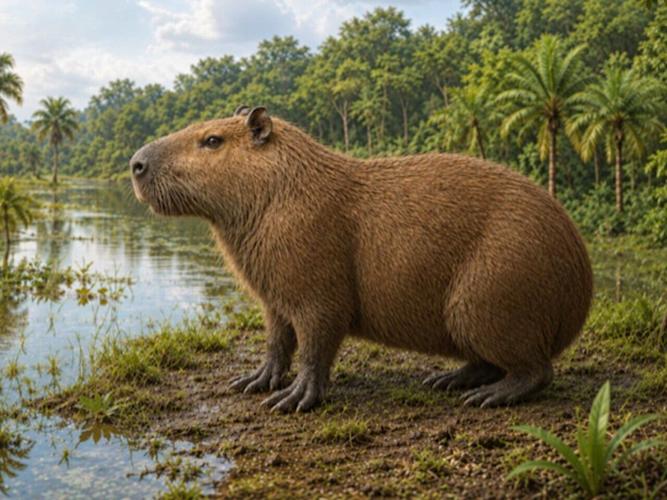
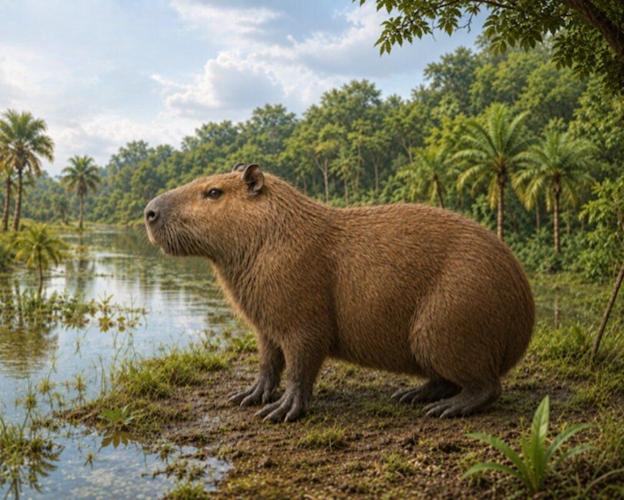


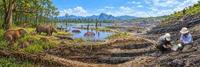

The discovery of giant rodent teeth fossils in Krabi Province, Thailand, highlights the important role of Southeast Asia in the early evolutionary history of large-bodied rodents, including the newly identified Yakamys sirindhornae. (Yaowalak Chaimanee via SWNS)
By Stephen Beech
A new species of giant rodent that lived around 34 million years ago has been unearthed.
Scientists say that fossils found in Thailand suggest that “massive” rodent species evolved much earlier than previously thought, and not just in South America.
An international team of paleontologists discovered the remains of the “remarkably large” rodent — estimated to have weighed around the same as a Labrador retriever — in a Thai mine pit.
They say the find provides a new perspective on the early manifestation of “rodent gigantism” — the process by which animals evolve to become larger.
The new species, named Yakamys sirindhornae, lived around 34 million years ago during the mid-Paleogene period, according to a study published in the journal Scientific Reports.

bady abbas
Researchers discovered fossils of its lower second molar and lower incisor teeth at the Bang Mark Pit of the Krabi lignite mine in Krabi Province.
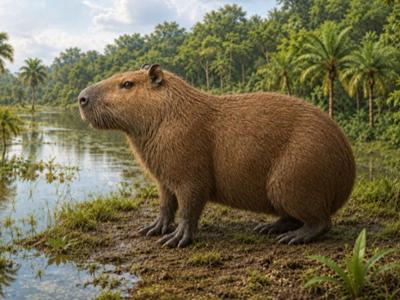
Study co-author Virginie Millien, of McGill University, Canada, said: “Today, the largest living rodent is the capybara, but very large rodents are not restricted to recent ecosystems.





“Giant rodents evolved repeatedly during the later history of the group, mostly in South America.
“This discovery suggests that Southeast Asia also played an important role in the early evolutionary history of large-bodied rodents.”
The new genus name, Yakamys, combines the Thai word “yak” — meaning giant — with the Greek “mys,” meaning mouse or rat.
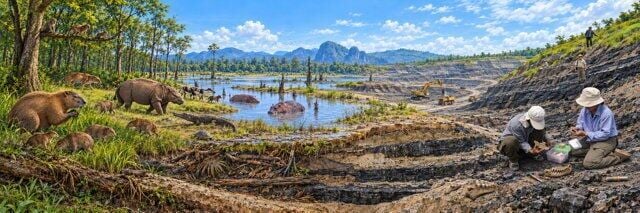
Illustration depicting the fauna and habitat at the time of Yakamys sirindhornae (left); on the right, the research team at work in the quarry. (Yaowalak Chaimanee via SWNS)
Millien said: “The species name, sirindhornae, honors Princess Maha Chakri Sirindhorn, in recognition of her longstanding support for science and paleontological research in Thailand.”
The fossils were discovered as part of a collaborative research project on fossil mammals in Thailand’s Krabi Basin involving scientsts
The project involves researchers from McGill University, the Department of Mineral Resources of Thailand and French research institutions.
Using seven established approaches for calculating body mass from dental dimensions, the researchers estimate that the Yakamys weighed around 30 kilograms (66 pounds) — about the same as a Labrador retriever, and twice the size of other known rodents from the era.
Millien added: “This is only a ballpark figure, as there is substantial uncertainty associated with fossil body-mass estimation.”
The research team said that because the fossil material is limited, it is difficult to determine exactly how the Yakamys evolved.
(0) comments
Welcome to the discussion.
Log In
Keep it Clean. Please avoid obscene, vulgar, lewd, racist or sexually-oriented language.
PLEASE TURN OFF YOUR CAPS LOCK.
Don't Threaten. Threats of harming another person will not be tolerated.
Be Truthful. Don't knowingly lie about anyone or anything.
Be Nice. No racism, sexism or any sort of -ism that is degrading to another person.
Be Proactive. Use the 'Report' link on each comment to let us know of abusive posts.
Share with Us. We'd love to hear eyewitness accounts, the history behind an article.