







(Photo by Roald Wagener via Pexels)
By Stephen Beech
Most young children like sharks — but grow up to fear them, reveals a new study.
Researchers found almost seven out of 10 youngsters described the apex predators in a positive light.
But associations between sharks and fear become more common as children get older, according to the international study.
Researchers from Adelaide University in Australia surveyed the parents of 374 children, aged between 2 and 12 years old, from 17 countries and regions to explore how they perceived and described sharks.
The study, published in the journal Human Dimensions of Wildlife, is the first to include toddlers’ perceptions of sharks and found that more than two-thirds of children (69%) said they liked sharks.
Youngsters commonly described sharks as “cool,” good swimmers or visually appealing.
When asked what sharks looked like, the most common features they identified were teeth (44%), being big (33%) and fins (31%).
But 13.9% of children explicitly associated sharks with being scary or said they were afraid of them — and the proportion increased “significantly” with age.

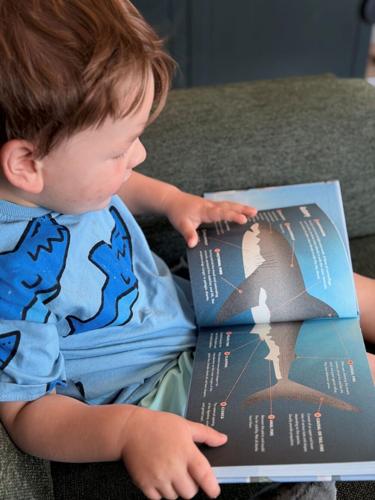
In 65% of cases, children develop an affinity with sharks via story books, according to a new global survey. (Adelaide University via SWNS)
Lead researcher Brianna Le Busque says the findings provided an important insight into how perceptions of sharks can develop during childhood.
She said: “What’s really interesting is that most of the children in our study actually liked sharks, and many were fascinated by them.
“But as children got older, we saw an increase in associations between sharks and fear.
“That raises important questions about what children are learning about sharks as they grow up and the role that society, media and other influences might play.”






The study showed that most children encountered sharks through books (65%) and aquariums (59%), followed by television shows (38%).
Almost one in four had watched films featuring sharks, including “Finding Nemo” and “Jaws.”
While the study did not directly measure the impact of media exposure on children’s attitudes, the researchers say it warrants further investigation.

(Photo by Helena JankoviÄová KováÄová via Pexels)
Le Busque, an environmental psychology scientist at Adelaide University, said: “Sharks are often portrayed in very dramatic and sensational ways, particularly when there is a shark bite or in popular films.
“We need to understand more about what children are seeing and hearing about sharks, because those messages could potentially influence how they perceive these animals.”
The study also found that children’s fear associations did not vary significantly according to their gender, country of residence or how frequently they visited the ocean.
Nor was there a significant association between parents’ reported fear of sharks and their children’s fear associations.
Nearly half of parents reported low fear of sharks, while 30% reported high fear.

Michal Ico
The researchers suggest that positive experiences and education may help challenge perceptions of sharks as simply dangerous predators.
Previous research has linked greater knowledge of sharks with lower levels of fear, while firsthand experiences with sharks have been associated with greater willingness to tolerate and care for them.
Le Busque said the findings highlighted an opportunity to encourage a more balanced understanding of sharks from an early age.
She added: “Children are clearly capable of seeing sharks as fascinating, interesting animals, rather than simply something to be afraid of.
“Education and positive experiences could be really important in helping children understand sharks as diverse marine animals and appreciate the important role they play in our oceans.”
(0) comments
Welcome to the discussion.
Log In
Keep it Clean. Please avoid obscene, vulgar, lewd, racist or sexually-oriented language.
PLEASE TURN OFF YOUR CAPS LOCK.
Don't Threaten. Threats of harming another person will not be tolerated.
Be Truthful. Don't knowingly lie about anyone or anything.
Be Nice. No racism, sexism or any sort of -ism that is degrading to another person.
Be Proactive. Use the 'Report' link on each comment to let us know of abusive posts.
Share with Us. We'd love to hear eyewitness accounts, the history behind an article.