

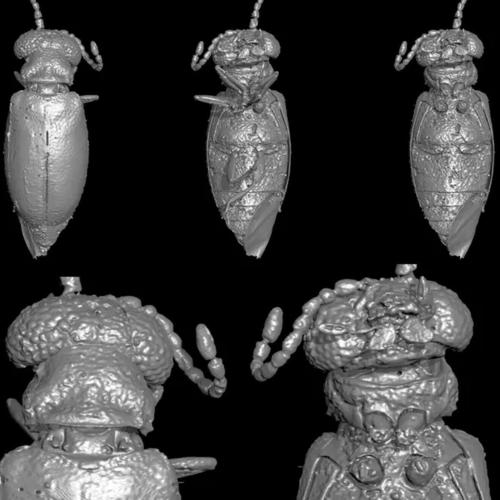






Cnopus twentyonepilotorum sp. nov., holotype C05038. 3D renderings. (Ferreira et al. 2026, ZooKeys via SWNS)
By Stephen Beech
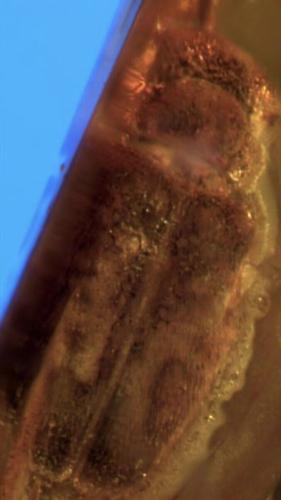
A 53-million-year-old beetle preserved in amber has been named in honor of the band Twenty One Pilots.
The tiny insect was identified as a new species by researchers in Spain and France.
Named Cnopus twentyonepilotorum, it is the first puppet beetle to be formally described from the Oise amber of northern France.
The research team says the dedication acknowledges the American alternative rock group’s contribution to “raising awareness of mental health” and to reducing the stigma around anxiety, depression and personal hardship.
The band’s name was inspired by Arthur Miller’s 1947 play, “All My Sons.”
The beetle study, published in the journal ZooKeys, was led by Jules Ferreira, a Ph.D. candidate at the Institut Botànic de Barcelona (CSIC-CMCNB), Spain.

Sry85 via Wikimedia Commons
He explained that puppet beetles, also known as ant-like leaf beetles, are small insects with about 1,000 living species found on every continent except Antarctica.
But their fossil record is sparse.
The Oise amber, from Le Quesnoy near Creil, is one of the oldest Cenozoic ambers in Europe and preserves the fauna of a warm, humid forest from the early Eocene.
Ferreira said: “Aderidae had already been reported from this amber, but none had ever been formally described.
“Our specimen offered the opportunity to fill this gap and to better understand the evolutionary history of the family.”
To study the fossil without damaging the amber, the team used state-of-the-art synchrotron X-ray microtomography, which allowed them to reconstruct a detailed 3D model of the fossil beetle and compare it with living species.







Cnopus twentyonepilotorum sp. nov., holotype C05038. Habitus of the holotype in dorsal view. Scale bars: 250 µm. (Ferreira et al. 2026, ZooKeys via SWNS)
They found that the beetle belongs to Cnopus, a genus that still exists today.
Until now, its oldest fossils of this genus came from the Baltic and Bitterfeld ambers, around 38 to 34 million years old.
The new discovery shows that the beetle lineage was already established in Western European forests in the early Eocene, around 15 million years earlier than previously documented.
Some internal structures normally used to distinguish living species were not preserved, so the fossil can’t be fully compared with all its modern relatives.
But Its age makes it “very unlikely” to belong to a species still alive today.
Ferreira said: “What surprised us most was how little the external morphology of this lineage has changed over time.

Drew de F Fawkes via Wikimedia Commons
“Despite more than 50 million years of evolution, major climatic changes and the transformation of European forests, the overall external morphology of these tiny beetles has remained remarkably stable.”
The team is now studying other puppet beetles from the Oise amber and hopes to learn which beetle groups persisted in European forests between the early and late Eocene.
Ferreira added: “Amber is exceptional in this respect.
“It sometimes preserves several organisms trapped together, offering rare snapshots of ancient ecological associations.
“Each new fossil adds a piece to this puzzle and helps us better understand how beetle communities were assembled and how they changed through time.”
The holotype is held in the paleontological collection of the Muséum national d’Histoire naturelle in Paris.
(0) comments
Welcome to the discussion.
Log In
Keep it Clean. Please avoid obscene, vulgar, lewd, racist or sexually-oriented language.
PLEASE TURN OFF YOUR CAPS LOCK.
Don't Threaten. Threats of harming another person will not be tolerated.
Be Truthful. Don't knowingly lie about anyone or anything.
Be Nice. No racism, sexism or any sort of -ism that is degrading to another person.
Be Proactive. Use the 'Report' link on each comment to let us know of abusive posts.
Share with Us. We'd love to hear eyewitness accounts, the history behind an article.