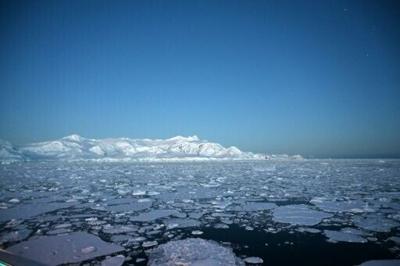
Antarctic sea ice coverage has likely rebounded this year, coming closer to its annual summer average after four years of extreme lows, US scientists said Monday.
The area covered by Antarctic sea ice likely reached its annual minimum level at 2.58 million square kilometres (996,000 square miles) on February 26, according to scientists at the National Snow and Ice Data Center (NSIDC) at the University of Colorado Boulder.
Every year Antarctic sea ice reaches a minimum level during the southern hemisphere's summer, so this is the point that scientists measure it for annual readings.
This year's level ranks as the 16th smallest since satellite measurements began in 1979.
The 2026 minimum sea ice extent is closer to average than in the past four years, and 730,000 square kilometres above the record low set in February 2023, the scientists said.
But it was still 260,000 square kilometres below the 1981-2010 average.
"Through most of the year, Antarctic sea ice was well below the daily average," said Ted Scambos, senior research scientist at the Cooperative Institute for Research in the Environmental Sciences (CIRES).
"Then in January and February, strong winds from the south pushed sea ice outward in the Weddell Sea. This slowed the overall decline in extent, leading to a near-average minimum," Scambos said.
The NSIDC cautioned that the 2026 figure is preliminary, noting that "continued melt conditions or strong onshore winds could still push the ice extent lower".
"This year's return to less extreme conditions is not unexpected given the large year-to-year variation of Antarctic sea ice seen in the satellite record," said Walt Meier, scientist at the NASA NSIDC Distributed Active Archive Center.
Keep it Clean. Please avoid obscene, vulgar, lewd,
racist or sexually-oriented language. PLEASE TURN OFF YOUR CAPS LOCK. Don't Threaten. Threats of harming another
person will not be tolerated. Be Truthful. Don't knowingly lie about anyone
or anything. Be Nice. No racism, sexism or any sort of -ism
that is degrading to another person. Be Proactive. Use the 'Report' link on
each comment to let us know of abusive posts. Share with Us. We'd love to hear eyewitness
accounts, the history behind an article.








(0) comments
Welcome to the discussion.
Log In
Keep it Clean. Please avoid obscene, vulgar, lewd, racist or sexually-oriented language.
PLEASE TURN OFF YOUR CAPS LOCK.
Don't Threaten. Threats of harming another person will not be tolerated.
Be Truthful. Don't knowingly lie about anyone or anything.
Be Nice. No racism, sexism or any sort of -ism that is degrading to another person.
Be Proactive. Use the 'Report' link on each comment to let us know of abusive posts.
Share with Us. We'd love to hear eyewitness accounts, the history behind an article.