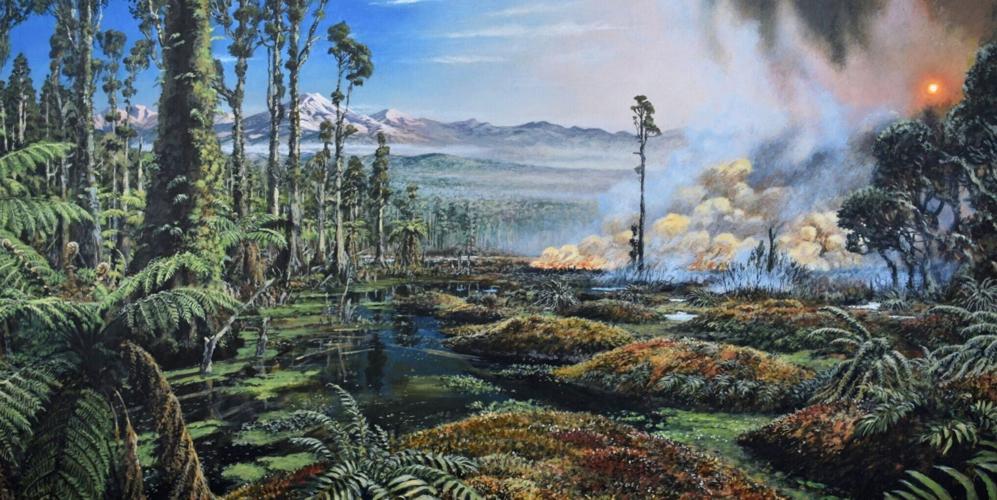



A visualisation of the Antarctic ecosystem around 90 million years ago. Research shows that forest fires occurred regularly near the South Pole at that time. (Alfred Wegener Ins / James McKay via SWNS)
By Stephen Beech
Wildfires burned in dinosaur-infested swampy rainforests near the South Pole 90 million years ago, reveals new research.
Earth's climate was so warm then that huge infernos regularly swept what is now snow and ice-covered Antarctica, say scientists.
An international research team, including Northumbria University scientists, has found — in a sediment core — evidence of recurring wildfires in Cretaceous period Antarctica near the South Pole.
The wildfires — the southernmost ever recorded on Earth — apparently promoted the spread of early peatlands in the wet swamp forests.
Scientists say the ancient coevolution of fire and peatland formation provides "valuable insight" into the development and preservation of raised bogs, which are today threatened by climate change and increasing drought.

(Photo by Lara Jameson via Pexels)
Their findings show that, in the Late Cretaceous period 90 million years ago, land around the South Pole was a swampy rainforest with conifers and tree ferns stretching as far as the eye can see.
Dinosaurs roamed through the misty wetlands, and the climate was mild and warm with the average annual temperature 12°C (53.6°F).
There was plenty of water too, as dry periods were regularly followed by monsoon-like rainy seasons.
But, for around four months of the year, the forest was shrouded in continuous darkness because the ecosystem in what is now West Antarctica endured the "polar night."
When the team published the results of an expedition in the journal Nature in 2020, the discovery caused quite a stir.
Stud leader Johann Klages, of the Alfred Wegener Institute, Germany, said: "In a sediment core from the Amundsen Sea in West Antarctica, we found an extremely well-preserved forest soil dating back around 90 million years, containing abundant pollen and spores and a dense network of roots.
"During the Cretaceous, tectonic conditions meant that this temperate rainforest lay even farther south, just 900 kilometers from the South Pole.
"Today, average annual temperatures at this location are around -30°C and everything is covered by an ice sheet several kilometers thick.
"Our discovery showed that during the warmest period of the Cretaceous, when atmospheric carbon dioxide levels were four to six times higher than today, a relatively warm and humid climate prevailed — even close to the South Pole."

(Photo by Pixabay via Pexels)






The researchers have now followed up with a new study, published in the journal Communications Earth ad Environment.
Co-first author Klages said: "We took another very close look at the core using a different range of methods and found clear evidence of recurring wildfires.
"The sediments recovered contain evidence of the southernmost wildfires ever recorded on Earth."
Throughout the Late Cretaceous section of the core, the research team found microscopic charcoal particles that became increasingly abundant in the younger sediments.
Analysis of the particles showed that mainly soft conifer wood had burned at relatively low temperatures, as is typical of surface fires that don't spread through the entire forest canopy.
Further evidence of fire came from amber — fossilized tree resin — which appears to have formed a kind of protective seal over fire-damaged areas of tree trunks.
Countless spores of peat moss also provided evidence of the earliest raised bogs, the formation of which was closely linked to the occurrence of recurring fires.
From those clues, the researchers were able to develop a scenario that may also be highly relevant today.

(Photo by Arturo A via Pexels)
Study co-first author Ulrich Salzmann, of Northumbria University, said: "90 million years ago, just 900 kilometers from the South Pole, a temperate and very swampy Antarctic rainforest with pronounced dry and monsoon seasons gradually silted up and developed into a peatland dominated by peat mosses.
"Wildfires, which became increasingly frequent, clearly played a decisive role in this process.
"They kept the vegetation open and enabled the development of a peat bog where ground-level smoldering fires then occurred repeatedly, similar to those that have become increasingly common in German peatlands in recent years."
Because volcanically active areas were at least 250 miles away at the time, the research team believe that it was probably lightning from thunderstorms, rather than lava or volcanic ash flows, that triggered the large-scale fires.
Study co-first author Thorsten Bauersachs, of RWTH Aachen University, Germany, said: "Peatlands play a key role in the climate system, both then and now, as highly effective long-term stores of carbon.
"In a warm climate, wetlands dry up more quickly and fires that prevent forest development occur more frequently.
"This can promote the formation of peatlands, where carbon-rich plant material accumulates over long periods."
Klages added: "The Late Cretaceous was extremely warm and prone to frequent fires.
"We were surprised to find evidence in our core of an early Antarctic ecosystem that, in many respects, resembled today's Arctic raised bogs and also experienced regular fires."
(0) comments
Welcome to the discussion.
Log In
Keep it Clean. Please avoid obscene, vulgar, lewd, racist or sexually-oriented language.
PLEASE TURN OFF YOUR CAPS LOCK.
Don't Threaten. Threats of harming another person will not be tolerated.
Be Truthful. Don't knowingly lie about anyone or anything.
Be Nice. No racism, sexism or any sort of -ism that is degrading to another person.
Be Proactive. Use the 'Report' link on each comment to let us know of abusive posts.
Share with Us. We'd love to hear eyewitness accounts, the history behind an article.