

(EAST LANSING, MICH.) More people are talking about the Declaration of Independence now than they likely have for decades, largely because of the festivities, exhibits, historical commemorations and other public events associated with the upcoming 250th anniversary of American independence.
But even as they discuss the historical meaning, purpose and ideas of the declaration, they should remember that independence was only the first step in becoming a nation.
Despite laying out the purposes of the new nation, the declaration did not say what kind of government the new United States should have. That discussion was left for later debates, leading first to the Articles of Confederation and then, ultimately, to the Constitution.
Yet, fully understanding the Constitution requires referring to the another crucial founding-era document: The Federalist, known to many as The Federalist Papers. Without it, the Constitution may not have been ratified, and it has helped guide American government and law for the past 2½ centuries.
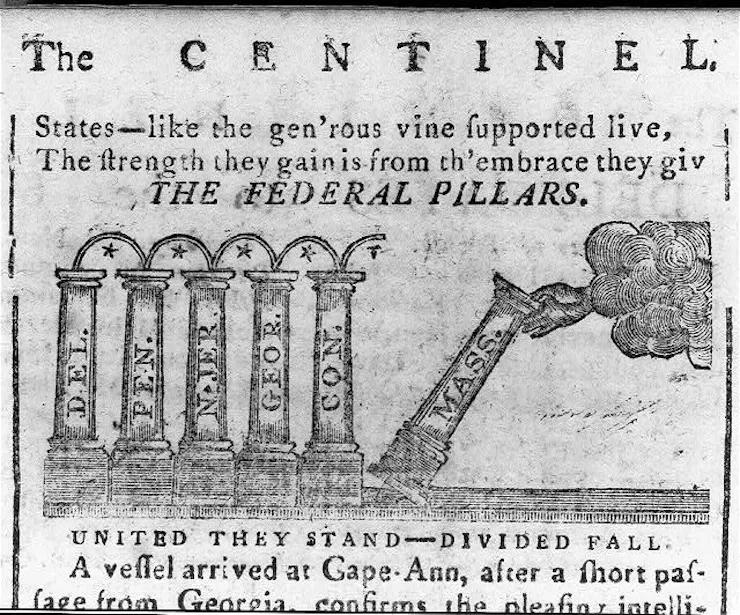
Drive for ratification
Under the Articles of Confederation, adopted by the Continental Congress in late 1777, the national government was exceptionally weak, unable to levy taxes or tariffs or enforce treaty obligations. Moreover, the states often abused their authority, both over their own citizens and with regard to each other. For example, states would often impose tariffs on each other’s goods, even if those goods were moving only from Virginia to Maryland and vice versa, thereby inhibiting the development of a national market and hamstringing internal trade.
The Constitution sought to correct these problems by creating a much stronger national government able to protect itself from national security threats, both foreign and domestic, and secure liberty at the same time.
Those supporting ratification adopted the name Federalists on the idea that they supported strengthening the national government, which was often described as a federal union. Their opponents, who sought to defeat the Constitution’s ratification, were then dubbed the Anti-Federalists, much to the latter’s consternation.
While there were a variety of Federalist authors writing to support the Constitution during the ratification debates in 1787-88, the essays of The Federalist were specifically co-authored by Alexander Hamilton, James Madison and John Jay under the collective pseudonym “Publius.”
The practical political purpose of the essays was to convince New York to ratify the Constitution. Nine states had to ratify to put the Constitution into effect, yet it was recognized that without key states such as New York, Virginia, Massachusetts and Pennsylvania, the Constitution – and more broadly the union – could not survive.
Thus, even though 10 states ratified before New York, enabling the Constitution to go into effect, New York’s ratification remained essential.
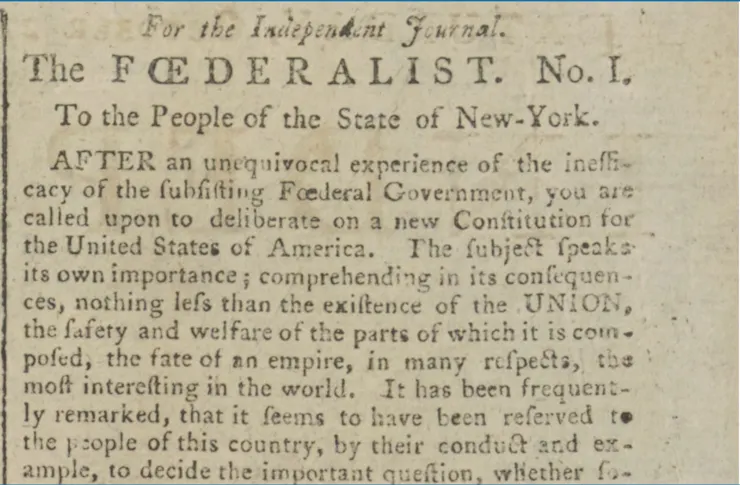
Each of The Federalist’s 85 essays – 51 by Hamilton, 29 by Madison and five by Jay – were addressed “To the People of the State of New York.” Nearly all were published in New York newspapers as op-eds, with some republished in other states. They were meant to be read and thought about by an interested and educated public, as the authors understood the importance of public opinion not simply to the ratification process but to any democratic system.
Ratifying the Constitution was the immediate goal of The Federalist. But in making their arguments, the authors went further, addressing fundamental questions of politics by laying out the political theory that underlies that Constitution.
In short, The Federalist sits at the intersection where theory meets practice.
Advancing political science
In “Federalist 1,” Hamilton breaks down major issues to be considered in deciding whether to adopt the Constitution: the utility of the union; the defects of the Articles of Confederation; the need for energetic government; how the Constitution is analogous to the New York constitution; how the Constitution will preserve liberty and prosperity; and how the Constitution creates a republican government. Such a republican government is defined by Madison in “Federalist 39” as a government with powers derived from the people and administered by representatives for a period of time.
Reflecting the political debate, however, the authors had to be flexible with their writing plans as they responded to the arguments made by their Anti-Federalist opponents.
Yet, even in that dynamic environment, there are two consistent themes that contribute to The Federalist’s timelessness.
The first theme revolves around what Hamilton in “Federalist 9” calls “the science of politics.” Hamilton and Madison frequently address the ideas of past political philosophers and the traditional assumptions of what republics were supposed to look like.
This is most evident in “Federalist 10” where Madison overturns the long-held belief, articulated most clearly by the French philosopher Montesquieu and embraced by the Anti-Federalists, that republics needed to be small to preserve liberty.
Madison shows that, on the contrary, it was a large republic that could best deal with the problem of factions and preserve liberty by preventing any faction from gaining a majority, thereby providing “a republican remedy for the diseases most incident to republican government.”
Similarly, in “Federalist 70,” Hamilton explains that a single strong executive is not inherently monarchical and antithetical to republican government, but rather is essential to a republic’s proper operation. “Energy in the Executive is a leading character in the definition of good government,” he wrote.






The Federalist advanced political science itself, changing the conception of what a republic was and could be.
Accounting for self-interest
A second theme is the recognition of how human motivations interact with institutions.
Past philosophers, such as Aristotle, emphasized the necessity of virtue in both the people and their rulers, and Montesquieu argued that virtue was the defining principle of republics.
But Hamilton and Madison, focusing more on historical experience than theory, emphasized the need for institutions to account for the self-interested behavior of officeholders.
This emphasis is evident at the very beginning when Hamilton asserts in “Federalist 1” that a clean debate on the merits of any public proposal “is a thing more ardently to be wished than seriously to be expected,” and that some people will be driven by personal interests.
In “Federalist 51,” Madison provides the clearest articulation of this view with his famous statement, “Ambition must be made to counteract ambition. The interest of the man must be connected with the constitutional rights of the place.”
In their view, it is not enough to rely on the virtue of officeholders. But we can arrange our institutions in such a way that our low, base, self-interested human nature may be channeled to ultimately serve a higher public good.
This is not, however, to say that The Federalist is a cynical work.
Enlightened statesmen not always at the helm
In “Federalist 55” Madison points out that “there are other qualities in human nature which justify a certain portion of esteem and confidence.”
That optimistic statement is followed by his observation, “Republican government presupposes the existence of these qualities in a higher degree than any other form.”
Republics rely on the people having some measure of public virtue to work. The key insight Madison brings out is that such higher qualities alone cannot be relied upon.
The institutions created by the Constitution are set up to be functional, but they are also built to account for the kind of human beings who will inhabit them. As Madison succinctly put it in “Federalist 10”: “Enlightened statesmen will not always be at the helm.”
Thomas Jefferson called The Federalist “the best commentary on the principles of government which ever was written.” It remains the most systematic and important exploration of our constitutional system.
As Americans celebrate the 250th anniversary of American independence, it is worth reflecting on the institutions that have facilitated the endurance of that independence. You can find no better guide to that reflection than The Federalist.
This article is republished from The Conversation, a nonprofit, independent news organization bringing you facts and trustworthy analysis to help you make sense of our complex world. It was written by: Jordan Cash, Michigan State University
Read more:
- Why free speech rights got left out of the Constitution – and added in later via the First Amendment
- Along with the ideals it expresses, the Declaration of Independence mourns for something people lost in 1776 − and now, too
- Do we need political parties? In theory, they’re the sort of organization that could bring Americans together in larger purpose
Jordan Cash does not work for, consult, own shares in or receive funding from any company or organization that would benefit from this article, and has disclosed no relevant affiliations beyond their academic appointment.


(0) comments
Welcome to the discussion.
Log In
Keep it Clean. Please avoid obscene, vulgar, lewd, racist or sexually-oriented language.
PLEASE TURN OFF YOUR CAPS LOCK.
Don't Threaten. Threats of harming another person will not be tolerated.
Be Truthful. Don't knowingly lie about anyone or anything.
Be Nice. No racism, sexism or any sort of -ism that is degrading to another person.
Be Proactive. Use the 'Report' link on each comment to let us know of abusive posts.
Share with Us. We'd love to hear eyewitness accounts, the history behind an article.