The parking lot grill is about to face its toughest test yet this season, with triple-digit heat, no reliable running water and hours of standing time before kickoff. Toss a cooler full of burgers and dogs into that mix, and the margin for error gets a lot smaller than most fans realize. A few deliberate steps before the first bite are what separate a Saturday worth remembering from one everyone would rather forget.
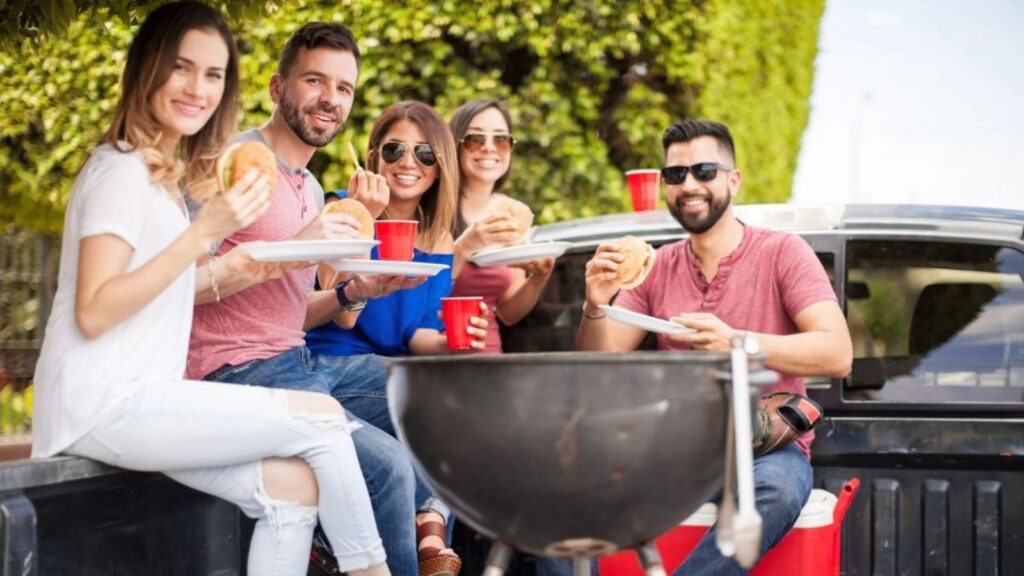
Fans start filing into the lot hours before kickoff, grills going, coolers open and conversations picking up right where they left off last season. The cooler stays open more than closed, and the ice melts a little faster with every trip back for another drink.
Nobody’s really counting the hours between arrival and the opening whistle, and on most Saturdays, that’s never mattered. As the season’s first games approach, that same easy scene is playing out under heat the region hasn’t shaken in weeks, and the habits that always felt harmless are worth a second look before the first plate gets passed around.
The heat is already here
This year’s timing collides with a heat wave that has gripped Texas, the Gulf Coast and much of the Southeast for more than a week. Earlier this week, the National Weather Service’s Weather Prediction Center tracked heat indexes as high as 105 to 115 degrees Fahrenheit across parts of the region.
The agency’s latest forecast says the most intense heat is expected to ease somewhat in the Southeast in the coming days but continue farther west across the south-central United States, meaning the season’s earliest games are kicking off into conditions the region hasn’t fully recovered from yet.
Tailgates run longer than a typical cookout
Fans commonly show up three to four hours before kickoff, and some of the most devoted show up even earlier. At the University of Oklahoma’s North Oval, campus policy allows fans to begin dropping off tailgate equipment as early as 5:30 p.m. the evening before a home game.
The policy covers tents, tables and chairs, not food, and it doesn’t change USDA’s guidance on perishable food and the danger zone. Once raw meat or prepared food climbs above 40 degrees and below 140 degrees Fahrenheit, the safe window is two hours, and that drops to one hour when the air temperature is above 90 degrees.
There’s no reliable sink in the parking lot





Unlike a home kitchen or even a park pavilion, a stadium parking lot doesn’t come with running water or a refrigerator. The U.S. Department of Agriculture’s Food Safety and Inspection Service says tailgating requires the same food safety practices as picnicking outdoors, since refrigeration and running water usually aren’t available on-site. That makes hand-washing water, a cooler packed with plenty of ice, and a food thermometer part of the core setup, not optional extras.
Hot dishes like chili or queso need an insulated container that can store food at or above 140 degrees Fahrenheit, since there’s no stove nearby to reheat them if the temperature drops. Once hot food falls below that line, the same two-hour window applies, and in 90-degree-plus heat, it drops to one hour.
Ground beef leaves less room for error than steak
Ground beef is the default tailgate protein, and it has a different risk profile than a whole cut like a steak or a chicken breast. Hot dogs are a different case since they’re precooked at the factory, so the main risk there is making sure they’re reheated until steaming hot, not undercooked from raw.
According to the USDA, bacteria can be present when ground meat is processed; grinding mixes them throughout instead of leaving them on the surface, where cooking can kill them more easily. That’s why ground beef needs to reach a higher internal temperature than a whole steak, to 160 degrees Fahrenheit. At a tailgate where several households share one grill and swap tongs, that smaller margin for error is easy to lose track of.
What actually changes this year
The fix isn’t complicated, but it does mean adding a few basic grilling safety tips to the usual routine. Packing extra ice, bringing a food thermometer, keeping raw meat sealed at the bottom of the cooler and setting a timer for the one-hour window that applies once the air temperature climbs past 90 degrees are small steps that matter more this year than most. For fans headed to campus this weekend, the heat isn’t going away, and neither is the parking lot’s total lack of reliable water access. Planning around both is what keeps a tailgate a tailgate instead of a health scare.
College football’s return is still the main event, heat wave or not. Fans have tailgated on hot Saturdays for generations, and this year won’t be any different. What’s different is how much attention that first cooler check deserves before the grill even gets going. A few extra minutes with a thermometer now beats an uncomfortable Sunday later.
Jennifer Allen is a retired professional chef and long-time writer. Her work appears in dozens of publications, including MSN, Yahoo, The Washington Post and The Seattle Times. These days, she’s busy in the kitchen developing recipes and traveling the world, and you can find all her best creations at Cook What You Love.
The post Burgers, heat and hours in a parking lot are a tricky combination in this year’s tailgate season appeared first on Food Drink Life.

(0) comments
Welcome to the discussion.
Log In
Keep it Clean. Please avoid obscene, vulgar, lewd, racist or sexually-oriented language.
PLEASE TURN OFF YOUR CAPS LOCK.
Don't Threaten. Threats of harming another person will not be tolerated.
Be Truthful. Don't knowingly lie about anyone or anything.
Be Nice. No racism, sexism or any sort of -ism that is degrading to another person.
Be Proactive. Use the 'Report' link on each comment to let us know of abusive posts.
Share with Us. We'd love to hear eyewitness accounts, the history behind an article.