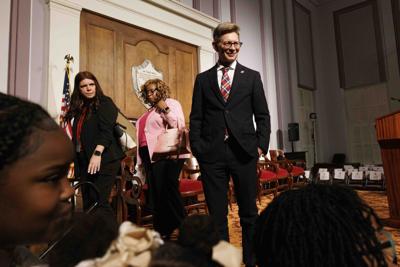

Alabama State School Superintendent Eric Mackey said Thursday three school districts under state intervention were showing improvements, including two in the Black Belt.
Bessemer City, Dallas County and Sumter County Schools were all placed under intervention by the state between 2023 and 2025. All three districts faced issues with finances, driven in part by falling population.
Mackey said during the Alabama State Department of Education meeting all of the schools are doing well as the new school year has started.
“Bessemer City started back to school and showed remarkable student achievement growth in this last year’s data,” Mackey said. “There is a lot more work to be done, but it’s certainly headed in the right direction.”
According to reading scores on the Alabama Comprehensive Assessment Program, the percentange of Bessemer City Schools second graders reading at or above grade level went from 58.5% in the 2024-25 school year to 64.6% during the 2025-26 academic year.
Third grader meeting the score went from 68.1% to 68.9% in the 2025-26 school year.
The cut score is used to determine if students are on or above grade level.
Mackey said Sumter County, which has been under state intervention the longest, is doing well following the opening of the county’s new school last month. Sumter County’s population fell over 10% between 2010 and 2020, according to the U.S. Census Bureau, and the district has closed three schools.
“One of which had been condemned for it was unsafe for people to walk in the building, and they were still using it as a school. So we had to get students out of there immediately,” Mackey said during the meeting. “Another school was close to being condemned, and half the school was unoccupiable because of the asbestos and dangerous chemicals. And so we had to close three schools and work with them to build a new school to replace those three, the new Sumter County Central Elementary School, and it’s a beautiful building.”
Mackey said the new leadership in Dallas County Schools was making progress as well.
“They’re (Dallas County Schools) off to a good school year this year, and things are going very well. We also brought in a new superintendent there, Corey Jones, who’s doing a remarkable job, and this will be his second year as the superintendent. So we feel really good about that,” Mackey said.
Mackey did not give any indication of when intervention would stop for the three school systems.
Mackey also went over the Legislature-approved Education Trust Fund budget for the upcoming fiscal year. The 2027 budget, which goes into effect on Oct. 1, includes a 2% pay raise for teachers. The Legislature funded the pay raise, which Mackey called a “huge win” that would prevent the system from drawing money from reserves.
The Legislature approved the ETF budget for fiscal year 2027 in April. Along with the 2% raise for state employees, the department received $4 million in funding for the English Language Learners program, up $2 million from last year, and $114 million for the Alabama Numeracy Act, up $19 million from last year.
Mackey reiterated several times during the meeting that the budget for the next fiscal year would be tighter than this year’s budget, a sentiment shared by legislative fiscal officers back in January.
Towards the end of the meeting, District 2 Representative Tracie West said she wanted to consider giving grant money to schools to provide free breakfast to students in the next budget cycle.
“I have heard from several parents this year that started with school breakfast in their district, and they are loving it because they are able to get their children to school on time, and they know that they’re getting either a hot breakfast or a nutritious cold breakfast,” she said.
Currently, there is $7.3 million in the ETF supplemental budget for a school breakfast program. West said she’d like to see the money be in the direct budget.
“I just feel like it’s the type of thing that needs to have some permanency for our districts to access,” West said.
Mackey said the department planned to meet with Alabama Arise, a nonprofit policy organization, to discuss funding for the school breakfast program. Mackey said federal reimbursement rates are lower for students who do not qualify for free or reduced breakfast or lunch.
“There’s a group of districts in the middle that are offering lunch to everybody, but they’re actually losing some money. And the same way with breakfast, and so some of them don’t offer breakfast because the difference is they’re saying they’re just not able to eat that,” he said.
Andrea Tinker covers Alabama education policy and government for Alabama Reflector, a nonprofit news agency based in Montgomery.

(0) comments
Welcome to the discussion.
Log In
Keep it Clean. Please avoid obscene, vulgar, lewd, racist or sexually-oriented language.
PLEASE TURN OFF YOUR CAPS LOCK.
Don't Threaten. Threats of harming another person will not be tolerated.
Be Truthful. Don't knowingly lie about anyone or anything.
Be Nice. No racism, sexism or any sort of -ism that is degrading to another person.
Be Proactive. Use the 'Report' link on each comment to let us know of abusive posts.
Share with Us. We'd love to hear eyewitness accounts, the history behind an article.