While Florida in March often makes headlines for its spring break crowds, Central Florida, with its moderate temperatures, lower humidity, and active wildlife, offers a strong window for nature-based travel beyond the beaches.
This shift in traveler preference is already visible. In TripAdvisor’s 2026 Travelers’ Choice “Best of the Best Beaches” rankings, Florida placed four beaches in the U.S. top 10, and every one of them was in Central Florida, on the Gulf Coast.
For travelers seeking nature and open spaces rather than dense oceanfronts, Central Florida presents a range of outdoor experiences quite different from that.
Stargazing At Kissimmee Prairie Preserve State Park
March marks the beginning of "Milky Way season" at Kissimmee Prairie Preserve State Park, Florida's first designated Dark Sky Park.
With minimal light pollution and expansive prairie landscapes, the preserve offers some of the clearest night skies in the Southeast. On cloud-free evenings, the Milky Way is visible to the naked eye.
Staying within the park, Timberline Glamping, Kilpatrick Hammock Campground and Kilpatrick Hammock Campground are all practical bases for travelers seeking low-impact outdoor adventures such as hiking, biking, horseback riding and bird watching.
The State Park is about 70 miles south of Orlando, roughly a 1.5-hour drive via Florida's Turnpike and U.S. Highway 441.
Bald Eagle Spotting On Lake Tohopekaliga
Florida's peak bald eagle nesting season runs from fall through winter at Lake Tohopekaliga. Commonly known as Lake Toho, it is not only Kissimmee's largest lake but also one of Central Florida's largest.
Since eaglets often remain with their parents for weeks after hatching, visitors can still see active nests in March and well into spring. The season officially concludes around May or June.
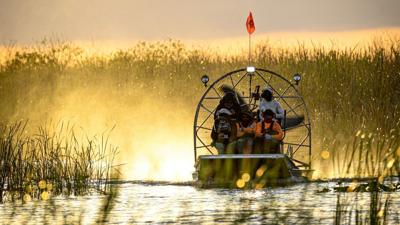
Airboat operators such as Spirit of the Swamp Airboat Rides and Boggy Creek Airboat Adventures run wildlife-focused private tours on Lake Tohopekaliga.
Lake Tohopekaliga is located in Kissimmee, about 25 to 35 minutes south of Orlando.
Paddling At Shingle Creek Regional Park
Shingle Creek Regional Park marks the 'Northernmost Headwaters of the Florida Everglades."
In March, cooler temperatures and stable water levels create favorable conditions for kayaking and paddleboarding through cypress forests.






Wildlife sightings may include wading birds, turtles and alligators. Several outfitters provide rentals and guided paddles, offering access to a lesser-known ecosystem that plays a critical role in South Florida's watershed.
Just steps from the creek, the Osceola County Welcome Center & History Museum showcases the region's natural and cultural heritage with dioramas of native habitats such as swamp, pine flatwoods, oak hammock and lakefront, and interactive displays that help visitors connect the region.
Visiting the nearby Pioneer Village, which preserves over a dozen historic structures, including 19th-century homes, a church, a schoolhouse and a general store, will round out the trip.
Shingle Creek in Osceola County is approximately 25 minutes south of downtown Orlando by car via Interstate 4 and local roads into Kissimmee.
Manatee Viewing In Crystal River
Crystal River in Citrus County remains the only location in North America where visitors can legally swim with West Indian manatees.
Until the end of March, large numbers gather in the warm spring-fed waters of Crystal River National Wildlife Refuge to mate, birth and nurse their young.
Three Sisters Spring is the main attraction since it is the only spring accessible by land. Walking its elevated boardwalk offers visitors easy vantage points to watch manatees glide through the shallow waters. Daily ranger-led programs are offered at Three Sisters Spring until March 31.
Guided swim, kayak, and snorkeling tours, such as those offered by the Plantation Adventure Center in Kings Bay, provide ethical experiences with manatees.
Crystal River is about 90 minutes northwest of Orlando via Florida's Turnpike and U.S. Highway 19.
Birdwatching At Merritt Island National Wildlife Refuge
Spring migration makes Merritt Island National Wildlife Refuge a prime destination for birders, and March is the last month of its peak birdwatching season. Warblers, shorebirds, and nesting species are active throughout the refuge's diverse habitats until the end of March.
The seven-mile Black Point Wildlife Drive allows visitors to observe wildlife from their vehicles. Beyond birds, alligators, bobcats and river otters live in this area. Visitors need a $10 day pass per vehicle to enter and complete the approximately 40-minute drive.
Merritt Island National Wildlife Refuge is roughly one hour east of Orlando via State Road 528 toward the Space Coast.
Trading white sand beaches, theme parks and high-energy crowds for the silence of a cypress canopy or the vastness of the night sky can provide visitors of Central Florida sense of discovery that feels increasingly rare in today's world.



(0) comments
Welcome to the discussion.
Log In
Keep it Clean. Please avoid obscene, vulgar, lewd, racist or sexually-oriented language.
PLEASE TURN OFF YOUR CAPS LOCK.
Don't Threaten. Threats of harming another person will not be tolerated.
Be Truthful. Don't knowingly lie about anyone or anything.
Be Nice. No racism, sexism or any sort of -ism that is degrading to another person.
Be Proactive. Use the 'Report' link on each comment to let us know of abusive posts.
Share with Us. We'd love to hear eyewitness accounts, the history behind an article.