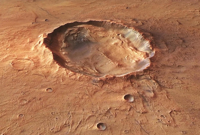
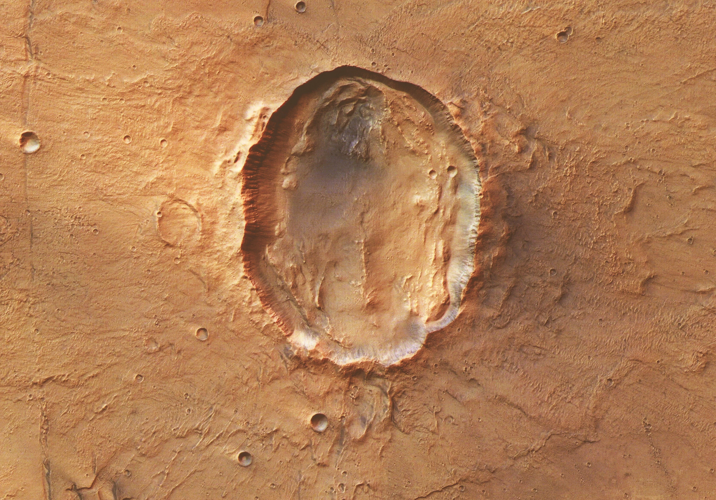
Scientists say the unusual formation, captured in the planet’s northern lowlands, is the result of a meteorite impact that sent material flying outwards, forming two distinct lobes or “wings” of raised ground.
The crater lies within the Idaeus Fossae region — a network of valleys and ridges near the edge of the Tempe Terra plateau.
In the Mars Express imagery, the crater’s uneven wings appear to stretch diagonally from the central, walnut-shaped basin.
ESA said: “Is it an insect? A strange fossil? An otherworldly eye, or even a walnut? No, it’s an intriguing kind of Martian butterfly spotted by ESA’s Mars Express.
“Insects aren’t commonplace on Mars, so it’s no surprise that this is no butterfly as we know it. It’s actually a kind of crater, formed as a space rock hurtled towards the Red Planet and collided with its red-brown surface.”
Keep it Clean. Please avoid obscene, vulgar, lewd,
racist or sexually-oriented language. PLEASE TURN OFF YOUR CAPS LOCK. Don't Threaten. Threats of harming another
person will not be tolerated. Be Truthful. Don't knowingly lie about anyone
or anything. Be Nice. No racism, sexism or any sort of -ism
that is degrading to another person. Be Proactive. Use the 'Report' link on
each comment to let us know of abusive posts. Share with Us. We'd love to hear eyewitness
accounts, the history behind an article.










(0) comments
Welcome to the discussion.
Log In
Keep it Clean. Please avoid obscene, vulgar, lewd, racist or sexually-oriented language.
PLEASE TURN OFF YOUR CAPS LOCK.
Don't Threaten. Threats of harming another person will not be tolerated.
Be Truthful. Don't knowingly lie about anyone or anything.
Be Nice. No racism, sexism or any sort of -ism that is degrading to another person.
Be Proactive. Use the 'Report' link on each comment to let us know of abusive posts.
Share with Us. We'd love to hear eyewitness accounts, the history behind an article.