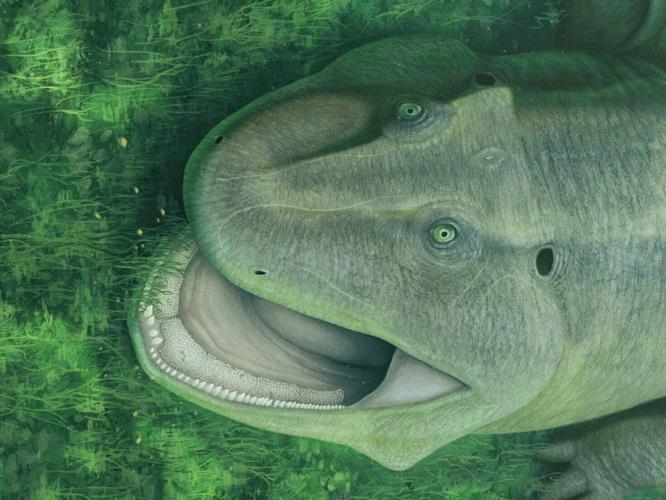
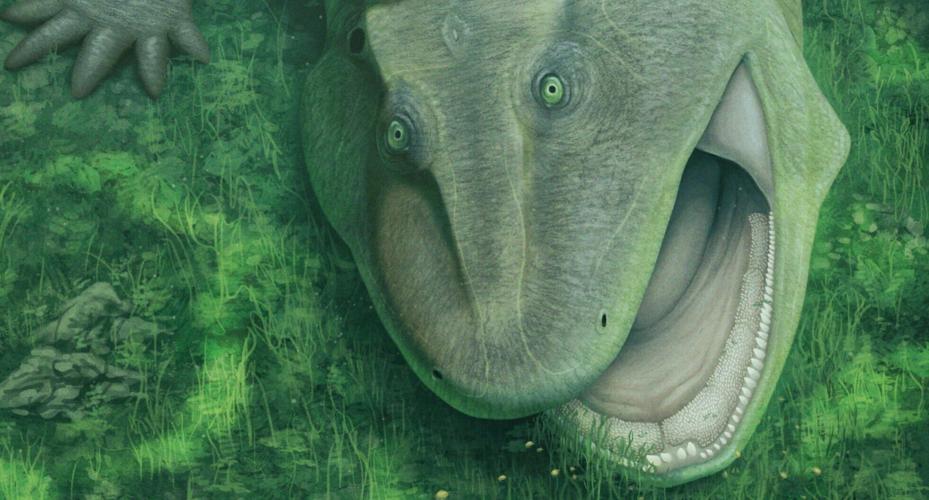
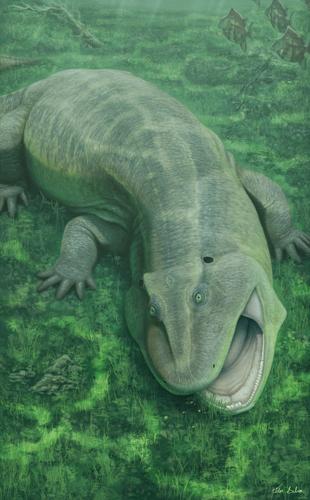
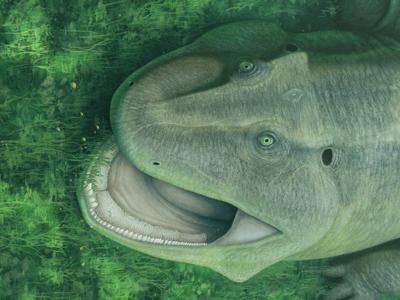

Illustration showing Tanyka amnicola in life, eating underwater plants. (Vitor Silva via SWNS)
By Stephen Beech
The remains of a "weird" creature with a twisted jaw and sideways-facing teeth have been discovered in the Amazon jungle.
Scientists say the plant-eater Tanyka was a “living fossil” when it stalked the Earth around 275 million years ago, from a lineage that was thought to have already gone extinct.
An international team of palaeontologists first found a fossilised jawbone in a dry riverbed in Brazil, within a dense forest near the Amazon.
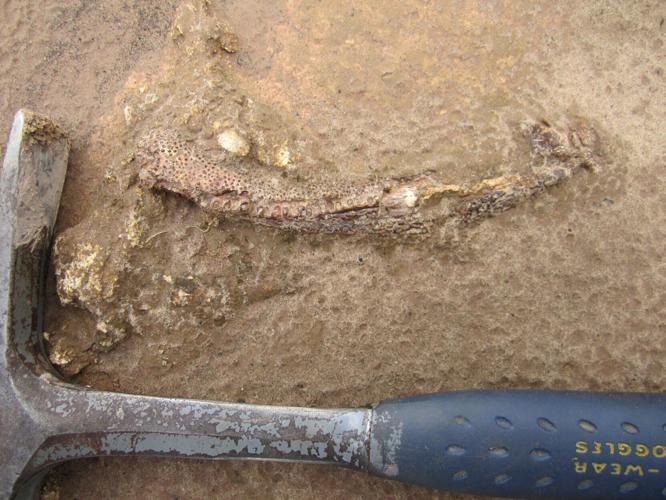
Over the course of their fieldwork, the team found eight similar bones, each around six inches long - but no others that they could use to complete a skeleton.
But the jawbones alone were enough to reveal that they belonged to a species that would have lived around 275 million years ago.
The researchers described the jawbones as "oddly twisted" with some teeth pointed out and to the sides, and numerous smaller teeth lining the inside of the jaws - a sign that the creatures were among the first of their kind to grind up plants for food.

Tanyka jawbone, with rock hammer for scale, found in the Brazil. (Dr. Ken Angielczyk / Field Museum via SWNS)
The new species, described in the journal Proceedings of the Royal Society B, was given the name Tanyka amnicola by the research team.
The name Tanyka comes from the local Indigenous Guaraní language - meaning “jaw” - and amnicola meaning “living by the river.”
Study lead author Dr Jason Pardo said: “Tanyka is from an ancient lineage that we didn’t know survived to this time, and it’s also just a really strange animal.
"The jaw has this weird twist that drove us crazy trying to figure it out.
"We were scratching our heads over this for years, wondering if it was some kind of deformation.
“But at this point, we’ve got nine jaws from this animal, and they all have this twist, including the really, really well-preserved ones.
"So it’s not a deformation, it’s just the way the animal was made.”
He said Tanyka is part of a much larger group of animals called tetrapods,which are four-legged animals with backbones.

Illustration showing Tanyka amnicola in life, eating underwater plants. (Vitor Silva via SWNS)
Modern tetrapods include reptiles, birds, mammals, and amphibians.
The oldest tetrapod lineage, called the stem tetrapods, eventually split into two groups - ones that laid eggs outside of water, and ones that laid their eggs in the water.
Today’s reptiles, birds, and mammals are all descendants of the branch that laid watertight eggs on land.
Modern amphibians such as frogs and salamanders are the relatives of the tetrapods whose eggs needed to remain moist.
But even after the tetrapod family split into the new groups, some of the stem tetrapods remained,and the research team say Tanyka was one of them.





Dr Pardo, of the Field Museum in Chicago, US, says new members of an older lineage can evolve alongside their more “advanced cousins” with the mammal family being a good example.
The first mammals laid eggs, but some mammals evolved the ability to give birth to live young.
While most mammals alive today reproduce that way, there are still a couple, such as platypuses, that are members of the older, egg-laying lineage.
Dr. Pardo said: “In the sense that Tanyka was a remaining member of the stem tetrapod lineage, even after newer, more modern tetrapods evolved, Tanyka is a little like a platypus.
"It was a a living fossil in its time.”
But the researchers say a lot about Tanyka, including its body shape, remains a mystery.
Study co-author Dr. Ken Angielczyk, a curator of paleomammalogy at the Field Museum, said: “We found these jaws in isolation, and they're really weird, and they're very distinctive.
"But until we find one of those jaws attached to a skull or other bones that are definitively associated with the jaw, we can't say for sure that the other bones we find near it belong to Tanyka.”

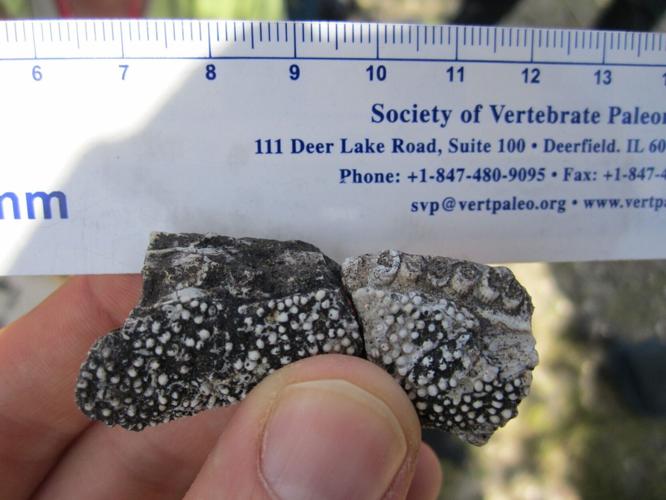
Fossil showing the denticles on the jaw, forming a cheese-grater-like surface that may have been used for grinding plant matter. (Dr. Ken Angielczyk / Field Museum via SWNS)
Dr Pardo said: “We can say, by comparison with close relatives, that Tanyka might have looked kind of like a salamander with a slightly longer snout."
The researchers aren’t sure how big Tanyka would have been, but they estimate that it might have been up to three feet long.
They say it probably lived in lakes, based on the kind of rocks in which the fossils are found
But Tanyka’s jawbone alone was enough to show scientists what an unusual animal it was.
The surface of Tanyka’s jawbone is covered in a series of smaller teeth called denticles, which form a grinding surface sort of like a cheese grater.
Scientists have yet to find the bones that would make up Tanyka’s upper jaw, but they imagine its top teeth and denticles were oriented similarly to the ones on the lower jaw.
Dr Pardo said: “We expect the denticles on the lower jaw were rubbing up against similar teeth on the upper side of the mouth.
"The teeth would have been rasping against each other, in a way that’s going to create a relatively unique way of feeding."
He says teeth that are able to grind against each other are usually used for crushing up plant material.
Study co-author says Juan Carlos Cisneros, from the Federal University of Piauí (UFPI), Brazil, said: “Based on its teeth, we think that Tanyka was a herbivore, and that it ate plants at least some of the time."
The researchers say that it’s surprising that a stem tetrapod such as Tanyka would have evolved to eat plants, since most of its fellow stem tetrapods only ate meat.
They said that hen Tanyka was alive the area that’s now Brazil was part of a "supercontinent" called Gondwana, which included much of modern South America, Africa, Australia, and Antarctica.
Dr Angielczyk added: “The Pedra de Fogo Formation in Brazil is one of the only windows we have into Gondwana’s animals during the early Permian Period of Earth history.
"Tanyka is telling us about how this community actually worked, how it was structured, and who was eating what."



(0) comments
Welcome to the discussion.
Log In
Keep it Clean. Please avoid obscene, vulgar, lewd, racist or sexually-oriented language.
PLEASE TURN OFF YOUR CAPS LOCK.
Don't Threaten. Threats of harming another person will not be tolerated.
Be Truthful. Don't knowingly lie about anyone or anything.
Be Nice. No racism, sexism or any sort of -ism that is degrading to another person.
Be Proactive. Use the 'Report' link on each comment to let us know of abusive posts.
Share with Us. We'd love to hear eyewitness accounts, the history behind an article.