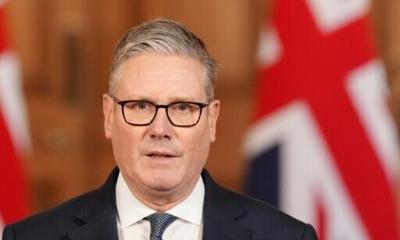

UK Prime Minister Keir Starmer said Monday British military bases in Cyprus will not be used by the US in its ongoing war with Iran.
Starmer's comments came despite criticism from US President Donald Trump over the UK leader's initial refusal to let Washington use British military bases in the conflict.
On Sunday Starmer announced that he had agreed to a US request to use British military bases for a "specific and limited defensive purpose".
But in comments to parliament on Monday he said this will not include bases on the Mediterranean island.
"The bases in Cyprus are not being used and not going to be used by the US... because they're not suitable," he said.
An Iranian drone hit the runway of the UK's Akrotiri air force base which lies on the southern tip of the island on Sunday.
Starmer stressed to MPs that this was "not in response to any decision that we have taken" but was launched before the UK's announcement that it would allow the US to use its bases.
The area around the base was evacuated, the Cypriot interior ministry said.
Paphos airport in western Cyprus was also evacuated but later got the all clear and was operating as normal, an airport official said.
More than 60 flights had been cancelled at Larnaca and Paphos airports, the official added. Larnaca, on the southeastern coast, was also now operating as usual.
The evacuations came after two drones headed towards the Akrotiri base were also intercepted earlier Monday.
"As a precautionary measure we are moving family members who live at RAF Akrotiri to alternative accommodation nearby on the island of Cyprus," the UK Ministry of Defence told AFP, although the base continued to operate as normal.
The damage had been "minimal" and there were "no casualties", a spokesperson added.
- Runway hit -
Greece, meanwhile, said it was sending two frigates and two F-16 fighter jets to Cyprus.
Athens would assist Cyprus in "countering threats and illegal actions on its territory", its defence ministry said.
Defence Minister Nikos Dendias also said he would travel to Cyprus on Tuesday.






Britain's foreign minister Yvette Cooper said the strike on the Royal Air Force base at Akrotiri, a British overseas territory near the coastal city of Limassol, hit the "airport runway".
Cypriot President Nikos Christodoulides said the incident just after midnight (2200 GMT) involved "a Shahed unmanned aerial vehicle".
- UK 'not at war' -
Cooper said the government was "working on every possible option" to help its nationals in the region return home if needed.
"There's an estimated 300,000 British citizens in Gulf countries that have now been targeted by Iran, including countries where now airspace is closed," she told Sky News.
More than 100,000 UK nationals had so far registered their presence in the region, she said.
UK Middle East minister Hamish Falconer insisted the nation was "not at war".
"Let me be really clear: the UK took a deliberate decision not to be part of the first wave of strikes conducted by the United States and Israeli governments.
"But in the face of reckless attacks from Iran... we took the decision, as the Prime Minister announced last night, to support the US's request to use our bases in order to conduct defensive actions," he added.
- Spectre of Iraq -
Trump said he had been "very disappointed" in Starmer's initial position.
In an exclusive interview with The Daily Telegraph Trump described the prime minister's later decision to allow the use of bases on specific grounds as "useful" but said it "took far too much time".
Any potential military action in the Middle East is politically sensitive in the UK following former prime minister Tony Blair's disastrous support for the US-led invasion of Iraq.
Evie Aspinall, director of the British Foreign Policy Group think tank, said that the UK would not want to be "seen as a key party in this conflict".
"Hence allowing defensive not offensive strikes, although the difference between the two is, in practice, often very minimal," she said.
burs-har-mp/rmb



(0) comments
Welcome to the discussion.
Log In
Keep it Clean. Please avoid obscene, vulgar, lewd, racist or sexually-oriented language.
PLEASE TURN OFF YOUR CAPS LOCK.
Don't Threaten. Threats of harming another person will not be tolerated.
Be Truthful. Don't knowingly lie about anyone or anything.
Be Nice. No racism, sexism or any sort of -ism that is degrading to another person.
Be Proactive. Use the 'Report' link on each comment to let us know of abusive posts.
Share with Us. We'd love to hear eyewitness accounts, the history behind an article.