Key findings
- Sixty percent of approved borrowers sought financing for working capital needs, like paying for inventory, overhead or repairs.
- Approved borrowers reported earning a median annual revenue of $900,000, though it varied by quarter, industry and time in business.
- The gap between what borrowers requested and what they ultimately received was widest among lower-revenue businesses. But smaller businesses borrowed more relative to their annual sales.
Revenue is the lifeblood of small businesses. It helps owners cover day-to-day costs, invest in growth and even qualify for a small-business loan.
The 2026 NerdWallet Business Loan Study found that higher-revenue businesses were approved more often and received larger loan amounts. But the door isn’t shut on low earners. Businesses with at least $100,000 in annual revenue still found funding options through NerdWallet.
This report takes a deeper look at revenue and how it shapes funding needs and outcomes. To come up with our findings, we analyzed completed loan applications that were approved through NerdWallet’s online marketplace between April 2025 and March 2026. Applicants self-reported details such as annual revenue, time in business and intended use of funds. See our full methodology below.
Here’s what we found.
Working capital needs rise with revenue
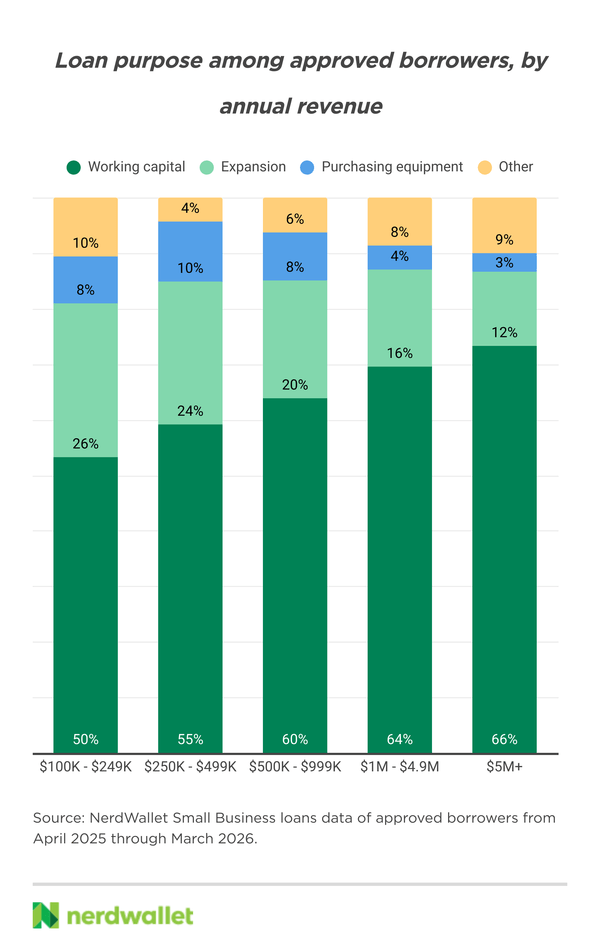
Higher revenue didn’t erase the need for working capital
Sixty percent of approved borrowers sought loans to cover working capital needs (i.e., short-term costs like inventory, overhead or an emergency repair).
Among funded businesses with $100,000 to $249,999 in annual revenue, half said they were seeking financing to use as working capital.
And our data found that working capital wasn’t just a concern for lower-revenue businesses. Even seven-figure businesses needed help keeping operations moving.
More than 65% of funded businesses with $5 million or more in revenue sought funding for working capital.
Scaling up can make cash flow tighter
As businesses scale, so do their costs. Payroll, software subscriptions, insurance, equipment repairs — it adds up. One slow month or quarter can put your business’s finances in a squeeze if you don’t have the cash on hand to cover those costs.
Smaller businesses often have more flexibility. Our data found that businesses with less than $500,000 in annual revenue balanced daily operating needs with growth-oriented investments, like expanding their business or buying equipment.
Working capital was a priority across industries
Working capital was also the leading funding need across industries in our study. General contractors, healthcare service providers and restaurant owners were the top industries that sought funding for working capital.
Approved borrowers report a median of $900,000 in annual revenue
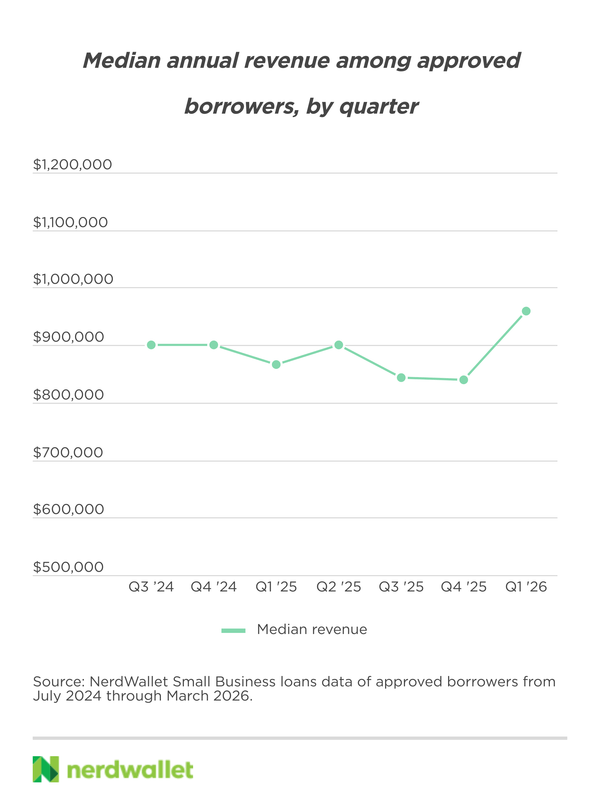
Reported revenue jumped in early 2026
Approved borrowers in our study reported earning a median annual revenue of $900,000 between April 2025 and March 2026. This is in line with what borrowers reported in our 2026 annual survey report, which covered July 2024 to June 2025.
One thing that stands out in our data is the jump in reported revenue in the first quarter of 2026.
It’s hard to give a single reason for that increase, but one possible explanation is that a larger share of higher-revenue businesses simply needed funding in this time frame than in previous quarters.
Older businesses tended to report more revenue
Revenue can vary widely from business to business. Industry, location and customer demand all play a role.
Our data found that time in business mattered, too. Funded businesses that had been around for one to two years reported median annual revenue of $753,000. Those open for 11 years or more reported nearly $1 million in revenue.
This makes sense, as older businesses typically have more time to build customer bases, refine operations and grow sales.
Some industries reported higher revenue than others






Revenue also varied by industry. Wholesalers and healthcare businesses, which include doctors and dentists, were among the highest earners among top funded industries in our study.
When looking quarter-to-quarter, the revenue profiles of restaurants, general contractors and automotive supply and repair businesses stayed relatively stable. In contrast, construction, trucking and creative and marketing businesses showed larger quarter-to-quarter swings in what borrowers reported in annual revenue.
Higher-revenue businesses get closer to their requested loan amount
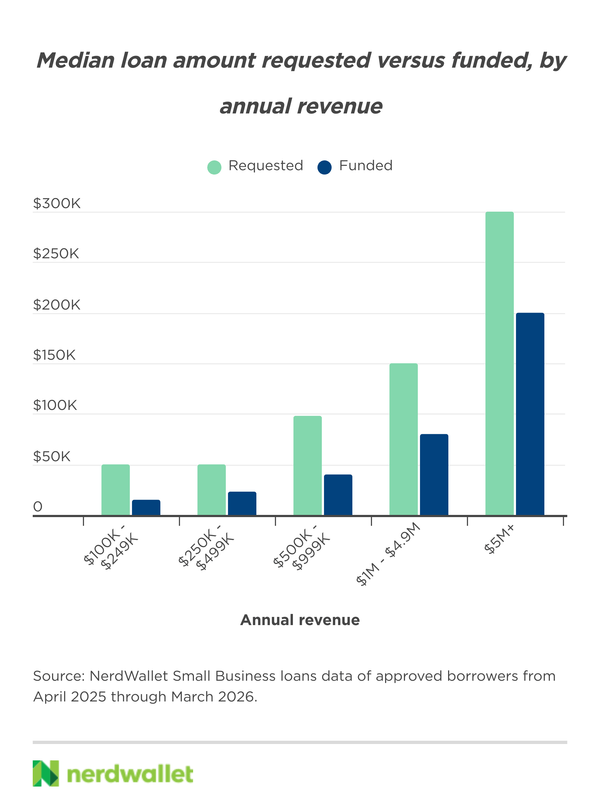
Businesses with more revenue tended to request (and receive) larger loans than lower-revenue businesses. They also tended to get a larger share of what they asked for.
Lower-revenue businesses saw the widest funding gap
The gap between what borrowers requested and what they ultimately received was widest among lower-revenue businesses.
While it’s normal for business owners to not get the full amount of funding they ask for, this could suggest a greater mismatch between how much funding smaller businesses think they need and how much they’re actually able to qualify for. It could also reflect lenders’ reluctance to extend large loan amounts to businesses with little revenue.
Revenue wasn’t the only factor shaping loan amounts
Borrowers with lower annual revenue also tended to have lower credit scores and shorter time in business than borrowers with higher-revenue businesses, our data found.
Most lenders consider all three factors (plus other criteria), when making loan decisions. Our 2026 Business Loan Study explores those themes in more detail.
Smaller businesses borrowed more relative to their sales
Even though businesses with more revenue tended to get larger loans in dollar terms, smaller businesses borrowed more relative to their annual sales.
That means lower-revenue businesses may be taking on a larger percentage of debt, even if the actual loan amounts are smaller.
How to turn these findings into smarter borrowing decisions
Build liquidity before you need it
Small-business financing like working capital loans can help cover short-term needs. But it’s best to prepare for a cash flow crunch before it becomes urgent.
If you don’t already have one, work on building an emergency fund that can get you through at least three to six months’ worth of business expenses. Also consider establishing a business line of credit you can tap in a pinch when money is tight and you’ve exhausted your cash reserves.
Size your loan request realistically
Whether your business earns a little or a lot, it’s important to avoid asking for more than you need (or more than you’ll likely qualify for).
This is where an outside expert can help, like a business loan broker or financial advisor. NerdWallet Small Business also has funding advisors who can give insights into what sorts of loans or amounts you may qualify for.
You can also use NerdWallet’s business loan calculator to get an idea of what different loan amounts will cost and how much interest you may be charged.
Try smaller banks
If you’re applying for a business loan, consider starting with a smaller bank. The Federal Reserve’s 2026 report on employer firms found that small businesses that applied for financing through small banks were more likely to be fully approved than those that applied through other sources, like large banks or online lenders.
Methodology
This study analyzes loan application data from small-business owners approved for financing through NerdWallet Small Business’s loans marketplace between April 2025 and March 2026. Applicants self-reported data for personal credit scores, business revenue, business start dates, funding purposes, industry information and loan amount requested. We also analyzed the actual amount applicants received and the type of business loan borrowers ended up with.
Note: The data reflects businesses that found funding through NerdWallet’s marketplace and is not representative of all U.S. small businesses or all small-business loan applicants.
More From NerdWallet
The article Data: Most High-Revenue Business Loan Applicants Need Money for Day-to-Day Expenses originally appeared on NerdWallet.

(0) comments
Welcome to the discussion.
Log In
Keep it Clean. Please avoid obscene, vulgar, lewd, racist or sexually-oriented language.
PLEASE TURN OFF YOUR CAPS LOCK.
Don't Threaten. Threats of harming another person will not be tolerated.
Be Truthful. Don't knowingly lie about anyone or anything.
Be Nice. No racism, sexism or any sort of -ism that is degrading to another person.
Be Proactive. Use the 'Report' link on each comment to let us know of abusive posts.
Share with Us. We'd love to hear eyewitness accounts, the history behind an article.