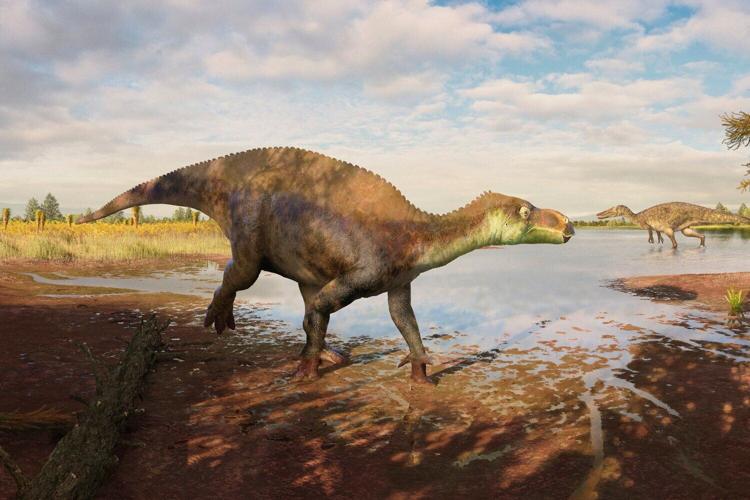

A reconstruction of the iguanodontian dinosaur Paludohadros proudlovii walking through mud along the edge of a shallow body of water. In the distance, the large predatory dinosaur Baryonyx can be seen. (Guilherme Gehr via SWNS)
By Stephen Beech
A dinosaur that lived in Britain 125 million years ago has been identified as a new species 25 years after it was unearthed.
The relative of the giant herbivore Iguanodon was discovered in the collections of the Natural History Museum in London.
Remains of Paludohadros proudlovii was found at Wienerberger’s Ewhurst brick and roof tile works in Surrey, England in 2001, and were subsequently donated to the museum.
It was a member of the iguanodontians — a group of dinosaurs known for their charismatic thumbspikes, according to a new study published in the Journal of Systematic Palaeontology.
Historically, iguanodontians found in southern England were considered to be either Iguanodon or its smaller relative Mantellisaurus.

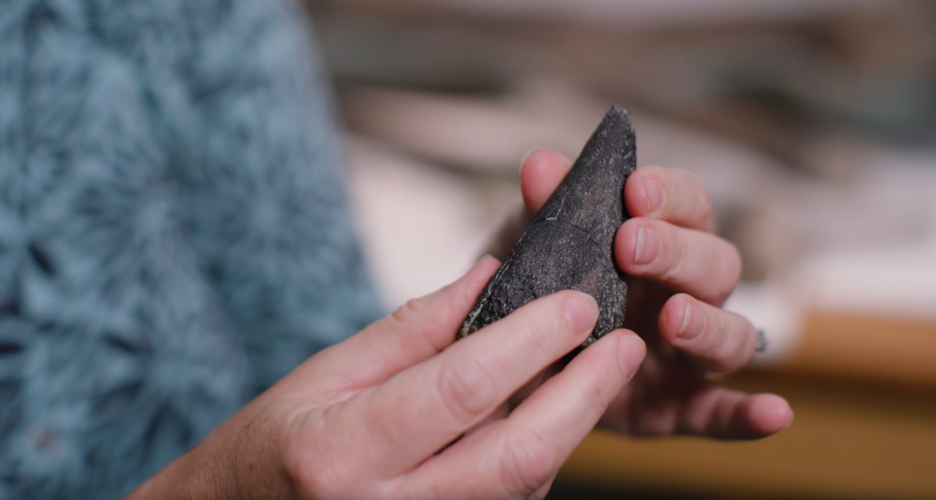
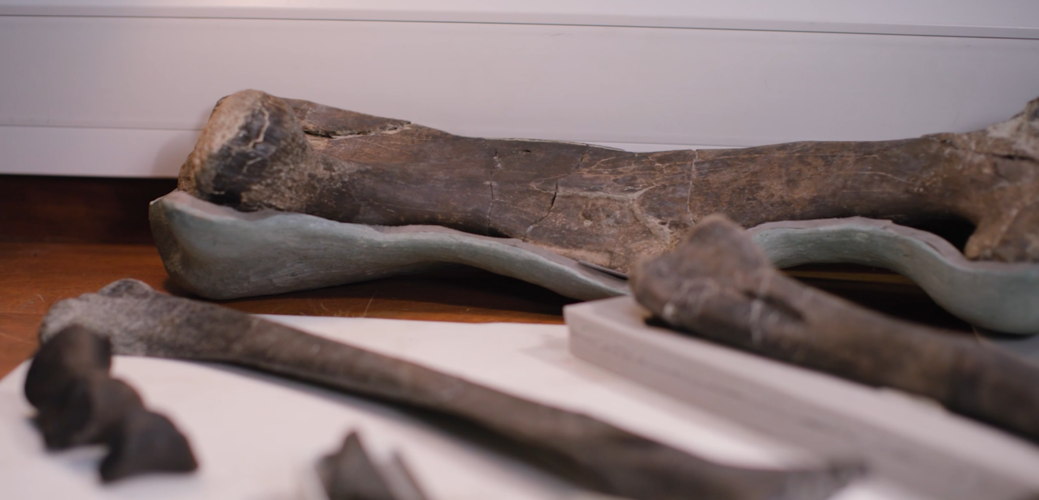
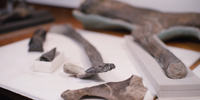
One of the bones found in England in 2001. (Guilherme Gehr via SWNS)
However, a detailed redescription of the latter by Natural History Museum scientists, published in 2023, has allowed key differences to be identified.
That has led to a flurry of newly named iguanodontians in recent years — including Brighstoneus, Comptonatus, the sail-backed Istiorachis and now Paludohadros.
The new species has been named in honor of Will Proudlove, a former manager of the brick and roof tile works who died aged just 35 shortly before its excavation.
Paludohadros was uncovered not far from where Baryonyx, an iconic Cretaceous carnivore that ate young iguanodontians as well as fish, was first found.
Experts say the four-legged herbivore lived around 125 million years ago during the Early Cretaceous Period, when southern England would have been covered in muddy wetlands at the time.
The environment helped to give the dinosaur its name, as “palus” means “swamp” in Latin.
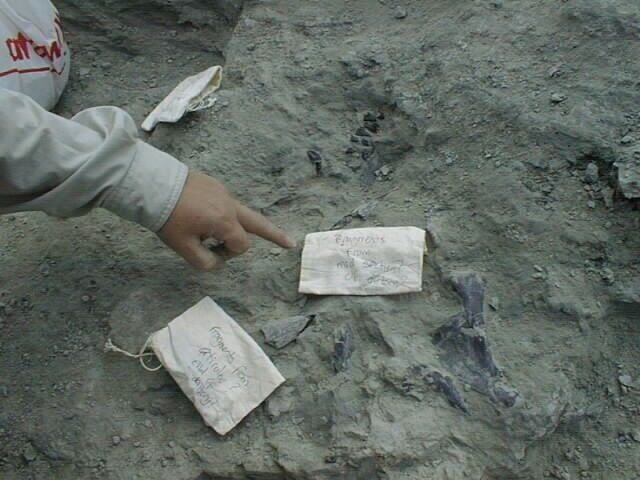
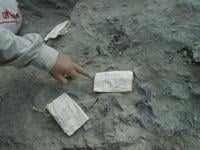
In situ skull bones. (Tim Burgess / Wienerberger Ltd via SWNS)
The name of the species — proudlovii — honors Proudlove, a former employee of the Ewhurst Works who had worked his way up through the ranks to become manager.
He died shortly before Paludohadros was excavated, leaving his wife Rachael as well as their young children Ellie and Matt.
Proud Rachael said: “Will always had an interest in dinosaur fossils and was fascinated about what, if anything, would be uncovered each time a layer of clay was removed from the quarry.






“Sadly, this dinosaur was only discovered the year after he died, but its story has become a part of our lives since then.”
She added: “We were invited to go and look at it being excavated back in 2001, so it’s amazing to hear all this time later that it’s not just a new species of dinosaur, but a new genus too.
“We’re absolutely overjoyed and honored that Will’s name and legacy will live on in this dinosaur.”
At around 5 meters long (16.4 feet) and around 1.5 to two metric tons in weight, Paludohadros proudlovii would have been a similar size to a rhino when it died.

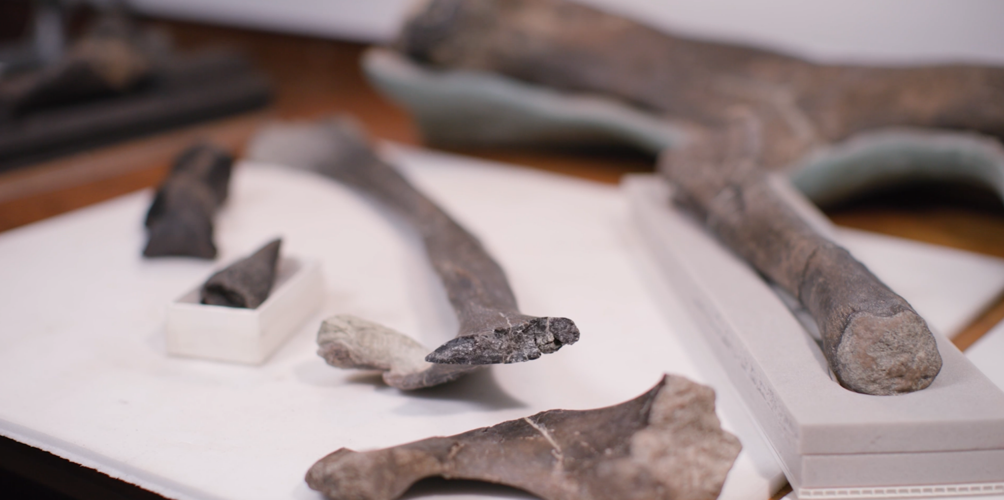
Some of the Paludohadros proudlovii fossils. (Guilherme Gehr via SWNS)
However, as its bones don’t appear to have been fully developed, experts say it’s likely that the individual was still a juvenile — and could potentially have grown twice as large as an adult.
Paludohadros would have lived alongside several other dinosaurs species — including Baryonyx walkeri, a fearsome two-legged carnivore discovered at the Ewhurst Works in 1983.
Study senior author Susannah Maidment, of the Natural History Museum and the University of Birmingham, said: “Paludohadros was found just 100 meters away from Baryonyx, whose fossils we also look after at the Natural History Museum.
“While Baryonyx is best known for eating fish, this dinosaur’s last meal also included a baby iguanodontian.”
She added: “We can’t tell for certain which species this came from, so it’s possible that Baryonyx could have been scavenging on the remains of young Paludohadros or even hunting them when it had the opportunity.”
The naming of Paludohadros and other iguanodontians in recent years has led to paleontologists re-examining fossils in the Natural History Museum’s care, with several other Paludohadros specimens identified among specimens first collected in the 1950s.

The Paludohadros proudlovii, of which some remains are shown here, was about the size of a modern-day rhino. (Guilherme Gehr via SWNS)
The reanalysis is due to continue, with potential for more species to be discovered.
Research leader Ricardo Sacamoto, a Ph.D. student at the Natural History Museum, said: “Paludohadros is the first species I’ve ever named and I’m honored to have been able to work on it.
“I still remember the incredible moment when I realized that this was a new species that no one had ever identified before.”
He added: “I’m now going to go through the Natural History Museum’s iguanodontian collections to identify what’s there as part of my Ph.D.
“This could lead to the discovery of more new dinosaur species that haven’t yet been recognized.”
(0) comments
Welcome to the discussion.
Log In
Keep it Clean. Please avoid obscene, vulgar, lewd, racist or sexually-oriented language.
PLEASE TURN OFF YOUR CAPS LOCK.
Don't Threaten. Threats of harming another person will not be tolerated.
Be Truthful. Don't knowingly lie about anyone or anything.
Be Nice. No racism, sexism or any sort of -ism that is degrading to another person.
Be Proactive. Use the 'Report' link on each comment to let us know of abusive posts.
Share with Us. We'd love to hear eyewitness accounts, the history behind an article.