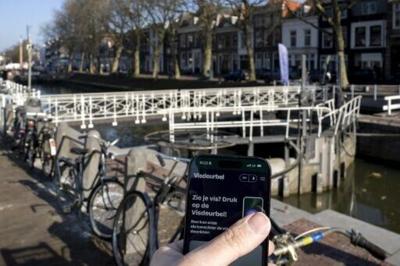
A cloud of small bubbles and a fishy gurgle announce the latest arrival at the "fish doorbell" in the Netherlands: a perch, recognisable by its dorsal fin and tiger-striped scales.
As the perch stares at the camera with globulous eye, thousands watching a livestream race to click a button that will open a lock separating the River Vecht from the canals of Utrecht, enabling the fish to glide through.
Open from March to June, the "fish doorbell" allows web users from all over the world to ease the path of perch, catfish, and eels -- a key need in the Netherlands where millions of fish find themselves blocked by locks, dykes and pumping stations.
"A number of species of fish migrate in spring to reproduce and they get stuck at all the obstacles," said Anne Nijs, who operates the doorbell along with the Utrecht authorities.
The quirky "fish doorbell" has shot to fame, even being featured on the US talk show "Last Week Tonight", with comedian John Oliver spending a full 10 minutes explaining it.
Nijs, 46, told AFP that there was a serious side to the doorbell, raising awareness of the man-made obstacles fish and other aquatic animals have to face on their life journey.
Before the doorbell was set up in 2021, fish would sometimes wait for weeks before passing through the lock, which is closed for much of the time.
As well as losing valuable reproduction time, the wait made them vulnerable to predators both from the water and the air, Nijs explained.
Now, every click sends a screenshot to her and her team, who decide when a critical mass is reached to ask the lock-keeper to open the doors.
"Sometimes 300 people ring the bell for one fish... it takes up a bit of time but it's one big positive project," she told AFP.
"Lots of people say that it's kind of slow TV to them, (it helps them to) calm down," she added.
- 'Inland waters' -
Despite its popularity, the fish doorbell is just a drop in the ocean.





The Dutch are world-famous for creating an intricate system of flood defences and dykes to shield the low lying country from rising sea levels.
The problem is that these barriers also block aquatic life, preventing several species from their natural migratory path or reaching cooler waters.
Like the fish doorbell, sometimes human intervention is the only solution.
For 12 years, the Dutch Foundation for A Sustainable Eel Sector (DUPAN) has organised the transport of millions of European eel fry into Dutch waters.
"They are coming here, but they cannot get into the inland waters where they grow," said Magnus van der Meer from DUPAN.
After wriggling across the Atlantic Ocean from their birthplace in the Sargasso Sea off the east coast of the US, the glass eels arrive in the cooler waters of Europe.
Many thrive in Portuguese or French waters, but thousands find themselves stuck trying to get into the Netherlands.
So DUPAN transports three million eels annually from France -- where they thrive -- to rebalance the Dutch population.
"Of course there should be another solution. It would be nice to offer the eel the opportunity to just come naturally inside the Dutch waters," the 70-year-old told AFP.
But as long as water levels are high, the Dutch need their defences, meaning "that solution will not be available in the near future," he added.
Many of the eels will grow to adulthood, be fished and eventually eaten. Others however are released back into the sea to continue the migratory cycle.
Some might even make it to Utrecht and a webcam where from far away, the lock is magically opened for them.
sh/ric
(0) comments
Welcome to the discussion.
Log In
Keep it Clean. Please avoid obscene, vulgar, lewd, racist or sexually-oriented language.
PLEASE TURN OFF YOUR CAPS LOCK.
Don't Threaten. Threats of harming another person will not be tolerated.
Be Truthful. Don't knowingly lie about anyone or anything.
Be Nice. No racism, sexism or any sort of -ism that is degrading to another person.
Be Proactive. Use the 'Report' link on each comment to let us know of abusive posts.
Share with Us. We'd love to hear eyewitness accounts, the history behind an article.