
By Ed Chatterton
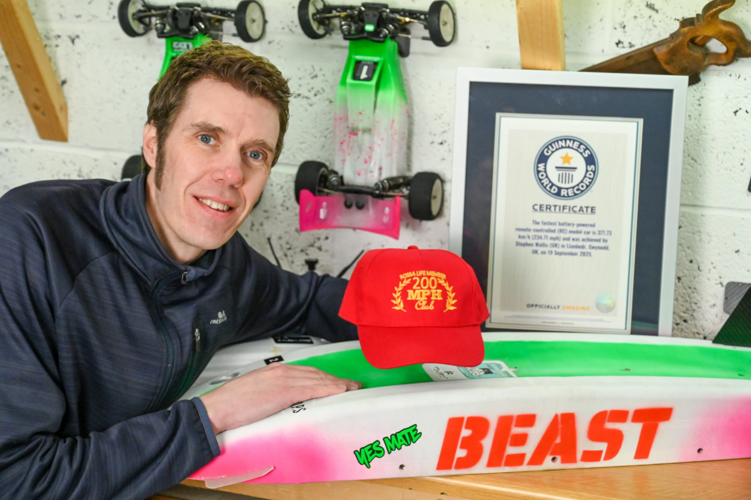
A motorcycle engineer has set a new record after building the world's fastest remote control car out of a drone - capable of hitting 234mph.
Stephen Wallis, 43, spent around $2,300 over a year-and-a-half designing and building The Beast, which can go quicker than a McLaren F1.
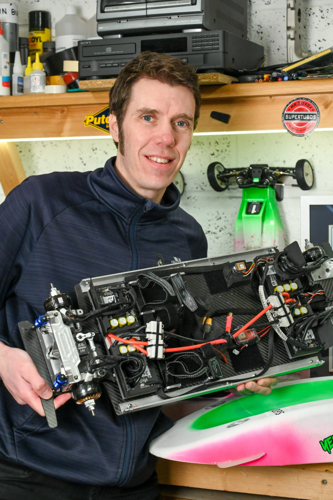
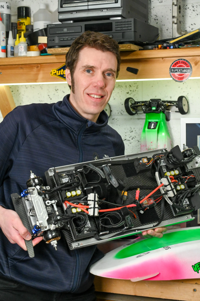
The married dad-of-two constructed the 3ft 2ins-long (1.1m) model which is made from 3D-printed components, carbon fiber, aluminium as well as motors from a drone, in his garage at home.
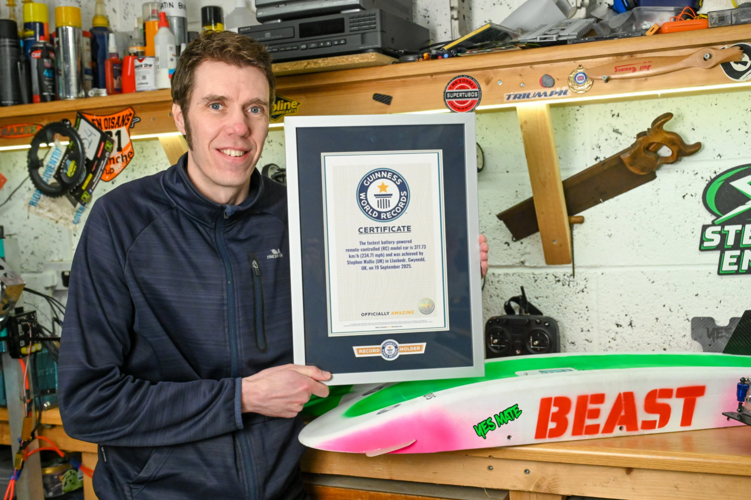
He has now achieved the fastest-ever speed recorded by a remote control car after hitting 234.71mph (377.7km/h) at LLanbedr Airfield in North Wales.
Stephen, of Rugby, Warks., said his fascination with remote control cars began when he was just eight-years-old and inspired him into engineering.

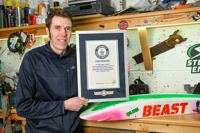
Stephen Wallis remote control car can go up to 234 mph. (Emma Trimble via SWNS)
But it was only when his 13-year-old son Rory began taking a recent interest in them a couple of years ago that he went about designing the fastest RC car ever made.
Stephen would sometimes spend eight hours a day just working on The Beast, which weighs 10.5kg and is capable of 0-60mph in three-and-half-seconds and 0-200mph in around ten-and-half seconds.
Guinness World Records confirmed recently his effort attempt back in September had broken the previous record for fastest battery-powered remote-controlled (RC) model car - by over 15mph (25 km/h).
Stephen said: "It felt incredible to achieve the fastest speed ever for a remote control car.
"I had three attempts on the day and my first run was 218mph and the record was 218.5mph so we came pretty close.
"Then it started drizzling so I didn't know if I was going to achieve it, but I had a decent tail wind which I think helped.
"I was constantly having to blink my eyes, using them almost as windscreen wipers, as I couldn't see the car properly as it got further away.
"It was an amazing feeling when I saw the speed. I couldn't believe the jump up from the first attempt, we smashed it.
"My interest in remote control cars began when I was aged eight so I've come a long way since then, it kickstarted my route into engineering.
"It was one of those cars connected to wire so to get one without a wire aged 12 was an absolute game changer.
"I got into racing and tinkering with them and I can thank them for sparking my interest in engineering in the first place that led to the job I'm doing today."

(Emma Trimble via SWNS)






Stephen, who works part-time at Royal Enfield Motorcycles in Leicestershire, stopped RC racing around aged 17 before he picked up the hobby again thanks to his son around 2020.
He added: "My son started getting into remote control cars after I visited a friend who had one and we soon became aware of these videos of people trying to get them going as fast as they could.
"I thought it looked interesting and just fancied a go. Most people were doing them on quiet roads or car parks but this can soon get dangerous once you get to 60mph or above.
"We found out about the Radio Operated Scale Speed Association (ROSSA) speed test events in Wales and that's where I first saw someone using drone motors.
"Theirs failed quite badly but I thought that might be the way to go in order to give the vehicle some direct drive and set about building my first car, which cost around £200.
"I tested out the idea with a quadcopter drone and in June 2024 I got my first ROSSA hat for hitting 129mph.
"The idea evolved and I set myself a goal of getting to 200mph, so started building a bigger version which I called The Beast.
"I went about using better components and getting a higher voltage for speed.
"I lost some of the drone electronics but kept the drone motors on the wheels, narrowed them down, and in June last year I reached 196mph.
"But I managed to set all three speed controllers on fire, so its been back to the drawing board a few times. But it's that same body that went on to set the world record.
"I've put a lot of work into it, sometimes working 40 hours a week on it at times, so it became another full-time job.

(Emma Trimble via SWNS)
"The car itself cost around £2,000 to make in total and with entry into the events, I've probably spent around £6,000."
The Beast gets its name from an industrial-type drone called BEAST-class, which are often used to power camera drones for films.
Its white, neon green and pink color scheme was in order to be able to still see it from a distance as its speeds along a runway.
Stephen said the design did not prove too tricky but the electronics were the challenge, and his car now runs on a battery layout running 75.6 volts
Stephen added: "It turns out it would never have done 240mph with my original set-up.
"But I went away and learned as much as I could about brush-less motors and how you can make them go faster.
"It is now powered by four drone motors, bolted directly to the wheels which are in turn bolted directly to the vehicle's chassis.
"It has been a labor of love but completely worth it. I hope it can inspire more young people into science."



(0) comments
Welcome to the discussion.
Log In
Keep it Clean. Please avoid obscene, vulgar, lewd, racist or sexually-oriented language.
PLEASE TURN OFF YOUR CAPS LOCK.
Don't Threaten. Threats of harming another person will not be tolerated.
Be Truthful. Don't knowingly lie about anyone or anything.
Be Nice. No racism, sexism or any sort of -ism that is degrading to another person.
Be Proactive. Use the 'Report' link on each comment to let us know of abusive posts.
Share with Us. We'd love to hear eyewitness accounts, the history behind an article.