A new list of the world's most-visited countries shows that France leads the pack, with Spain and the United States following. According to the Data Pandas review, France's 89.4 million tourist arrivals in 2024 put the country atop the list, welcoming nearly 6 million more visits than the runner-up.
These figures present questions about sustainable tourism in European cities like Paris. Many of the world's major cities and vacation spots have reached a tourism tipping point.
The backlash against international tourism in Europe has recently become somewhat normalized. Reports of protests, intimidation, and bureaucratic meddling are now commonplace, especially in the most oversaturated places.
Europe’s Tipping Point
In a recent op-ed, journalist Paul Thornton explains Europe reached its limit. He sees a sad irony in countries whose monuments have survived millennia listing under the wave of overtourism.
"Pristine wildlife areas degrade; the markets and butcher shops that sustained locals give way to souvenir stores," he says of the tourist curse. He references several cities, such as Venice, whose core population has fallen under 50,000, "a level not seen since the Middle Ages."
Unbridled Overtourism Driving Inequality
Unfortunately, the rise of the Airbnb economy prices out locally born workers before they have a chance to put down roots. Critics blame this well-documented issue on "gig economy" tourism and heavy cruiseliner tourism in some port cities.
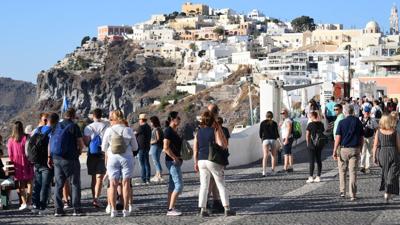
Another by-product of this modern crisis is the Santorini effect, named after the infamous volcanic eruption. The metaphors are strong: Santorini, Greece, often regarded as one of the world's most beautiful islands, has recently lost its charm to an explosion of selfie stick-wielding holidaymakers.
Santorini's Curse
Reuters contributor Valentini Anagnostopoulou interviewed Santorinians amid a record-breaking 2024 tourist season. Even local hoteliers have had enough and see everyday island life only suffering. One such local, Georgios Damigos, declared, "Our standards of living have gone down. It's as simple as that."
WorldCrunch writer Basile Dekonink interviewed the island's mayor, Nikos Zorzo, who feels little joy at the financial rewards from all the visitors. His native island is now, in his words, "saturated."
Overcrowded Cruise Ports
Today, cruise ships are thinking twice about docking there. In a shocking move this past spring, Princess Cruises announced its world-famous Sun Princess would no longer be docking at Santorini.
The cruise firm confirmed its decision in an email to alarmed guests scheduled to visit the bucket-list Greek Island. The ship will now dock in Chania, Crete.
Cruise ship congestion is an ongoing issue across the Mediterranean, and Greece's Ministry of Tourism took action at the end of the 2024 season. After the season, Greece's parliament passed a daily tax increase on short-term vacation rentals.






In addition, lawmakers added a cruise ship levy of around $21 on arrivals in Santorini and Mykonos and a $5 fee for other destinations.
Falling Living Standards
Infrastructure and worn historical monuments aren't the only ones bearing the brunt of the annual influx. Living standards for everyday residents in tourist hotspots continue to suffer, leading to displacement and economic inequality.
Last year, one report explored Tenerife's growing problem for service workers, showing a contingent of local seasonal workers could only afford to sleep in tents over the 2024 season. The Canary Islands are a popular vacation spot, especially for British families, who come in droves over the summertime.
In the piece, writer James Badcock spoke to José, a 65-year-old restaurant worker who used to rent an apartment for $425 monthly. That changed when the owners made it a short-term holiday property, more than doubling the rent overnight. José then moved into a derelict building without amenities, though he still paid $1,000 for the season.
Over the summer, he found himself in a tent community, from where he commuted to his job. "Now anything with one or two bedrooms costs at least €900," he explained. "I earn minimum wage: €1,100. If I have to pay that kind of rent, then we won't be able to eat."
Northern Europe Shares the Burden
While Southern Mediterranean nations grapple with an overtourism impact, their Northern European neighbors are not exempt.
Countries like Iceland are experiencing the same problem, which local writer Jóhannes Bjarkason blames on the country's pivot toward the mass tourism "gold rush."
While property owners can capitalize on their assets, those without such privileges are at the mercy of the free market. Bjarkason argues such a system doesn't consider its Indigenous residents' welfare. "The rapidly expanding industry demands more workers than the domestic population can sufficiently supply, meaning the import of foreign workers," he writes. This situation leads to fewer rentals for locals and a subsequent reduction of living standards, two issues that are all too common across Europe now.
Of course, Europe is a huge continent with an incredible history spread across dozens of countries. One Euronews breakdown of the least-visited places in the region shows which could become competitive destinations.
Examples given include San Marino, a landlocked mountain state within the borders of Italy and the fifth-smallest country in the world. San Marino boasts stunning landscapes and 11th-century architecture within its 23,000-square-mile territory.
Moldova is officially the least frequented place in Europe, which is unsurprising considering its far-easterly location between Romania and Ukraine. However, the country is fast becoming a must-visit destination for wine lovers.
A New Regulatory Dawn
How does Europe mitigate this snowballing dilemma? A BBC feature documented the recent summer's tourism across the continent, and new regulations are widespread. For example, Venice now requires daytrippers to pay a $5 tourist tax; Rome is introducing a Trevi Fountain ticketing system.
Perhaps the biggest change will come in the accommodation rentals market, where short-term lets are under scrutiny. One aspect of European travel will be apparent in the near future, especially for the busiest cities and resort towns. Travelers will see vacations become increasingly expensive until mainstream Europe can reverse the trend.

(0) comments
Welcome to the discussion.
Log In
Keep it Clean. Please avoid obscene, vulgar, lewd, racist or sexually-oriented language.
PLEASE TURN OFF YOUR CAPS LOCK.
Don't Threaten. Threats of harming another person will not be tolerated.
Be Truthful. Don't knowingly lie about anyone or anything.
Be Nice. No racism, sexism or any sort of -ism that is degrading to another person.
Be Proactive. Use the 'Report' link on each comment to let us know of abusive posts.
Share with Us. We'd love to hear eyewitness accounts, the history behind an article.