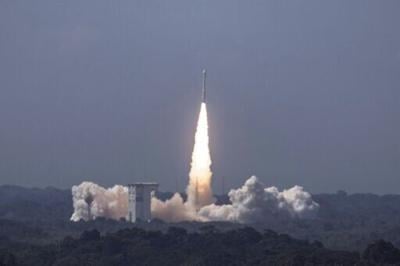
The European Vega C rocket blasted off into space on Monday, successfully putting a South Korean Kompsat-7 satellite into the Earth's orbit.
After two delays, Vega C achieved lift-off from the Guiana Space Centre in French Guiana at 2:21 pm (1721 GMT), an AFP journalist saw, with a significant South Korean delegation that had made the trip to South America watching on.
After 45 minutes of flight, the lightweight rocket deposited the Kompsat-7 into orbit, with the 1.8-tonne satellite set to monitor the Korean peninsula for at least five years.
The mission's success contrasts with the failure of the Vega C's first commercial flight, when the rocket lost two Airbus satellites at a time when Europe was already deprived of Russia's Soyuz rockets following the Kremlin's invasion of Ukraine.
As a result, Europe lost an independent way to launch its missions into space for a year, while its new-generation heavyweight Ariane 6 rocket suffered repeated delays.
Although Ariane 6 finally blasted off in 2024, the rocket is not reusable -- unlike SpaceX's Falcon 9 workhorse, which has helped Elon Musk's company rise to dominate the market.
Keep it Clean. Please avoid obscene, vulgar, lewd,
racist or sexually-oriented language. PLEASE TURN OFF YOUR CAPS LOCK. Don't Threaten. Threats of harming another
person will not be tolerated. Be Truthful. Don't knowingly lie about anyone
or anything. Be Nice. No racism, sexism or any sort of -ism
that is degrading to another person. Be Proactive. Use the 'Report' link on
each comment to let us know of abusive posts. Share with Us. We'd love to hear eyewitness
accounts, the history behind an article.


(0) comments
Welcome to the discussion.
Log In
Keep it Clean. Please avoid obscene, vulgar, lewd, racist or sexually-oriented language.
PLEASE TURN OFF YOUR CAPS LOCK.
Don't Threaten. Threats of harming another person will not be tolerated.
Be Truthful. Don't knowingly lie about anyone or anything.
Be Nice. No racism, sexism or any sort of -ism that is degrading to another person.
Be Proactive. Use the 'Report' link on each comment to let us know of abusive posts.
Share with Us. We'd love to hear eyewitness accounts, the history behind an article.