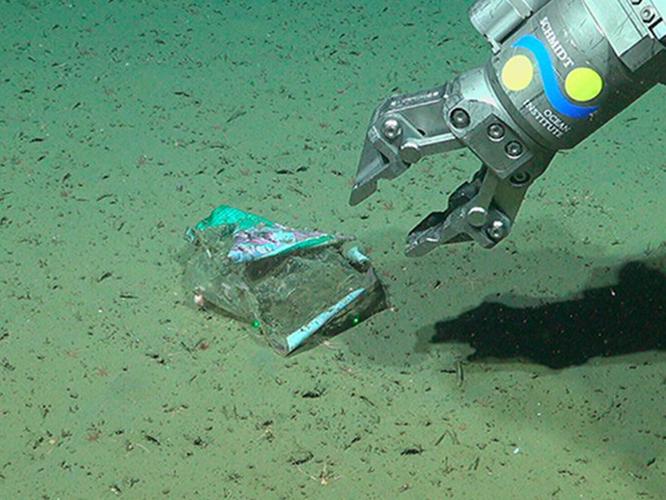
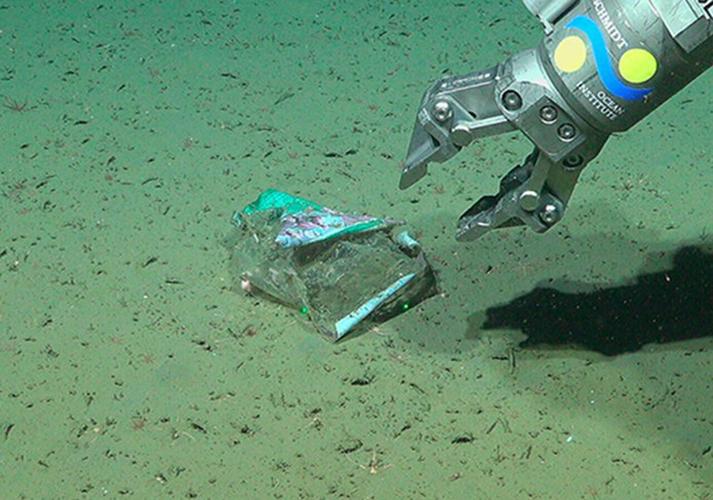
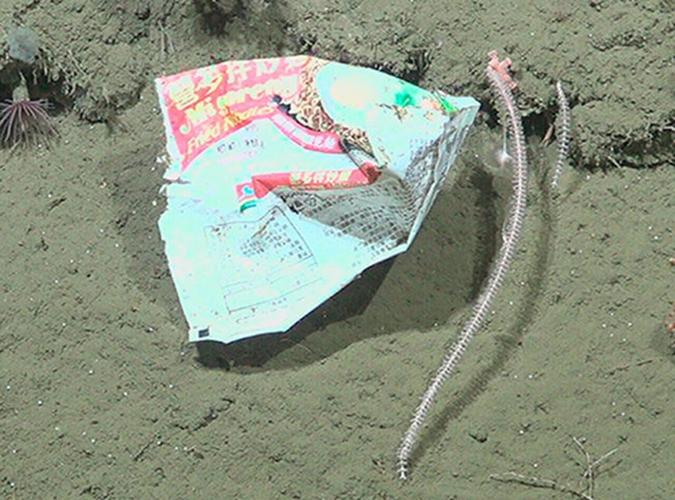
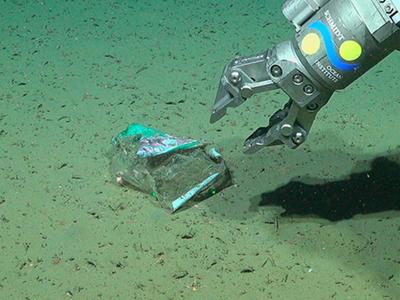

A plastic wrapper found at the bottom of the ocean. (Teso et al., 2026, PLOS One, CC-BY 4.0 via SWNS)
By Stephen Beech
The very deepest depths of the ocean have become a dumping ground for human litter, reveals new research.
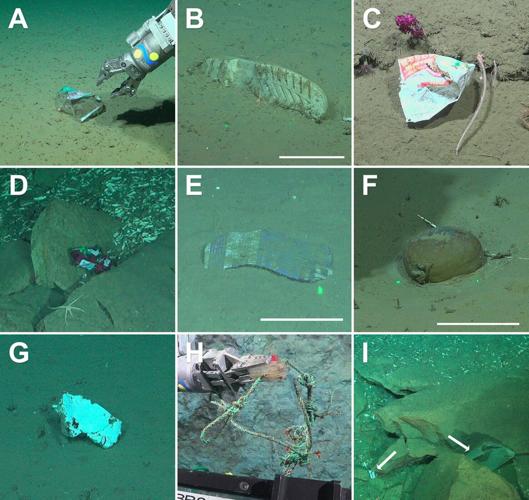
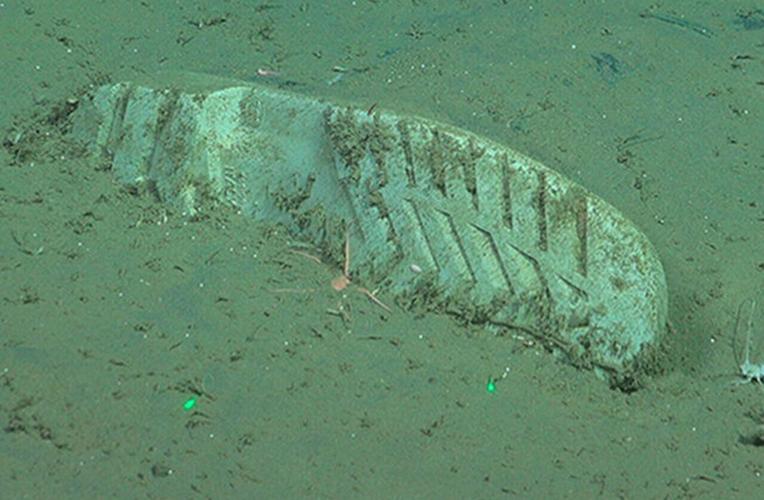
Food wrappers, plastic cups and even a rubber boot were found thousands of feet below the surface in the Mar del Plata Submarine Canyon, 180 miles off the coast of Argentina.
Scientists say the survey of the never-before-seen sea floor at depths of more than two miles show that even the deepest parts of the ocean aren't immune to plastic pollution.
An international team led by Daniel Lauretta, of Argentina's Natural Science Museum, found that litter has accumulated in a part of the planet usually considered pristine when the survey was conducted in the Atlantic.

Examples of deep-sea litter found in the Mar del Plata Submarine Canyon. (A) Medium-sized plastic wrapper, 2,109 m. (B) Rubber boot, 2,598 m. (C) Food wrapper, 1,920 m. (D) Snack wrapper, 3,231 m. (E) Tissue paper wrapper, 3,814 m. (F) Sediment-filled plastic bag, 3,739 m. (G) Highly degraded plastic fragment, 3,709 m. (H) Nylon cord with a hook, 1,949 m. (I) White plastic cup and bag (arrows), 3,243 m. Scale bars: 10 cm. All images courtesy of Schmidt Ocean Institute/ ROV SuBastian (CC BY 4.0), expedition FKt250712. (Teso et al., 2026, PLOS One, CC-BY 4.0 via SWNS)
Lauretta said: "The ocean's depths remain one of Earth's greatest unknowns, but as the fish swims - or as the debris sinks - the sea floor is not all that distant.
"On average, our oceans are just a few miles deep, and thus, not so far from human influence."
The study, published in the journal PLOS One, marked the first time scientists had taken images of the seafloor within the Mar Del Plata Submarine Canyon.
Researchers documented around 40 species that may be new to science — but also some more familiar sights.

A rubber boot found on the bottom of the ocean. (Teso et al., 2026, PLOS One, CC-BY 4.0 via SWNS)





Across 10 of the 17 dives with a remotely operated submersible, the team saw 29 identifiably manmade objects.
Lauretta said: "The vast majority were plastic, along with a few rubber items.
"They ranged from fishing gear to plastic bags and food wrappers and even a boot.
"Some were buried in the sediment, while others were trapped in rocks or still drifting."
The researchers observed more litter inside the canyon compared with the surrounding area, suggesting the geography and currents funneled the items into the fissure.

Fried noodles wrapper littering the ocean. (Teso et al., 2026, PLOS One, CC-BY 4.0 via SWNS)
The team also saw some animals interacting with the waste.
Lauretta said: "Mobile creatures like crustaceans had transient interactions while more stationary creatures -like starfish and corals - had attached to some debris, often partially subsumed plastic packaging and fishing ropes."
Just a few months before the expeditions in the Mar Del Plata Submarine Canyon, a plastic bag was found in the Mariana Trench, Earth's deepest fissure.
Lauretta said: "The sinking of organic material is essential to life beyond the reaches of sunlight, but this new study adds to emerging evidence that nutrients aren't the only matter pulled to the ocean floor."
He added: "Unveiling a species previously unknown to science in the endless darkness of the deep sea may be one of the most extraordinary experiences a marine biologist can have."
(0) comments
Welcome to the discussion.
Log In
Keep it Clean. Please avoid obscene, vulgar, lewd, racist or sexually-oriented language.
PLEASE TURN OFF YOUR CAPS LOCK.
Don't Threaten. Threats of harming another person will not be tolerated.
Be Truthful. Don't knowingly lie about anyone or anything.
Be Nice. No racism, sexism or any sort of -ism that is degrading to another person.
Be Proactive. Use the 'Report' link on each comment to let us know of abusive posts.
Share with Us. We'd love to hear eyewitness accounts, the history behind an article.