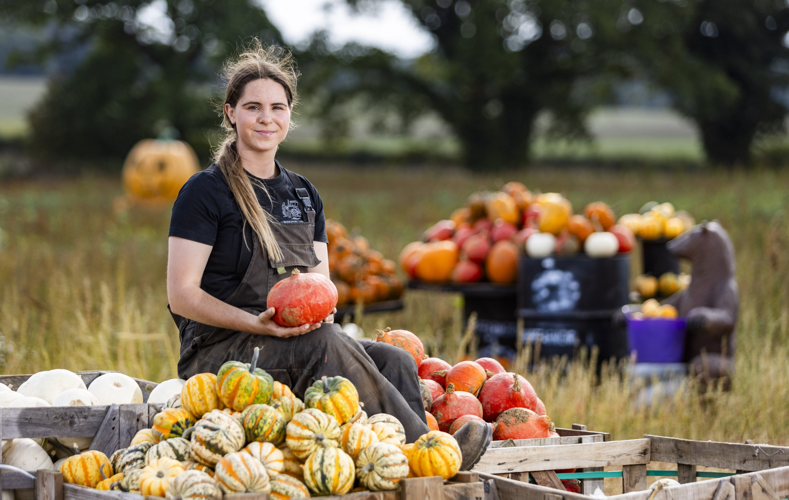
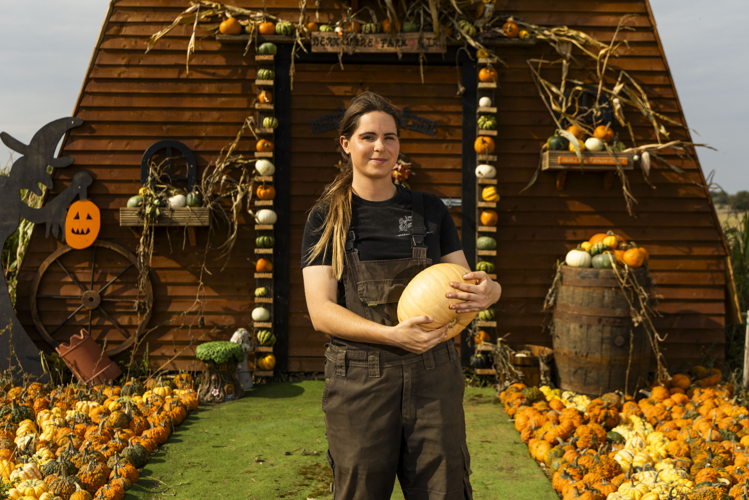
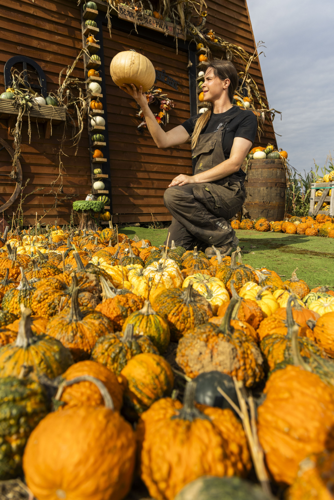
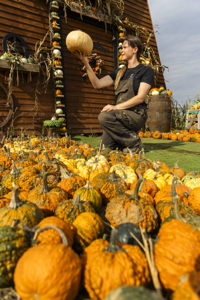

(Tom Wren via SWNS)
By Isobel Williams
Farmers have warned that Britain's beloved pumpkin patches are under threat this fall - after the scorching summer ruined growing conditions.
Every year families flock to farms across the nation to pick pumpkins for their houses ahead of Halloween.
But, after the relentless temperatures over the 2026 summer, farmers have said there could be considerably fewer of the squash to pick from.
Eleanor Gilbert, 24, who works on her family's Rookery Farm in Thatcham on the Hampshire-Berkshire border, claims all the local farms are struggling due to the dry conditions.
She estimates they have lost 50 percent of their crop and the pumpkins that have managed to grow have either been very small or have struggled to compete with weeds for light and space.
Having spent $8,000 on seed alone, Eleanor says she will barely be able to break even with the pumpkins that have materialized.

(Tom Wren via SWNS)
She said: "I am about 50% down on my average pumpkin crop.
"It is really quite devastating. It is not just me, it is farmers across the country. We are taking hits quite a lot lately.
"It is a lot more expensive this year to counteract the drought we have been facing.
"This year I am really feeling it, and I am not sure I am going to break even."
Eleanor has been growing her Berkshire Farm Girl Pumpkin Patch and Maize trail for the last four years, and has worked on her stepdad's farm since she was 14.
She then went to university to study farming, and is using the profits from her pumpkins to try and pay off her student loans.
One of the main money makers is her Pumpkin Patch & Big Bale Play events where people can pick pumpkins and explore a spooky maze.
However, with the reduced crop, she says decorations are looking sparse.
The corn used to create her maze has also not grown, which means she has instead had to create a bale maze at a higher cost.




The event opens on October 3 and there likely won't be any pumpkins leftover to sell as there normally would be.
Eleanor said: "I have spent the whole year creating this pumpkin patch to bring people onto the farm and I have put a lot of effort into it.
"This year is going to be a bit sparse because we just didn't get the yield we were expecting.
"This is a chance for people to come down, chat to farmers, and really show that food doesn't just come from the supermarket.
"We have lots of children come down every year and they love the freedom and running around on the bales. I think it will be a real shame if I can't do it again."

(Tom Wren via SWNS)
The main issues have been caused by the lack of rain, as Eleanor says pumpkins are around 90% water, and field fires from the dry conditions.
She says she couldn't afford to set up an irrigation system for her pumpkins and water is expensive, with getting her own supply costing upwards of £20,000.
Eleanor couldn't give an exact number on how much money she has lost, but used the example of her Hot Chocolate Pumpkin which she planted 1,000 of and ended up with one pumpkin.
That seed cost her a few hundred pounds, and she says that one pumpkin will definitely not be worth enough to make that money back.
The farmer, who posts on social media under Berkshire Farm Girl, says she always overplants so will just about have enough, but she might not be able to continue if summers get hotter.
She said: "Looking into the future they are saying it is going to be even hotter next year, and I am looking at it wondering whether we should be growing pumpkins anymore.
"It is really sad because I love farming and it is my passion. I hope I can carry it on, but this is really taking its toll on me as a young farmer.
"I am looking at whether this could be my last ever pumpkin harvest if I can't afford to carry on going."
The heatwaves also impacted other plants such as wheat, which was down 40% this year, and has started costing them $80 an acre rather than being profitable.
Eleanor believes the problem would be helped if the risk was spread across the supply chain, rather than just being placed on farmers themselves.
She added: "We need more supply chain fairness at the moment. Farmers are the ones that are taking all the risk. We need to spread that risk."
(0) comments
Welcome to the discussion.
Log In
Keep it Clean. Please avoid obscene, vulgar, lewd, racist or sexually-oriented language.
PLEASE TURN OFF YOUR CAPS LOCK.
Don't Threaten. Threats of harming another person will not be tolerated.
Be Truthful. Don't knowingly lie about anyone or anything.
Be Nice. No racism, sexism or any sort of -ism that is degrading to another person.
Be Proactive. Use the 'Report' link on each comment to let us know of abusive posts.
Share with Us. We'd love to hear eyewitness accounts, the history behind an article.