

Ahead of its first match in the 2026 World Cup, the Haitian national soccer team was forced to make a last-minute change. But it didn’t have anything to do with its roster or travel plans. It was the team’s jersey.
FIFA, the sport’s global governing body, said the jersey design violated its rules, which ban political slogans or imagery.
FIFA didn’t elaborate on which components of the jersey were problematic. But the issue almost certainly stemmed from the small image of a group of people holding the Haitian flag that appeared on the right hip of the jersey. After the decision was made, a spokesperson for the team confirmed that the original jersey included “an image depicting the Battle of Vertières and some independence heroes raising the Haitian flag.”
The commemoration was doubly symbolic since Haiti officially qualified for the World Cup for just the second time in the men’s tournament’s history on Nov. 18, 2025, which also marked the 222nd anniversary of the famous 1803 battle that secured Haiti’s victory over France in its war for independence.
While the spokesperson for the team described the image as including “some independence heroes,” I think it’s safe to assume that Jean-Jacques Dessalines, who led the Haitian revolutionaries during the Battle of Vertières, is the central figure of the vignette.
The subject of my 2025 book, “I Have Avenged America,” Dessalines was the man who declared Haiti’s independence from France, and he was Haiti’s first head of state.
Read more: Jean-Jacques Dessalines: Reassessing the Haitian revolutionary leader’s legacy
But because of his radical and violent fight for freedom, Dessalines’ enemies often described him as ferocious and barbaric, both during his lifetime and in the centuries after his death. They sought to undermine his leadership and undermine Haiti as a country, depicting him as a figure whose sole purpose was violence for violence’s sake, rather than a revolutionary driven by any ideological or political commitments.
A successful slave revolution
In the late 17th century, France had colonized the western third of Hispaniola, the island that Haiti now shares with the Dominican Republic.
By forcing enslaved men, women and children to work on sugar and coffee plantations, the French turned the colony, which they called Saint-Domingue, into one of the wealthiest in the world.
In August 1791, enslaved men and women rose up in revolution. It was the world’s first and only successful slave revolution: Within two years, they forced the French to abolish slavery.
The Haitian Revolution – as the event is known today – became a war for independence only when the French tried to reinstitute slavery in 1802. Dessalines declared Haitian independence on Jan. 1, 1804, and Haiti became the first nation to permanently ban slavery.
The ‘silencing’ of the revolution
The effort to discredit the Haitian Revolution by targeting Dessalines began during the war for independence against the French. Criticism only intensified after the Declaration of Independence.
That year, French propagandist Louis Dubroca, a mouthpiece of the Napoleonic government, published a slanted, factually incorrect biography of Dessalines. Even though the book got some basic facts wrong, such as claiming that Dessalines was born in Africa, its impact has been indelible.
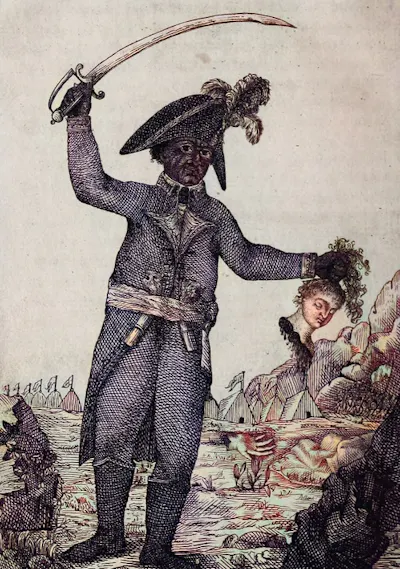
“Cunning and hypocritical,” Dubroca wrote, Dessalines “is also brutal, impetuous, and violently excessive. He inspires a kind of terror in all around him.”





An image that accompanied an 1806 Spanish translation of the book still haunts the memory of the Haitian Revolution: It depicts Dessalines hoisting a sword in one hand and holding the severed head of a white woman in the other
In the decades after the revolution, opponents of the young nation routinely claimed that Dessalines had massacred the entire white population on the island after declaring independence.
Yes, in the context of ongoing war with France, Dessalines executed some French citizens, including those who had participated in Napoleon Bonapart’s bloody campaign from 1802 to 1803 to regain control over the colony and reintroduce slavery. After 1804, however, hundreds of white French people remained in Haiti and were naturalized as Haitian citizens, securing equal rights under Dessalines’ 1805 Haitian constitution.
But the facts didn’t matter. The hyperbolic narrative of unmitigated violence served to discredit and undermine the revolution’s successes.
Thomas Jefferson became so worried that enslaved people in the United States would be inspired by the Haitians that in his correspondence he frequently depicted the Haitian Revolution as a violent upheaval rather than a struggle for freedom. Jefferson went on to ban trade with Haiti in 1806, and the U.S. did not formally recognize Haiti’s independence until 1862.
The strategy of denying Haiti’s success became so effective that the Haitian anthropologist Michel-Rolph Trouillot called it the “silencing” of the Haitian Revolution.
A pattern emerges
The World Cup jersey ban marks Haiti’s second sartorial controversy of 2026.
In early 2026, the International Olympic Committee required Haiti’s Winter Olympics team to modify its opening ceremony outfit for similar reasons.
The garments, designed by Stella Jean, a Haitian Italian fashion designer, featured a painting of the Haitian revolutionary Toussaint Louverture, Dessalines’ fellow revolutionary.
Once again, the design was deemed political.
Dessalines and Louverture fought together throughout the revolution, but they are often portrayed as opposites. Louverture, in this framing, is strategic, diplomatic, rational and reasonable. In contrast, Dessalines is typically described as violent, unthinking, emotional and heartless.
But there’s a noteworthy distinction between the Olympic ban and the current one imposed by FIFA. For the Olympics opening ceremony, the banned outfits depicted a single, specific person: Louverture. In the case of the World Cup jerseys, the mere implication of Dessalines, standing alongside his fellow revolutionaries, was enough to elicit a backlash.
Ever since the Haitian revolutionaries first rebelled against the French in 1791, the proslavery and imperialist powers of Europe and the Americas had a special interest in ensuring that Haiti failed.
Both then and now, targeting revolutionaries like Dessalines has supported that goal. The irony is that more people may be learning about Haiti’s revolutionary history in the process. Saeta, the company that designed the controversial jersey, has announced on Instagram that it will restock it. The jersey has become a fan favorite.
This article is republished from The Conversation, a nonprofit, independent news organization bringing you facts and trustworthy analysis to help you make sense of our complex world. It was written by: Julia Gaffield, William & Mary
Read more:
- Haiti at the World Cup is more than an underdog tale – it is the story of global migration
- Meet Haiti’s founding father, whose black revolution was too radical for Thomas Jefferson
- For Iran’s diaspora, a tough World Cup call: To support the national team or protest – or both?
Julia Gaffield does not work for, consult, own shares in or receive funding from any company or organization that would benefit from this article, and has disclosed no relevant affiliations beyond their academic appointment.



(0) comments
Welcome to the discussion.
Log In
Keep it Clean. Please avoid obscene, vulgar, lewd, racist or sexually-oriented language.
PLEASE TURN OFF YOUR CAPS LOCK.
Don't Threaten. Threats of harming another person will not be tolerated.
Be Truthful. Don't knowingly lie about anyone or anything.
Be Nice. No racism, sexism or any sort of -ism that is degrading to another person.
Be Proactive. Use the 'Report' link on each comment to let us know of abusive posts.
Share with Us. We'd love to hear eyewitness accounts, the history behind an article.