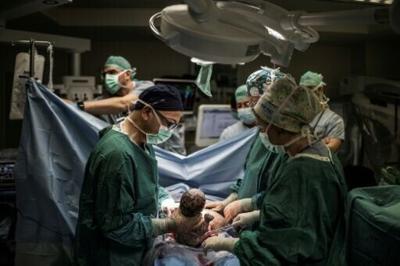
Inside an underground shelter at a hospital in the Israeli city of Haifa, a television screen flickers with images of Iranian missiles as doctors and midwives deliver Sarah Bird's third child.
"She's beautiful," a midwife says, placing the newborn in her mother's arms for a first kiss.
"She is!" exclaims Bird, 38, breaking into a broad smile.
Her husband Yitzhak, tense throughout, finally exhales, then explains that the couple will wait a week before choosing a name.
The couple had arrived just hours earlier at the Mount Carmel Medical Center and were taken straight to the facility's underground shelter, carved into the mountainside.
About 10 babies are born there each day, according to Clalit, Israel's main healthcare provider, which operates the hospital.
Since the war began on February 28 with US-Israeli strikes on Iran, 370 newborns have been delivered in the shelter.






Within hours of the initial strikes on Iran, major hospitals across Israel shifted to maximum emergency readiness, moving patients and critical departments underground.
Operating theatres, intensive care units and even maternity wards have been relocated to protected subterranean spaces.
A fragile ceasefire between Washington and Tehran took effect on April 8, and no Iranian missiles have been fired at Israel since.
But in Haifa — still reeling from a strike on a residential building that killed four people days before the truce — sirens continue to wail.
Rocket fire from Lebanon's Hezbollah movement, an ally of Tehran, has not stopped. Israel says Lebanon is not covered by the ceasefire and has continued strikes on its neighbour, which have left more than 300 people dead this week.
More than 20 rocket alerts sounded in northern Israel on Thursday alone, along the Lebanese border, after Hezbollah said it had fired multiple barrages.
ml-cf-jd/lba/dc
(0) comments
Welcome to the discussion.
Log In
Keep it Clean. Please avoid obscene, vulgar, lewd, racist or sexually-oriented language.
PLEASE TURN OFF YOUR CAPS LOCK.
Don't Threaten. Threats of harming another person will not be tolerated.
Be Truthful. Don't knowingly lie about anyone or anything.
Be Nice. No racism, sexism or any sort of -ism that is degrading to another person.
Be Proactive. Use the 'Report' link on each comment to let us know of abusive posts.
Share with Us. We'd love to hear eyewitness accounts, the history behind an article.