Home insurance companies chose to not renew 2.02 million policies in 2024, a nearly 61% increase from the year before, when they non-renewed about 1.26 million policies, according to a new National Association of Insurance Commissioners (NAIC) report.
“Non-renewals have gone from an occasional headache to a recurring part of the week,” independent agent Tom Firestine, of Longmeadow Insurance in Chicago, told Insurify.
Even as the non-renewals piled up, higher premiums and underwriting changes have helped insurers restore profitability following several challenging years.
The opposing trends illustrate an increasingly difficult home insurance market for consumers. Insurers remain financially capable of providing coverage, but many homeowners are paying considerably more for it, if they can even find a company willing to continue covering them.
“The trends support what some consumers are already feeling — in some places, homeowners insurance is becoming more expensive and harder to keep,” the NAIC report stated.
Non-renewals accelerate across the country
Insurer-initiated non-renewals increased across all U.S. regions between 2018 and 2024, according to the NAIC report. Regional increases ranged from 96% to 216%, the report found.
The Southeast experienced the largest cumulative increase, with its non-renewal rate rising 216% during the seven-year period. The Northeast recorded a 147% increase.
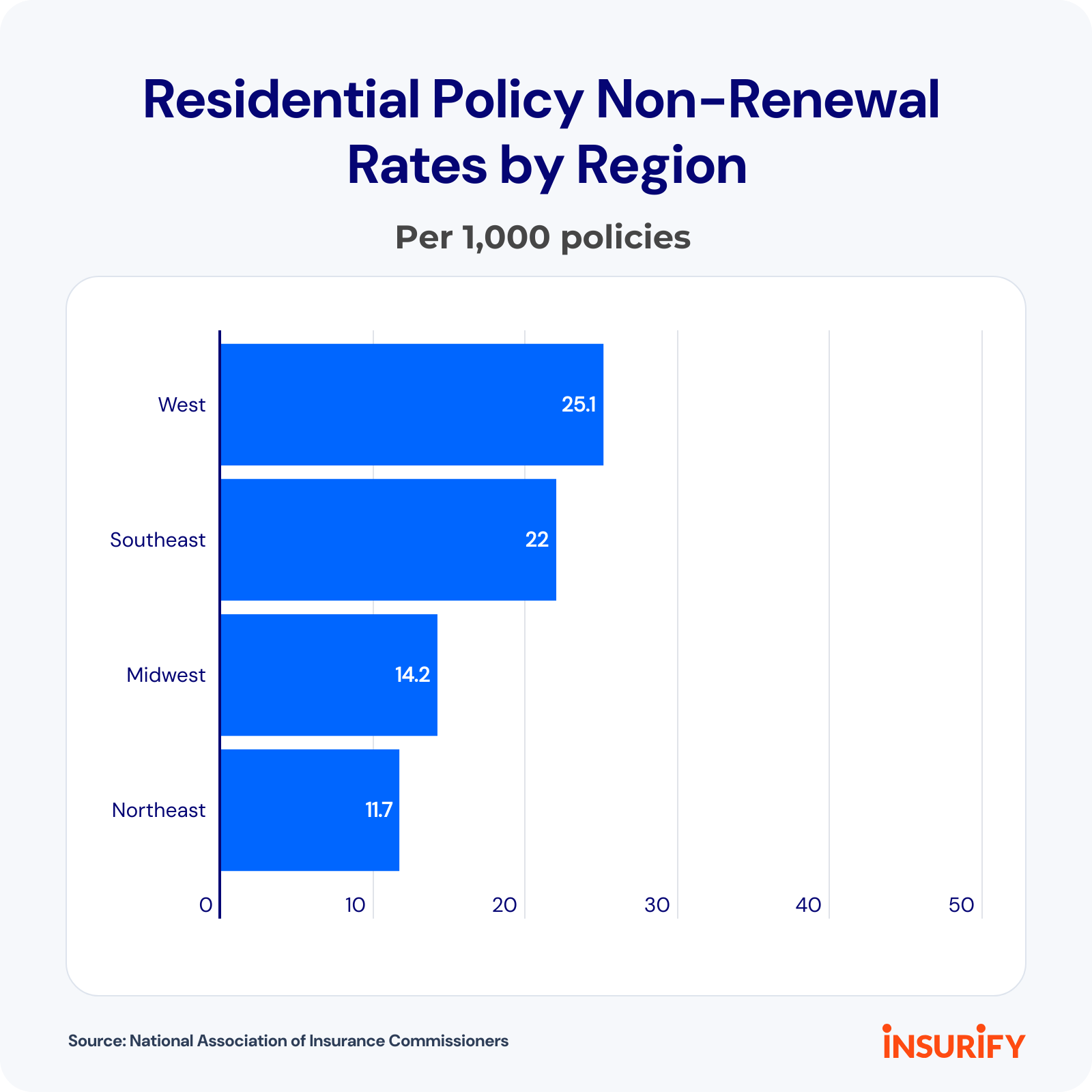
The West, meanwhile, had the highest non-renewal rate in 2024, at 25.1 per 1,000 policies. Insurers in these states initiated 852,019 non-renewals during the year, accounting for 42% of the national total. The West’s non-renewal rate rose from 13.7 per 1,000 policies in 2023 — about an 83% increase in one year.
The Southeast followed, with 22 non-renewals per 1,000 policies, while the Midwest and Northeast had lower rates.
 A non-renewal occurs when an insurer decides not to continue a policy after its term expires. It differs from a cancellation for non-payment, which occurs when a policyholder fails to pay the required premium.
That distinction is becoming increasingly important. Non-payment cancellation rates generally leveled off in 2023 and 2024, while insurer-initiated non-renewals continued to accelerate.
In the West, the non-renewal rate was equal to 46% of the rate of cancellations for non-payment in 2024, up from 15% in 2022. The change shows that insurer-initiated non-renewals are growing much faster than cancellations caused by policyholders’ failure to pay.
Homeowners who receive a non-renewal notice must find replacement coverage, often in a market with higher premiums, stricter underwriting requirements, and fewer affordable choices.
One reason for rising non-renewals is technology, according to some industry experts.
“Carriers now run high-resolution aerial and satellite imagery against the entire in-force book, not just new applications,” Firestine said. “And vendors score the images automatically.”
As a result, he said, roof staining, granule loss, patched sections, tarps, moss, overhanging limbs, overgrown vegetation, debris or clutter in the yard, an unfenced pool, or a trampoline can all lead to a non-renewal notice.
“The homeowner never sees an inspector and may have no claims at all,” Firestine said. “And the first they hear about it is a non-renewal notice or a demand to replace a roof the carrier scored as end-of-life from an overhead photo.”
Large insurers reduce their exposure
Although the overall number of residential property policies increased between 2018 and 2024, more than half of the insurers operating consistently in each region reduced the number of policies they wrote.




Among insurers that consistently wrote residential property policies in a region from 2018 through 2024, 54% to 55% reduced their policy counts during that period, depending on the region.
Large insurers operating in numerous states were frequently among the companies reducing their policy counts. Smaller regional and state-focused insurers absorbed much of that business, according to the NAIC.
That means the national policy count can remain stable or even increase, even as individual homeowners experience non-renewals and fewer choices from major insurers.
The shift has also contributed to greater market concentration, according to the report. The number of insurers has remained relatively flat or declined slightly, while the number of policies increased, leaving more policies concentrated among the companies that continued to expand.
“What I’ve seen is that carrier pressure actually increases before anything gets non-renewed,” said Mike Plactere, the owner of We Buy Long Island Homes. “Carriers have seemingly stopped waiting for a claim and have started sending an inspector out, and the inspection comes back with a condition attached to keeping the policy.”
Insurer profitability rebounds
The consumer pressures intensified even as insurers’ financial results improved.
Homeowners insurance underwriting profitability increased in every region in 2024 and was positive in three of the four regions, the NAIC found. The rebound followed a decline in underwriting profitability across all four regions in 2023.
The results suggest that premium increases, non-renewals, and other underwriting changes have helped insurers improve their financial position. But those same measures have transferred more of the market’s financial pressure to homeowners through higher costs and less certainty that their coverage will continue.
“A non-renewal does not necessarily mean a home is uninsurable, but it does mean homeowners should act quickly,” said Sam Joffee, founder of SJJ Insurance Services. “They should review the notice for the exact reason and effective date, document recent improvements such as a new roof or storm-hardening work, and begin comparing coverage before the current policy expires.”
Every state and Washington, D.C., has laws that require insurance companies to notify policyholders when they intend to cancel or non-renew a policy, typically 30–60 days before the end date.
National figures may hide local insurance problems
The NAIC described the overall homeowners insurance market as “operationally robust,” noting that hundreds of insurers continue to provide coverage and that the total number of policies has grown.
But the report also acknowledged that regional and national figures can obscure serious problems in individual states and communities.
This means a state may appear to have a healthy insurance market overall while homeowners in wildfire-prone, hurricane-exposed, or other high-risk ZIP codes struggle to find affordable coverage.
The analysis also combines multiple residential policy types, including traditional homeowners, renters, condominium, dwelling, and mobile-home policies. It excludes the excess-and-surplus market and doesn’t include New York in its multiyear regional analysis.
The report also doesn’t identify which insurers reduced their policy counts. It also analyzes individual insurance companies rather than consolidating affiliated companies into their larger corporate groups.
The NAIC and state regulators are collecting more detailed ZIP-code-level information on premiums, policies, claims, deductibles, non-renewals, and coverage types. That data could provide a clearer picture of where homeowners face the most severe problems with affordability and availability.
For now, the national findings show a market that has recovered financially — but one in which homeowners are paying more and facing a growing risk that their insurers will decide not to renew their policies.
(0) comments
Welcome to the discussion.
Log In
Keep it Clean. Please avoid obscene, vulgar, lewd, racist or sexually-oriented language.
PLEASE TURN OFF YOUR CAPS LOCK.
Don't Threaten. Threats of harming another person will not be tolerated.
Be Truthful. Don't knowingly lie about anyone or anything.
Be Nice. No racism, sexism or any sort of -ism that is degrading to another person.
Be Proactive. Use the 'Report' link on each comment to let us know of abusive posts.
Share with Us. We'd love to hear eyewitness accounts, the history behind an article.