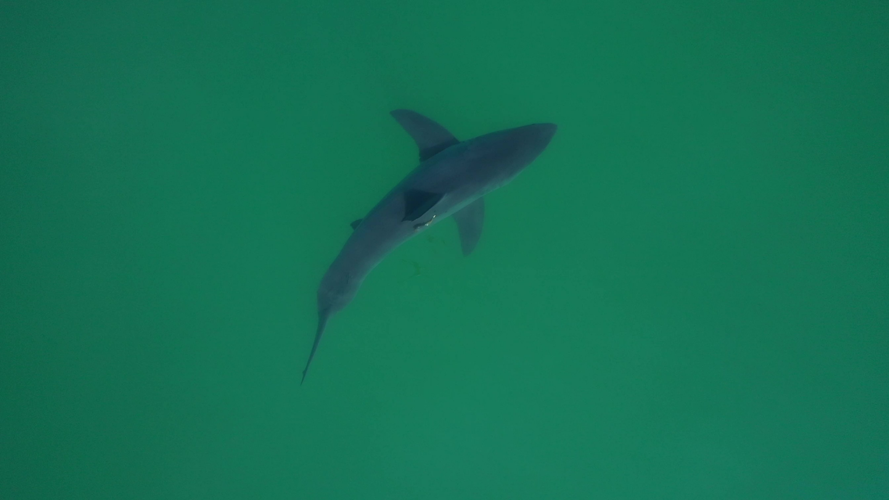
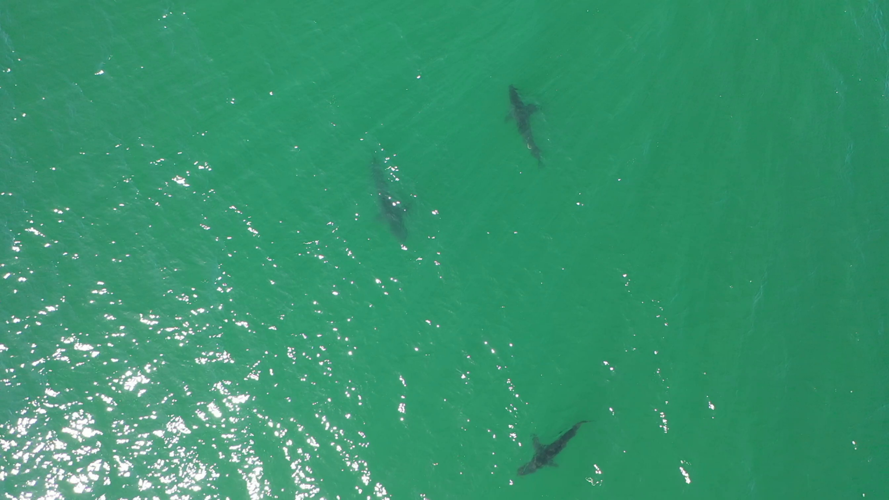

(UCSB's Benioff Ocean Science Lab via SWNS)
By Blaise Cloran
AI-powered shark-monitoring drones are being used to keep tourists safe.
Unusually warm waters have led to higher-than-average shark numbers near California this summer, and scientists are developing new technology to keep swimmers informed.
Scientists at UC Santa Barbara's Benioff Ocean Science Laboratory have developed AI technology that uses drone flights to capture and scan videos to see if great white sharks are present off the coast of Padaro, California.
If the apex predators are spotted, information is shared with local beaches and officials to help keep beachgoers safe and collect scientific data on the animals.
A notification sent to nearby communities typically tells them how many sharks have been seen and where.
And then local surf shops and surf camp owners are contacted.
Neil Nathan, senior research scientist at Benioff Ocean Science Lab in Santa Barbara, leads the program, named SharkEye.
Since starting the project, which is the first of its kind, seven years ago, scientists noticed that white shark populations in Southern California appeared to be increasing.
They are currently in the final stages of testing an app that would allow members of the public to check the waters before they jump in.
Nathan said: “We have been field testing this year, and with unusually warm waters this year from a recent marine heatwave and now a developing El Niño, there have been higher-than-average shark numbers at Padaro and other spots in Southern California — so a great year to field test our new app.
"We are in the final stages of testing of our SharkEye app, which would be a free and open-source app with our AI detection model that could help other users (lifeguards/public safety officials) to monitor shark activity at their local beaches."
SharkEye drone videos identify the number of great white sharks as well as their estimated size.
After being analyzed by an AI tool, push alerts are sent in real time to beachgoers nearby via a shark app.
Nathan said: “We started the program back in 2019, and we primarily study juvenile or young sharks.

(UCSB's Benioff Ocean Science Lab via SWNS)
“Young sharks tend to cluster close to the coast because they are less able to regulate their body temperature and their food sources are there.






“They focus on the seafloor, where they hunt for stingrays and leopard sharks or halibut. Where they gather is called aggregation sites.
“Food source, temperature and even social elements will affect where these sites are.”
Nathan said areas in Southern California, such as the Santa Barbara Channel, are great white shark hotspots.
The team hopes through using drones to collect data on sharks, they can raise respect and awareness for the animals.
Nathan added: “Our program is trying to understand these aggregation sites as there is still so much we don't know about their dynamics and persistence.
“Our survey site is at a beach called Padaro Beach, also known as Santa Claus Beach.
“Before 2017 it was rare to see a shark fin here; now this is a juvenile great white shark hotspot and has been a stable and persistent aggregation site for 10 years.
“We started doing surveys of shark numbers and we thought that drones would be a good tool to use.
“Other labs do boat-based surveys and put tags in the dorsal fin of the shark, but it is difficult to do that and it changes their behavior.
“The drones allow us to be a fly on the wall.
“We are able to get a beautiful snapshot without affecting their behavior.”
Nathan explained Padaro Beach is home to a lot of beachgoers and there are lots of children's surf camps there.
He said: “We can share our data with the public and inform everyone on shark presence.
“For example, our program director’s kids were in a surf camp and sharks were nearby in the water.
“We have never seen an incident — even though there are kids surfing in the water with them.
“White sharks, especially juveniles, are not dangerous. We are not even on the menu — they are feeding on the floor of the water.
“The data is still useful for families to know about as it is the shark’s home that we are guests in, and it helps us spend time more safely in the water."
SharkEye does not provide locations within its videos, and its survey area is consistently the same square mile of coastline at Padaro Beach.

(0) comments
Welcome to the discussion.
Log In
Keep it Clean. Please avoid obscene, vulgar, lewd, racist or sexually-oriented language.
PLEASE TURN OFF YOUR CAPS LOCK.
Don't Threaten. Threats of harming another person will not be tolerated.
Be Truthful. Don't knowingly lie about anyone or anything.
Be Nice. No racism, sexism or any sort of -ism that is degrading to another person.
Be Proactive. Use the 'Report' link on each comment to let us know of abusive posts.
Share with Us. We'd love to hear eyewitness accounts, the history behind an article.