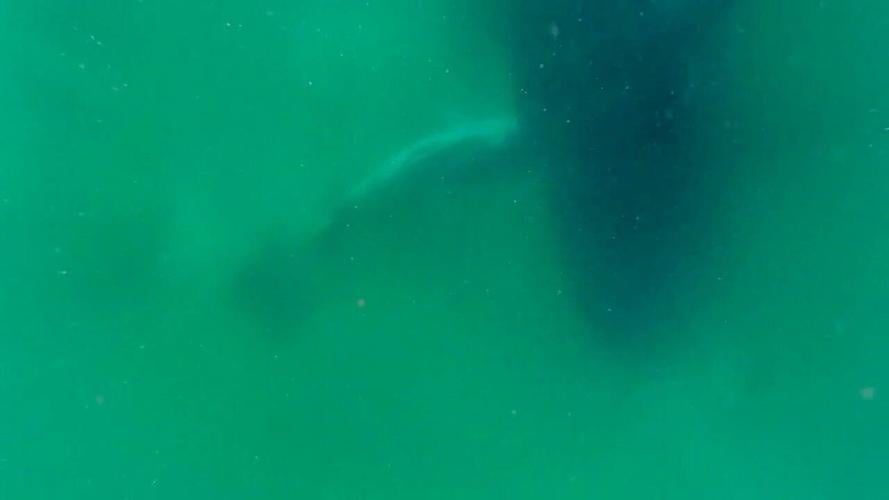

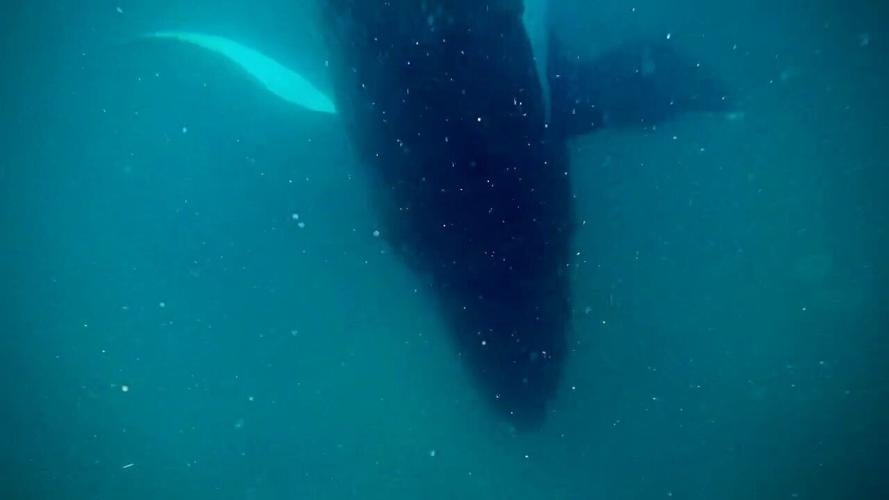
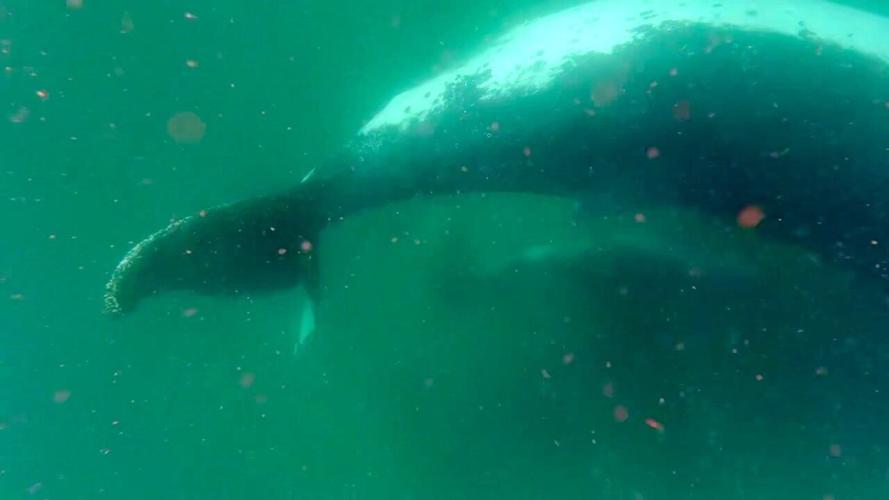
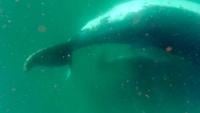
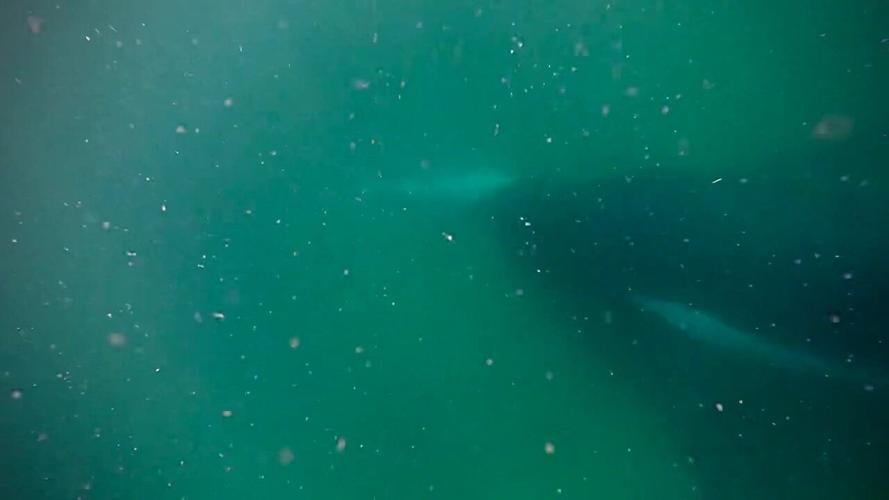


Video grab as a humpback whale has been observed grieving for her stillborn calf. The video, taken in 2025 off the southern Queensland coast in Australia, shows a humpback whale mother returning to the seafloor to her stillborn calf. (Andy Mulville via SWNS)
By Stephen Beech
A humpback whale has been observed grieving for her stillborn calf.
It is the first filmed evidence that baleen whales mourn the loss of a loved one, say ecologists.
The emotional scenes of a female humpback whale, who had given birth to a presumed deceased calf and remained with it for several hours and possibly days, were observed off Australia's southern Gold Coast.
Olaf Meynecke said post-death attentive behavior had been previously documented among toothed whales and dolphins, but not baleen whales such as humpback whales.

(Andy Mulville via SWNS)
Meynecke, of Griffith University, Australia, said: "Unlike reports of toothed whales where mothers have been observed lifting their dead calves to the surface, this humpback whale mother showed prolonged post-mortem behavior and attention towards her deceased calf under the surface.
"She remained close to the calf, maintaining eye contact and positioning herself next to her calf over several hours and maybe even days.






"These observed behaviors were consistent with care-giving or nurturing actions and post-mortem attentive responses documented in socially complex mammals, and indicated an inherent, strong maternal attachment to the calf."
Eyewitness rescue boat Captain Andrew Mulville, of the Sea World Foundation, said: "When I actually worked out what was happening, I was totally surprised.
"At first sight, I thought it was just two whales resting on the surface, but their behavior was unusual.

(Andy Mulville via SWNS)
"It was definitely not what I was expecting to see out at sea that day."
Meynecke said while the 2025 observation, described in the journal Discover Animals, and others involving deceased calves were "incredibly sad," they were rare and added to the limited current understanding of the cognitive and emotional dimensions of death-related responses in whales.
He added: "This case study highlights the need for continued systematic documentation of rare neonatal mortality events to better understand the cognitive, emotional, and evolutionary significance of post-mortem behavior in large whales

(Andy Mulville via SWNS)
"Understanding how non-human animals responded to death provides insight into their emotional lives, social bonds, and cognitive capacities."
(0) comments
Welcome to the discussion.
Log In
Keep it Clean. Please avoid obscene, vulgar, lewd, racist or sexually-oriented language.
PLEASE TURN OFF YOUR CAPS LOCK.
Don't Threaten. Threats of harming another person will not be tolerated.
Be Truthful. Don't knowingly lie about anyone or anything.
Be Nice. No racism, sexism or any sort of -ism that is degrading to another person.
Be Proactive. Use the 'Report' link on each comment to let us know of abusive posts.
Share with Us. We'd love to hear eyewitness accounts, the history behind an article.