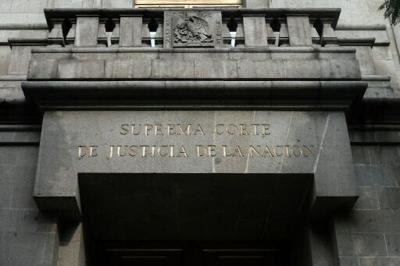

Hugo Aguilar, an Indigenous rights defender and former advisor to the Zapatista guerrilla movement, will be Mexico's first Supreme Court chief justice elected at the ballot box, official results showed Thursday.
The change in the key post, long reserved for elite jurists, follows unprecedented elections on Sunday in which Mexico became the only nation in the world to choose judges at all levels by popular vote.
Aguilar, a constitutional law specialist, is now one of the highest profile Indigenous leaders in Latin America.
During his campaign, he proclaimed "it's our turn" and denounced the "exclusion and abandonment" of native peoples.
Around 20 percent of Mexicans identify as Indigenous.
Aguilar, a member of the Mixtec Indigenous group in his early 50s, was a legal advisor to the now demobilized Zapatistas during negotiations with the government following an armed uprising in 1994.
He has said Mexico's native peoples are owed a "a significant debt," and vowed to wear traditional Indigenous clothing in court instead of a judge's robe.
Aguilar worked at the National Institute of Indigenous Peoples under President Claudia Sheinbaum's predecessor and mentor Andres Manuel Lopez Obrador -- both of whom have criticized what they say is the elite's grip on the judiciary.
He follows in the footsteps of Benito Juarez, Mexico's first Indigenous president who also led the Supreme Court from 1857 to 1858.
- 'Social sensitivity' -
Born in the southern state of Oaxaca, Aguilar was nominated by Sheinbaum's administration, but is not considered as close to the ruling left as some of the other candidates.
"Citizens are fed up with this justice system," Aguilar repeated during the campaign, echoing Lopez Obrador and Sheinbaum's accusation that the judiciary is at the service of political and economic elites.





He has never been a member of a political party or had any experience as a judge, but underscores his 30 years of experience working for marginalized communities.
Sheinbaum praised Aguilar as a "very good lawyer."
"I'm very pleased that the next Supreme Court president is an indigenous Mixtec from Oaxaca," she told a news conference.
"He has extensive knowledge. He's a modest, simple man, but with enormous intelligence and social sensitivity," she added.
The trailblazing judicial elections have been controversial in the Latin American nation.
The overhaul was initiated by Lopez Obrador, who frequently clashed with the Supreme Court over whether his policy changes were unconstitutional.
Despite confusion and low turnout -- with only about 13 percent of eligible voters participating -- Sheinbaum declared the election a success.
Her opponents, however, branded it a "farce" and warned it would consolidate the ruling party's power, as it already dominates both houses of Congress.
The majority of Mexico's Supreme Court justices quit over the judicial reforms last year and declined to stand for election. Their replacements are scheduled to take their seats in September.
The new judges must "set an example to Mexico and the world, that there can be a different justice system that isn't based on interest groups, involving money, on giving to some and not to others," Sheinbaum said.
sem/dr/sms

(0) comments
Welcome to the discussion.
Log In
Keep it Clean. Please avoid obscene, vulgar, lewd, racist or sexually-oriented language.
PLEASE TURN OFF YOUR CAPS LOCK.
Don't Threaten. Threats of harming another person will not be tolerated.
Be Truthful. Don't knowingly lie about anyone or anything.
Be Nice. No racism, sexism or any sort of -ism that is degrading to another person.
Be Proactive. Use the 'Report' link on each comment to let us know of abusive posts.
Share with Us. We'd love to hear eyewitness accounts, the history behind an article.