By Dean Murray
Killer whales appear to be inviting humans for lunch, a new study suggests.
The research investigated unusual occurrences of orcas in four oceans attempting to share prey with people.
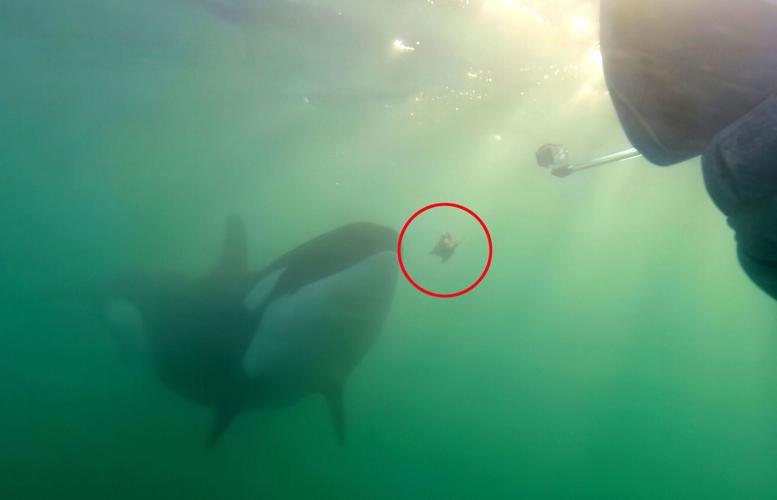
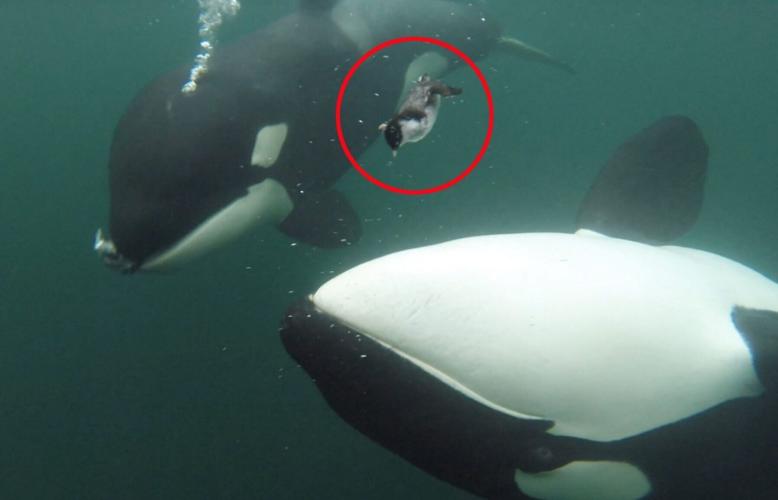
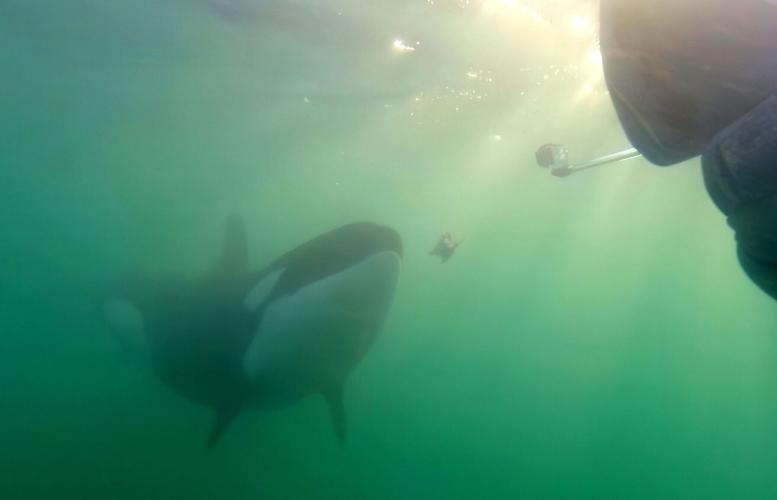
More than 30 cases were documented over two decades where the wild orcas offered people a range of freshly acquired fish, mammals, and even invertebrates. The whales approached people, dropped the item, and awaited a response.
The authors conclude that these cases provide opportunities for orcas to practice learned cultural behavior, explore or play, and in so doing learn about and potentially develop relationships with people.

A killer whale (orca) appears to offer its prey to a human. (Ingrid N. Visser via SWNS)
Having witnessed these events themselves, the authors also provide some ideas about how this behavior might have evolved and the implications of such interactions.






Lead author Jared Towers says: "There appears to be a prosocial element to these cases indicative of interspecific generalised reciprocity,f which is extremely unusual to witness in any non-human animal and is suggestive of evolutionary convergence between orcas and people."
Second author Dr. Ingrid Visser says: "Orcas are very social and we frequently see them food-sharing. To document and describe their behavior of them attempting to food-share with humans in various places around the globe is fascinating."
Third author Vanessa Prigollini says: "Orcas are apex predators that often eat other large mammals, but when it comes to people, they occasionally prefer to share, indicating their interest in building relationships outside their own species."

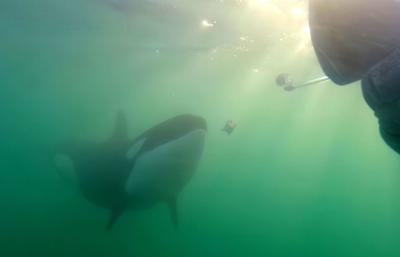
A killer whale (orca) appears to offer its sea bird prey to a human. (Ingrid N. Visser via SWNS)
Ecologist and author Dr. Carl Safina, who was not involved in this study, says: "Of the many and varied minds in the sea, likely the greatest are those of orcas.
"Casual stories of their almost surreal intelligence abound. But here these scientists have systematically gathered an impressive litany of instances where free-living orcas have shown that they possess a ‘theory of mind,’ meaning that their minds understand that humans have minds too.
"After living millions of years in the sea, to them we in our boats must seem like visiting aliens. And indeed, we are strangers in a strange place we hardly know, about which we yet have almost everything to learn."
The study will be published open access on June 30 in the Journal of Comparative Psychology.

(0) comments
Welcome to the discussion.
Log In
Keep it Clean. Please avoid obscene, vulgar, lewd, racist or sexually-oriented language.
PLEASE TURN OFF YOUR CAPS LOCK.
Don't Threaten. Threats of harming another person will not be tolerated.
Be Truthful. Don't knowingly lie about anyone or anything.
Be Nice. No racism, sexism or any sort of -ism that is degrading to another person.
Be Proactive. Use the 'Report' link on each comment to let us know of abusive posts.
Share with Us. We'd love to hear eyewitness accounts, the history behind an article.