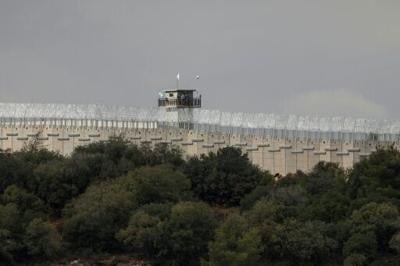

Lebanese and Israeli civilian representatives held their first direct talks in decades on Wednesday under the auspices of a year-old ceasefire monitoring mechanism, though Lebanon's prime minister cautioned that the new diplomatic contact did not amount to broader peace talks.
The two sides met at the UN peacekeeping force's headquarters in Lebanon's Naqura near the border with Israel, where the guarantors of the November 2024 ceasefire between Israel and Hezbollah regularly convene.
Lebanon and Israel have technically been at war since 1948, but Lebanese Prime Minister Nawaf Salam said the new discussions were strictly limited to fully implementing last year's truce.
"We are not yet at peace talks," Salam told journalists, including AFP, on Wednesday.
He said the talks only sought "the cessation of hostilities", the "release of Lebanese hostages" and "the complete Israeli withdrawal" from Lebanon.
Israel has kept up regular air strikes in Lebanon, usually saying it is targeting Hezbollah members and facilities, and it has kept troops in five areas in the south despite the ceasefire's stipulation that it pull out entirely.
Until now, Israel and Lebanon, which have no formal diplomatic relations, had insisted on limiting participation in the ceasefire mechanism to military officers.
"Today's meeting in Lebanon is an initial attempt to establish a basis for a relationship and economic cooperation between Israel and Lebanon. This is a historic development," said Shosh Bedrosian, a spokeswoman for Israeli Prime Minister Netanyahu.
"This is the first step to paving a path with Lebanon and it's clear the Lebanese recognise the economic challenges they are facing."
The ceasefire mechanism is orchestrated by the United States, and also includes the involvement of France and the UN.
The US embassy in Beirut said in a statement that Morgan Ortagus, the US special envoy for Lebanon, also attended Wednesday's meeting.
The United States has been piling pressure on Lebanon to rapidly disarm Hezbollah.
Washington's embassy welcomed the inclusion of the civilian representatives -- former Lebanese ambassador to the US Simon Karam and Israeli National Security Council official Uri Resnick -- in the ceasefire mechanism.
"Their inclusion reflects the Mechanism's commitment to facilitating political and military discussions with the aim of achieving security, stability, and a durable peace for all communities affected by the conflict," it said.
Ortagus was in Jerusalem a day earlier, where she met with Netanyahu and Israeli Foreign Minister Gideon Saar.
The United States has pushed for direct talks between the two neighbours in a bid to stabilise the region and further weaken Iran-backed Hezbollah.




Salam on Wednesday said Lebanon was "open to verification by the mechanism" when it came to its army's efforts to disarm Hezbollah in the country's south.
Lebanon has declared itself ready for negotiations with its southern neighbour.
Netanyahu has repeatedly said Lebanon should join the Abraham Accords, under which a handful of Arab and Muslim countries have normalised ties with Israel.
In 1983, after Israel's invasion of Lebanon, the two countries held direct talks, resulting in the signing of an agreement that would have established relations. It was never ratified.
Salam said on Wednesday that "normalisation will follow peace. It cannot precede peace."
- 'Basis for relationship' -
The new talks came days after the first anniversary of the start of the fragile truce between Israel and Hezbollah.
The ceasefire sought to end over a year of hostilities that erupted after the militant group launched attacks in support of its Palestinian ally Hamas in the wake of the October 7, 2023 attacks on Israel.
Israel has repeatedly bombed Lebanon despite the truce, saying it seeks to stop the group from rebuilding its military capabilities.
Under a government-approved plan, the Lebanese army is set to dismantle Hezbollah's military infrastructure south of the Litani river by the end of the year, before tackling the rest of the country.
Judging the Lebanese efforts insufficient, Israel has ramped up its strikes in recent weeks.
Israeli public broadcaster KAN reported Tuesday that Israel has been preparing for a "significant escalation" with Hezbollah, deemed "inevitable" despite Washington's efforts.
On the anniversary of the truce, the Israeli military said it had carried out around 1,200 "targeted activities" and "eliminated more than 370 terrorists" from Hezbollah, Hamas and other Palestinian groups during the ceasefire.
After his meeting with US envoy Ortagus on Tuesday, Israeli Foreign Minister Saar said on X that they "had a good discussion on the situation in Lebanon".
"I said that the one violating Lebanese sovereignty is Hezbollah. Hezbollah's disarmament is crucial for Lebanon's future and Israel's security," he added.
burs-at/jfx/smw


(0) comments
Welcome to the discussion.
Log In
Keep it Clean. Please avoid obscene, vulgar, lewd, racist or sexually-oriented language.
PLEASE TURN OFF YOUR CAPS LOCK.
Don't Threaten. Threats of harming another person will not be tolerated.
Be Truthful. Don't knowingly lie about anyone or anything.
Be Nice. No racism, sexism or any sort of -ism that is degrading to another person.
Be Proactive. Use the 'Report' link on each comment to let us know of abusive posts.
Share with Us. We'd love to hear eyewitness accounts, the history behind an article.