Every American music road trip follows the same map: Memphis, Tennessee, for the blues, Nashville, Tennessee, for country and New Orleans, Louisiana, for jazz. But serious music travelers know there’s a stop missing. Macon, Georgia, is where Otis Redding, Little Richard and the Allman Brothers didn’t just perform; they were made, and almost nobody puts it on the itinerary.
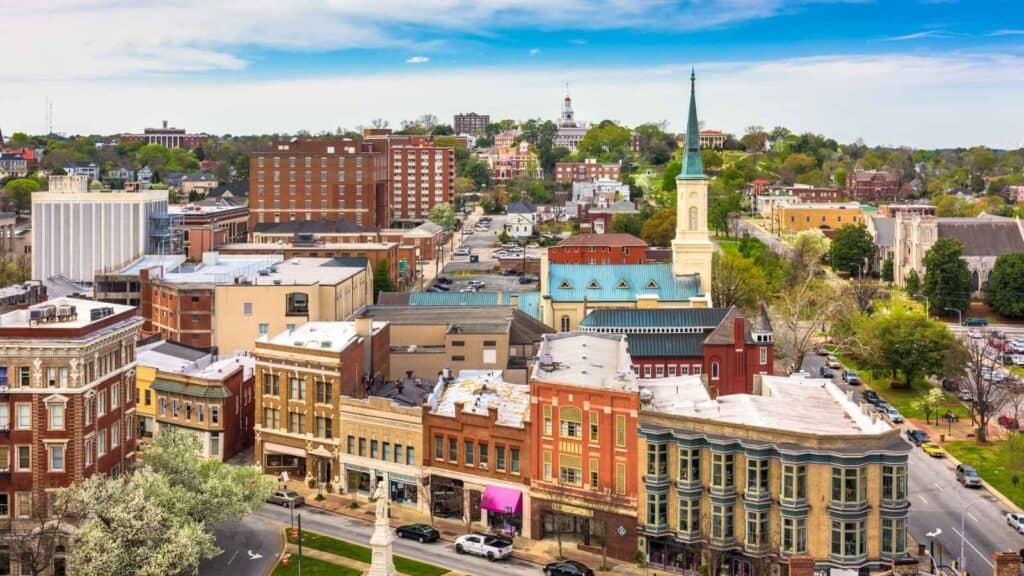
At its peak, Capricorn Records was one of the largest independent labels in the United States. The Charlie Daniels Band, the Marshall Tucker Band and Lynyrd Skynyrd all recorded at Capricorn Sound Studios, and the Allman Brothers signed with Capricorn in 1969 and made Macon their home base. James Brown recorded a demo at a Macon radio station that caught the ear of a King Records talent scout and launched one of the most influential careers in American music history, while Little Richard grew up singing gospel on these streets. What followed was one of the most concentrated outpourings of American music from a single city in a single decade, and almost none of it shows up on the standard road trip itinerary.
Start where the music never stopped
The serious music traveler doesn’t start at a museum. They start at Grant’s Lounge, the brick club on Poplar Street that opened in 1971 and still draws crowds when the Macon Music Revue takes the stage; check the schedule on their website for current dates.
The revue is a preservation band conceived by the Georgia Music Foundation in the spirit of New Orleans’ Preservation Hall Jazz Band, dedicated to keeping the city’s musical DNA alive and audible. Their debut album, recorded at Capricorn Sound Studios and released in August 2025, covers Little Richard, Otis Redding and the Allman Brothers. Standing in Grant’s on a Wednesday, it doesn’t feel like a tribute act. It feels like the city is reminding itself of what it is.
That same spirit drove Brent Cobb to launch the inaugural South of Atlanta festival in 2025, a two-day event that spread across Macon’s most storied venues. The Big House Museum, Capitol Theatre, Capricorn Sound Studios and Grant’s Lounge all hosted performances across the weekend festival. Capitol Theatre itself is worth the visit on its own terms, a beautifully restored historic venue in the heart of downtown that has been drawing audiences since 1920 and today hosts everything from touring acts to community events.
From there, the trail leads to Capricorn Sound Studios itself, revitalized through a project led by Mercer University and recording again since 2019. More than 750 sessions have taken place in those rooms, with Chuck Leavell, Marcus King and Brent Cobb among the artists who have passed through. The studio that helped define Southern rock is once again doing what it was built to do.
The people who made it
The deeper the traveler goes into Macon, the less the city’s musical history feels like history. The Douglass Theatre on Martin Luther King Jr. Boulevard is where a teenage Otis Redding competed in talent shows for the $5 prize. He won 15 consecutive times before the theater barred him from entering. Down on Cotton Avenue, the Otis Redding Museum holds pieces from the family’s personal collection, and the recently opened Otis Redding Center for the Arts has added recording studios, rehearsal spaces and a performance amphitheater to the block his family built.
A few blocks away, the story of Little Richard starts not with a record but with a church. Born in Macon in 1932, he performed as a teenager at what is now the Tic Toc Room, a downtown bar and music venue whose walls carry more than a century of history. He became one of the first 10 inductees to the Rock and Roll Hall of Fame. His childhood home, the Little Richard House, still stands as a community center and historical landmark.
James Brown moved to Macon with his band, recorded a demo at local radio station WIBB that caught the attention of a King Records talent scout, and was signed on the spot. The traveler who walks these blocks with that knowledge stops seeing downtown Macon as a quiet Southern city and starts seeing it for what it actually is: the room where American music was written.





Where the scene ate and slept
The Allman Brothers didn’t just record in Macon. They lived here, and the city fed them. H&H Restaurant on Cotton Avenue has been serving soul food since 1959, founded by Inez Hill and Louise Hudson. When the Allman Brothers were broke and hungry in the early years, Mama Louise fed them anyway. The friendship lasted decades. She rode the tour bus in 1972. H&H closed for a stretch after Mama Hill passed, reopened in 2014, and still serves the same cooking that made it a Macon institution.
The Rookery has been on Cherry Street since the late 1970s, when Capricorn was pressing records and the city was at its commercial peak. The Allman Burger is still on the menu. So are the hand-spun milkshakes.
For dinner, Downtown Grill occupies a space layered with music lore. Local lore holds that Gregg Allman proposed to Cher at a predecessor restaurant on the same site, and that musicians and celebrities moved through these rooms for decades. Today, it runs as an upscale steakhouse with prime Black Angus and an extensive wine list. The traveler who wants to keep the night going heads to The Monkey’s Paw Tiki Lounge, a reservation-only rum bar with a speakeasy atmosphere, a short walk away.
Where to stay and what to see
Hotel Forty Five is the first boutique hotel in Macon’s Historic Central Business District, situated in the heart of downtown on Cotton Avenue. The property takes its name from the street’s 45-degree angle through the city grid, and the music history carries through to the Hightales rooftop bar, where the cocktail list reads like a setlist from the Capricorn years.
No visit ends without The Big House Museum on Vineville Avenue, the Tudor home where the Allman Brothers and their extended circle lived from 1970 to 1973. The museum houses what it describes as the world’s largest collection of Allman Brothers Band memorabilia. Dickey Betts wrote Blue Sky in the living room and Ramblin’ Man in the kitchen. The serious music traveler stands in those rooms and understands, finally, why Macon belongs on the map.
The road trip stop that reframes everything
Memphis and Nashville deserve their place. But a road trip that skips Macon skips the city where some of the most important music in American history was not performed for tourists but actually made in studios, talent shows, church pews and kitchens. That story is still here, still intact and more alive than it has been in decades.
Jennifer Allen is a retired chef turned traveler, cookbook author and nationally syndicated journalist; she’s also a co-founder of Food Drink Life, where she shares expert travel tips, cruise insights and luxury destination guides. A recognized cruise expert with a deep passion for high-end experiences and off-the-beaten-path destinations, Jennifer explores the world with curiosity, depth and a storyteller’s perspective. Her articles are regularly featured on the Associated Press Wire, The Washington Post, Seattle Times, MSN and more.
The post Macon, Georgia, has one of the great American music stories, and almost no one makes the trip appeared first on Food Drink Life.

(0) comments
Welcome to the discussion.
Log In
Keep it Clean. Please avoid obscene, vulgar, lewd, racist or sexually-oriented language.
PLEASE TURN OFF YOUR CAPS LOCK.
Don't Threaten. Threats of harming another person will not be tolerated.
Be Truthful. Don't knowingly lie about anyone or anything.
Be Nice. No racism, sexism or any sort of -ism that is degrading to another person.
Be Proactive. Use the 'Report' link on each comment to let us know of abusive posts.
Share with Us. We'd love to hear eyewitness accounts, the history behind an article.