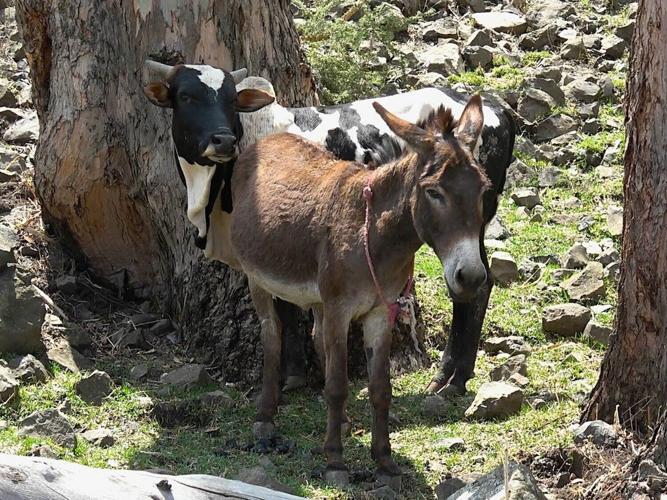
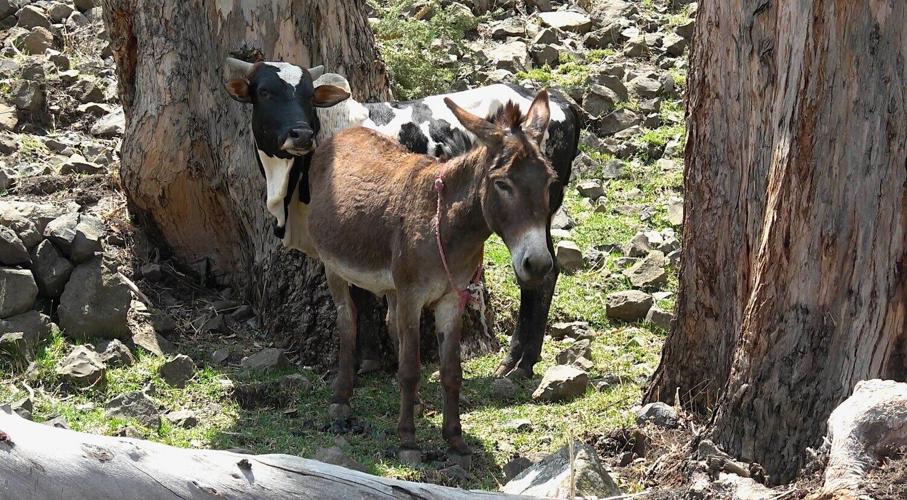
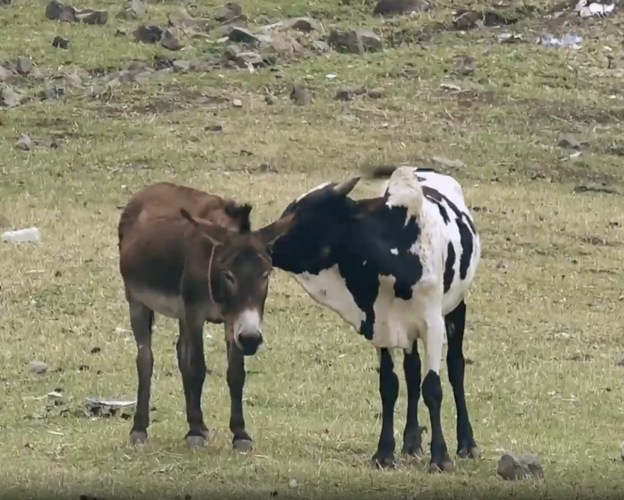
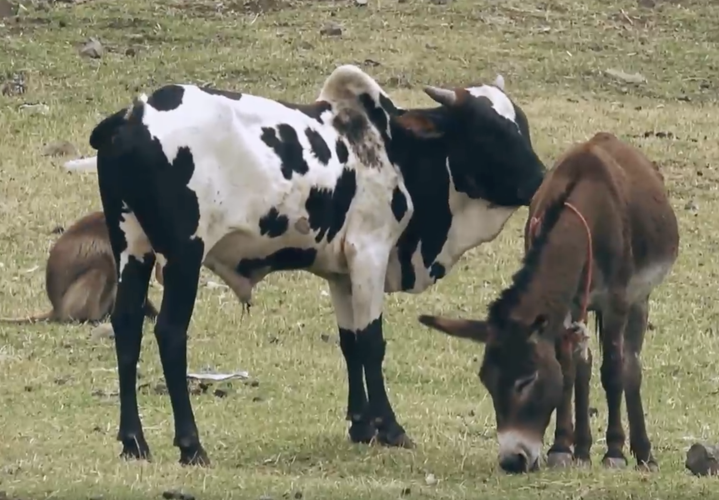
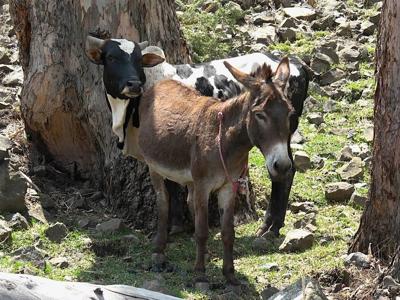

Achille the bull standing with Patroclo the donkey in between two trees. (André B. da Cruz via SWNS)
By Stephen Beech
A bull and a male donkey have developed an “unusual” sexual bond.
Scientists working on a project in Ethiopia witnessed firsthand how the bull, called Achille, and Patroclo, the donkey, became more than just friends.
The unlikely couple often licked, rubbed and nuzzled each other as well as having intercourse, according to a new study.
Experts say same-sex sexual relationships are widespread in nature, but such relationships involving two different species are not.
The new study, published in the journal Current Biology, described the ongoing sexual relationship between Achille and Patroclo.

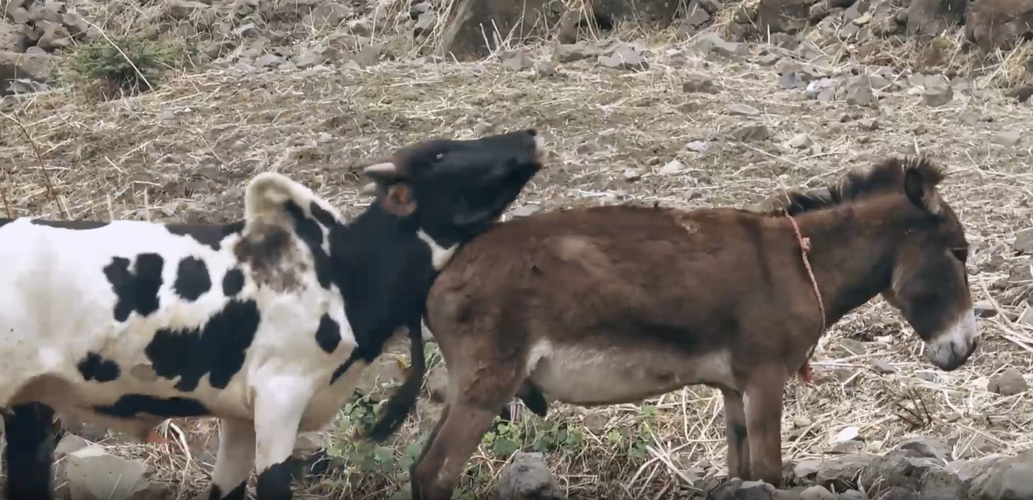
Achille nuzzles Patroclo in a field. (André B. da Cruz via SWNS)
While the two males could have easily chosen partners of the same species and opposite sex, researchers say they continued to choose each other — even though they belonged to different owners and only saw one another during time in the pasture.
Elisabetta Palagi, of the Università di Pisa (UNIPI) in Italy, said: “The sexual interactions between Achille, the bull, and Patroclo, the male donkey, were not isolated events.
“What really caught our attention was that these interactions were embedded in a very selective and consistent social relationship between the two individuals.”
The researchers first witnessed the interactions between the two animals while in the field conducting another study.
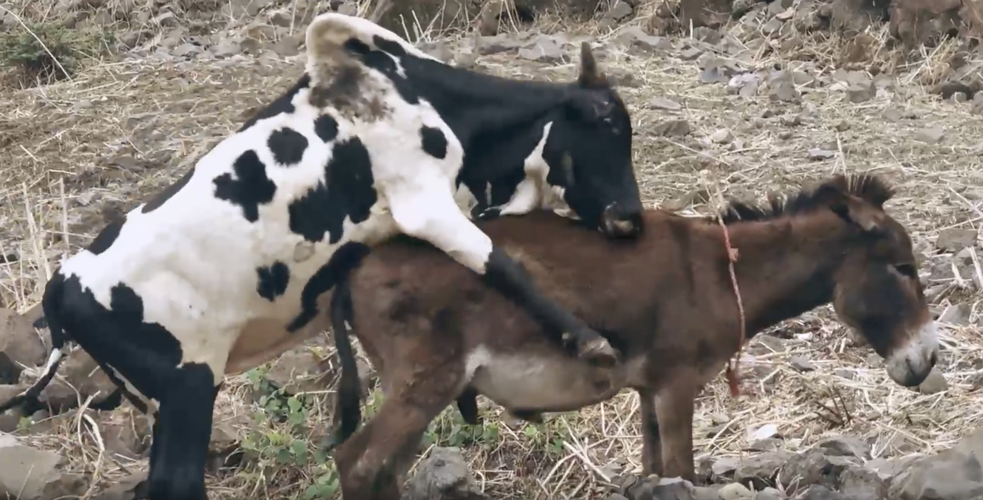
They observed Achille mounting Patroclo and were surprised to see that Patroclo didn’t try to avoid Achille, kick him or show any defensive reaction at all.

Achille and Potroclo having intercourse. (André B. da Cruz via SWNS)
It prompted them to look at the relationship systematically.
Study co-author André da Cruz, a Ph.D. student at UNIPI, said: “They repeatedly chose to stay close to each other and engaged in many different affiliative behaviors, such as licking, rubbing and nuzzling, alongside the repeated mounting behavior.
“Importantly, this was happening in a social environment where both animals had access to other potential partners, including individuals of both sexes and of their own species.”





The researchers recorded all interactions they witnessed involving either Achille or Patroclo.
In total, they saw 51 mountings between the male bull and donkey from March 6 to March 19 this year.
During that time, Patroclo often presented his hindquarters to Achille and nipped him.

The two are often seen close by each other's side. (André B. da Cruz via SWNS)
The researchers described how animals repeatedly directed most of their social and sexual interactions toward each other, with no indication from either that they wished to discourage those advances.
They say Achille mounted another male donkey only twice, and that other male showed “clear avoidance” behaviors and threatening expressions, such as flattened ears.
Study lead author Martina Francesconi, a Ph.D. student at UNIPI, said: “We believe the key finding is not simply that a bull mounted a male donkey.
“It is that this unusual sexual behavior was part of a broader, selective social relationship.
“Our observations suggest that it cannot be easily explained simply by a lack of alternative mating opportunities, although we cannot say from this study exactly what function these sexual interactions may have had.”

(André B. da Cruz via SWNS)
The researchers say that their observations have broader implications for understanding sexual behavior as a “complex social trait” beyond its role in reproduction.
Palagi said: “For us, a major question for future research is what mechanisms, and possibly what benefits, might underlie these interactions.
“Are they mainly related to social bonding? Could they play a role in maintaining relationships or reducing tension? Or do they emerge from a combination of social and sexual motivations?
“We think that comparative research across species with different social systems could help us distinguish between these possibilities.”
She added: “More broadly, we would like to better understand how social relationships shape sexual behavior and how behavioral flexibility allows animals to navigate complex social environments.
“We see this study as a starting point for asking these broader questions.”
(0) comments
Welcome to the discussion.
Log In
Keep it Clean. Please avoid obscene, vulgar, lewd, racist or sexually-oriented language.
PLEASE TURN OFF YOUR CAPS LOCK.
Don't Threaten. Threats of harming another person will not be tolerated.
Be Truthful. Don't knowingly lie about anyone or anything.
Be Nice. No racism, sexism or any sort of -ism that is degrading to another person.
Be Proactive. Use the 'Report' link on each comment to let us know of abusive posts.
Share with Us. We'd love to hear eyewitness accounts, the history behind an article.