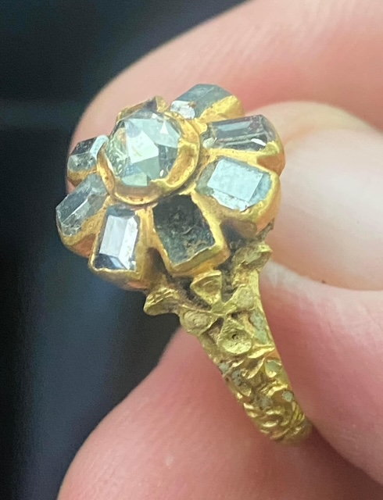
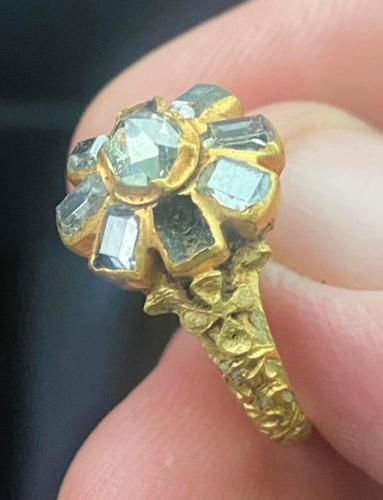
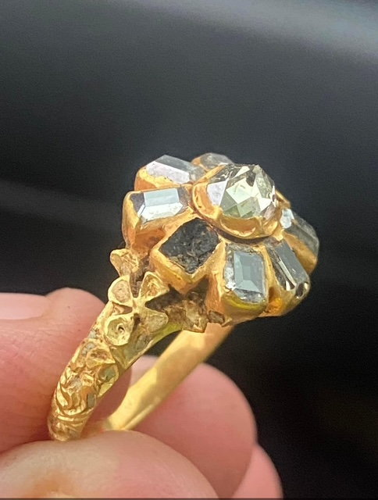
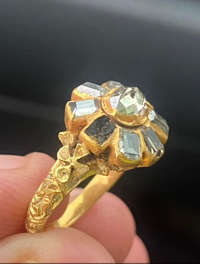



The 16th-century ring is expected to fetch up to $25,000 at Noonans of Mayfair on June 23.
By Filipa Gaspar
A metal detectorist has unearthed a 16th-century ring with eight diamonds — set to fetch up to $25,000 at an auction.
Stuart Jones uncovered the stunning "once in a lifetime find" in the village of Wormington, Gloucestershire.
The ring is expected to attract bids of between $18,750 and $25,000 at Noonans of Mayfair on June 23.

Stuart said the find came toward the end of a seven-hour day of searching.
He said: "When I recovered the ring, I was absolutely overwhelmed with joy. I was over the moon. Everyone around me was congratulating me and taking photographs.
"Without any doubt, the ring is the best find I have ever made.
"I describe it as my “once in a lifetime find”. Like many detectorists, I have always dreamed of finding something truly special, but I never imagined I would discover an item of this significance.
"I know I may never find anything that surpasses this discovery, but that is part of what makes it so special.





"Whatever happens at auction, finding the ring has already been an unforgettable experience and a moment that I will treasure for the rest of my life."
As he pulled the ring from the soil, one diamond came loose and fell into his hand and a second jewel was also missing.

Stuart Jones and the 16th-century ring. (Stuart Jones / Noonans via SWNS)
He gathered the soil around the spot where he uncovered the ring, washed and sieved the retrieved soil and found the missing diamond.
The proceeds of the auction will be shared equally with the landowner, and the ring was examined by the British Museum.
Laura Smith, jewelry specialist at Noonans, said: "Early 17th century baroque taste required grand rings to make an impression from a distance.
"Fashions in diamond rings moved from solitaires toward groups of small stones arranged in decorative patterns: rosettes, pansies, crosses, fleur-de-lys, etc.
"This ring has a flowerhead bezel composed of a cluster of eight ‘hogback’ diamonds (which is very rare), although two are loose."
"According to a PMI test on the XRF Analyzer, the gold is testing as 19.2ct.
''This exact gold standard was set by Edward I in 1,300; goldsmiths were forbidden to work gold of less than “the Touch of Paris”, being 80% pure gold (or 19.2ct)."

(0) comments
Welcome to the discussion.
Log In
Keep it Clean. Please avoid obscene, vulgar, lewd, racist or sexually-oriented language.
PLEASE TURN OFF YOUR CAPS LOCK.
Don't Threaten. Threats of harming another person will not be tolerated.
Be Truthful. Don't knowingly lie about anyone or anything.
Be Nice. No racism, sexism or any sort of -ism that is degrading to another person.
Be Proactive. Use the 'Report' link on each comment to let us know of abusive posts.
Share with Us. We'd love to hear eyewitness accounts, the history behind an article.