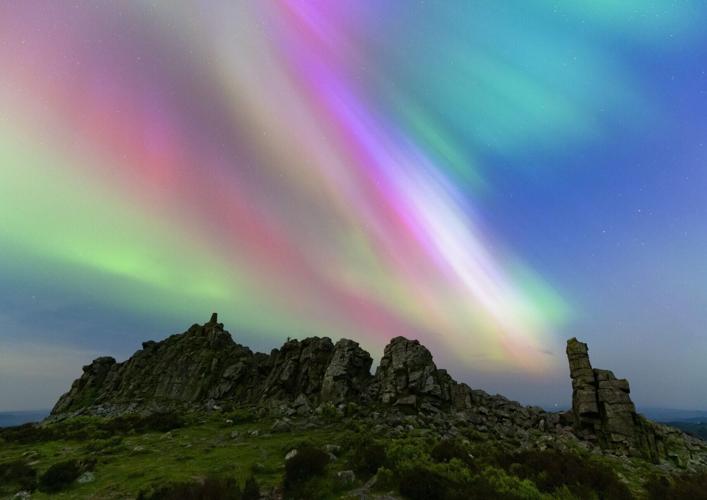


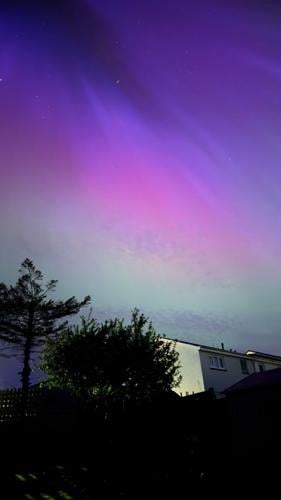
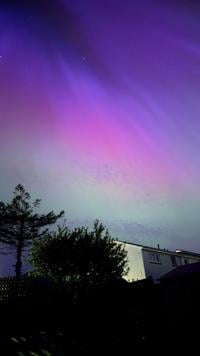

The northern lights above Manstone Rock on the Stiperstones in Shropshire on March 10 2024. (John Hayward via SWNS))
By Stephen Beech
The most powerful Northern Lights in a generation "exposed weaknesses" in the U.K.'s infrastructure, experts have warned.
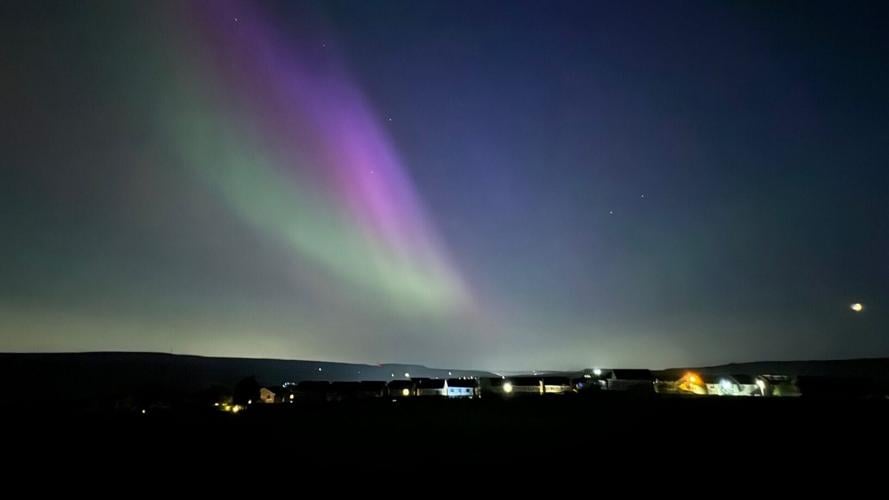
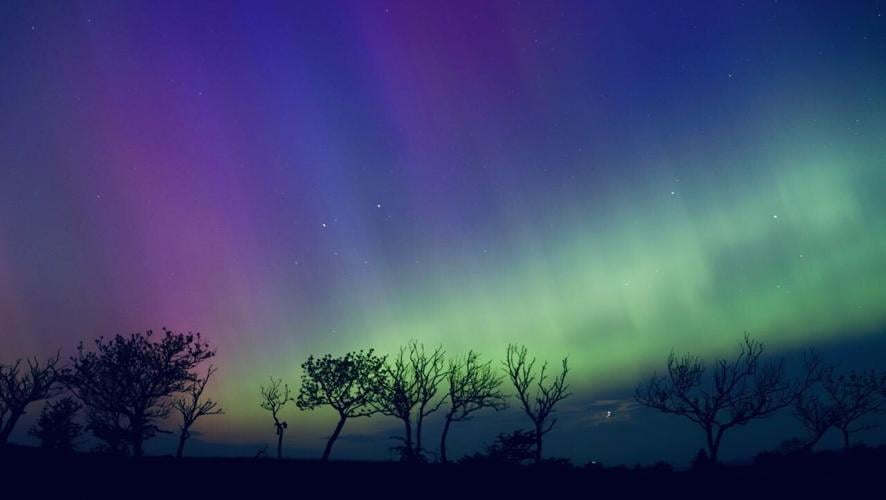
Millions of people nationwide enjoyed the spectacular natural wonder, also known as aurora borealis, that lit up the night sky in May 2024.
While the display captivated many, the geomagnetic storm behind it served as the biggest test in a generation of the U.K.'s preparedness for severe space weather.
And scientists from the Space Environment Impacts Expert Group (SEIEG) identified "multiple" infrastructure threats that the storm exposed.
Now, they have made 14 recommendations to better protect British electricity supplies, satellites, aviation and other critical infrastructure from future space weather events.
The May 2024 storm reached G5 — the highest category on the U.S. National Oceanic and Atmospheric Administration's (NOAA) geomagnetic storm scale.
The storm's strength came from the combined effects of five successive coronal mass ejections striking Earth one after the other over the course of two days.
While that specific storm caused relatively minor disruption in the U.K., experts say it highlighted "large gaps" in the country's resilience to more severe events.

Aurora over Bacup Rossendale, Lancashire, on May 10 2024. (Michael Almond via SWNS)
The team's recommendations include better monitoring of the electricity grid, strengthening satellite operations, enhancing aviation preparedness and developing more accurate space weather forecasts.
The group's findings were presented at the Royal Astronomical Society's National Astronomy Meeting in Birmingham by SEIEG Chair Richard Horne.
Horne, of the British Antarctic Survey, said: "The Northern Lights were the most visible sign of the May 2024 storm, but they were only one part of a much broader space weather event that tested the UK's critical infrastructure.
"The storm highlighted where we need better monitoring, better forecasting and more research so we're prepared for a more severe event in the future."
The recommendations were submitted to the government and are now under consideration.
The May 2024 storm was estimated to be about a one-in-13-year event.






By comparison, a Carrington-class event on the scale of the great solar storm of 1859 has an estimated 1% chance of occurring in any given year, making even more severe space weather a realistic future risk.
Horne said one of the key concerns is the electricity network.

(Photo by Ronan B via Pexels)
Geomagnetic storms can drive electrical currents through power transmission systems, potentially damaging transformers and disrupting electricity supplies.
Horne said: "During the May 2024 event, computer models suggested currents exceeded 50 amps at several substations, with a peak of around 68 amps.
"However, because there are currently no instruments measuring these currents anywhere in England or Wales, those estimates cannot even be checked."
The team recommends the deployment of a network of geomagnetically induced current monitors across England and Wales to determine how much current different transformer types can safely withstand.
They noted that New Zealand, which experiences comparable space weather conditions because it sits at a similar geomagnetic latitude as the U.K. in the opposite hemisphere, already monitors more than 80 transformer sites and successfully used its mitigation plans during the May 2024 storm.
Horne said the storm also highlighted growing challenges in Earth's increasingly crowded low-Earth orbit.

(Photo by beinspiredbymyview via Pexels)
Almost 5,000 satellites carried out maneuvers during the storm, compared with about 300 before it began, while U.K.-licensed satellites experienced a 35% increase in collision warnings.
Horne says more work is needed to understand how severe space weather could increase the risk of collisions and cascading debris events when satellite collisions create debris that can trigger further collisions.
The team also called for improved forecasting of coronal mass ejections and solar energetic particle events, with a long-term goal of providing reliable forecasts of severe geomagnetic storms two to three hours before they strike Earth.
Better warnings would allow operators of power grids, satellites and aircraft to take action before the worst impacts occur.
Horne added: "One of the biggest lessons from the May 2024 storm is that we still have important gaps in our monitoring and understanding of how severe space weather could affect UK infrastructure.
"We were fortunate that this was not a one-in-100-year event.
"We now have an opportunity to strengthen our monitoring, improve our forecasts and make sure the UK is better prepared before a much larger storm occurs."

(0) comments
Welcome to the discussion.
Log In
Keep it Clean. Please avoid obscene, vulgar, lewd, racist or sexually-oriented language.
PLEASE TURN OFF YOUR CAPS LOCK.
Don't Threaten. Threats of harming another person will not be tolerated.
Be Truthful. Don't knowingly lie about anyone or anything.
Be Nice. No racism, sexism or any sort of -ism that is degrading to another person.
Be Proactive. Use the 'Report' link on each comment to let us know of abusive posts.
Share with Us. We'd love to hear eyewitness accounts, the history behind an article.