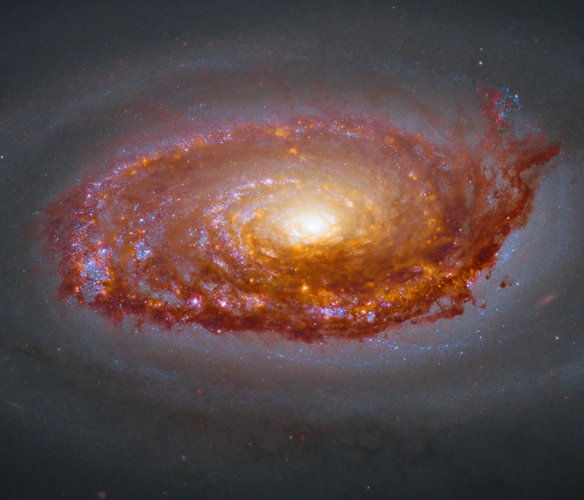
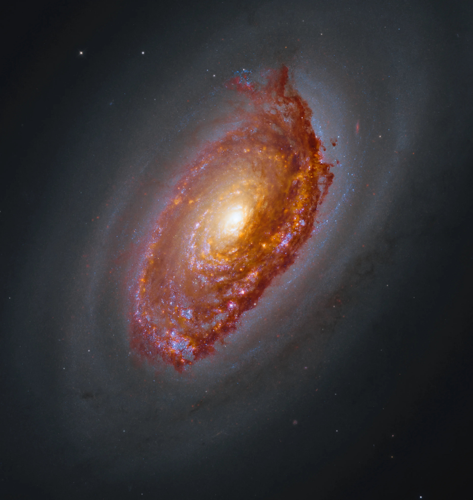

Messier 64 is also known as the "Black Eye Galaxy." (NASA/CSA/ESA et al. via SWNS)
By Dean Murray
Space scientists have shown off a new view of the so-called "Black Eye Galaxy."
NASA said the March 20 image shows Messier 64, which earns its nickname because of a dark band of absorbing dust in front of its eye-like bright nucleus.
The composite view was captured by NASA’s Hubble Space Telescope and James Webb Space Telescope.





(NASA/CSA/ESA et al. via SWNS)
NASA's Webb Telescope Team said Friday, June 12: "It shows Messier 64 captured at near- and mid-infrared wavelengths by Webb, while Hubble’s image shows the galaxy in ultraviolet, visible, and near-infrared light."
They add: "Messier 64 is characterized by its bizarre internal motion. The gas in the outer regions of this spiral galaxy is rotating in the opposite direction from the gas and stars in its inner regions.
"This strange behavior may be the result of a merger between M64 and a satellite galaxy over a billion years ago."

(0) comments
Welcome to the discussion.
Log In
Keep it Clean. Please avoid obscene, vulgar, lewd, racist or sexually-oriented language.
PLEASE TURN OFF YOUR CAPS LOCK.
Don't Threaten. Threats of harming another person will not be tolerated.
Be Truthful. Don't knowingly lie about anyone or anything.
Be Nice. No racism, sexism or any sort of -ism that is degrading to another person.
Be Proactive. Use the 'Report' link on each comment to let us know of abusive posts.
Share with Us. We'd love to hear eyewitness accounts, the history behind an article.