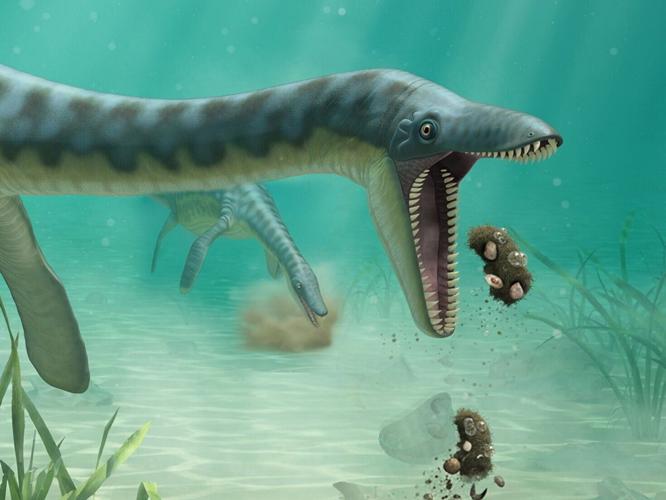

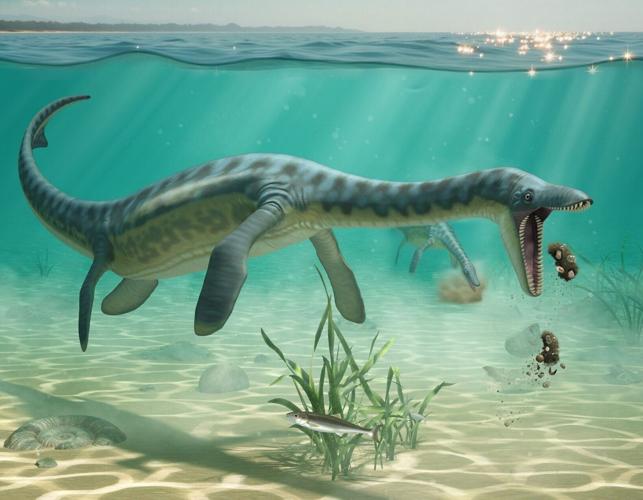
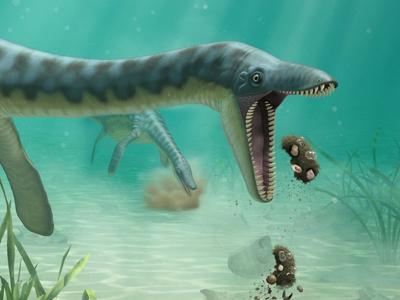

Artist's impression of plesiosaurs feeding on the sea floor [AI-assisted image]. (Lente Artemieff via SWNS)
By Stephen Beech
Queasy sea monsters swam to shore to vomit, reveals new research.
Plesiosaurs headed up river deltas 160 million years ago to throw up shells and other indigestible parts of their marine meals, suggests the study of Jurassic fossils.
Their behavior at the time dinosaurs roamed the Earth resembles that of today's fur seals and marine crocodiles, say scientists.
Previous research into plesiosaur anatomy and movement suggests the iconic long-necked marine reptile angled its head down to collect shellfish from the seafloor.
It is believed that they couldn't crush shells or other skeletal material with their teeth, so their stomachs compacted it to be vomited as pellets, as animals including owls do today.
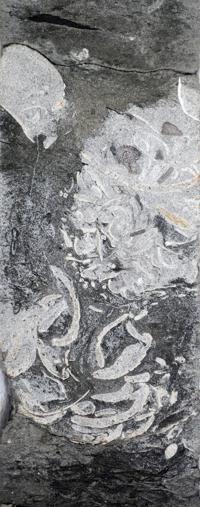
Paleontologist Dirk Knaust identified the fossilized remains of plesiosaur vomit pellets in what would have been the shallow waters of river deltas, 30 miles off the Norwegian coast.
The shellfish, which Knaust identified in the vomit, needed the kind of steady salt levels found in the open ocean to survive.
But Knaust discovered that the vomit was deposited in a river delta in which incoming freshwater would have continually changed the salt levels, making it impossible for the sensitive creatures to live there.
His detailed analysis of more than 20 regurgitalites — clumps of fossilized vomit ranging in size from a walnut to a mango — was published in Geological Magazine.
Knaust concluded that plesiosaurs must have eaten the shellfish from the seafloor in deeper water before swimming to shore to vomit up the indigestible parts.

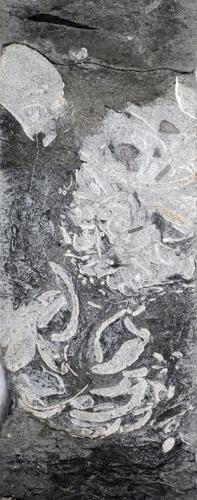
Drill core image of 160-million-year-old delta sand containing a clump of shells and plant remains, interpreted as plesiosaur vomit. (Dirk Knaust via SWNS)
He said: "There has been a lot of research into fossilized vomit over the last decade but most of it has focused on vertebrates eating other vertebrates.
"This is the first time that plesiosaur vomit, and the shellfish in it, have been identified, and these creatures tell us a great deal."
Over the last three decades, Knaust — a specialist in the fossil traces left by invertebrates — has analyzed several thousand meters of drill core samples taken from the North Sea wells operated by his employer, the Norwegian energy company Equinor ASA.
The vomit fossils he studied mainly come from the development of a subsea storage site for carbon dioxide in the vicinity of the Troll gas and oil field.
Knaust said: "Plesiosaurs may have come close to shore to relax or sleep after hunting, and that's likely when they vomited.
"We see fur seals and marine crocodiles doing something similar today but while they go onto land, plesiosaurs probably remained submerged due to their weight and shape.
"This vomit survived partly because it was so compacted and covered in mucus.
"Even so, most pellets would have been completely broken up by the waves and tides.
"Some clusters were, however, quickly covered by sediment arriving from the rivers, and some ended up in burrows left by crustaceans on the seafloor, where they were partially preserved and fossilized."






He was excited to find a bone and coprolites — fossilized feces — just a few inches from the fossilized vomit in one core.
Knaust said: "This was quite spectacular.
"To begin with, I thought it was a dinosaur bone but when we looked at the CT scan we realized, no, it must be from an ichthyosaur – a group of marine reptiles similar to but unrelated to dolphins.

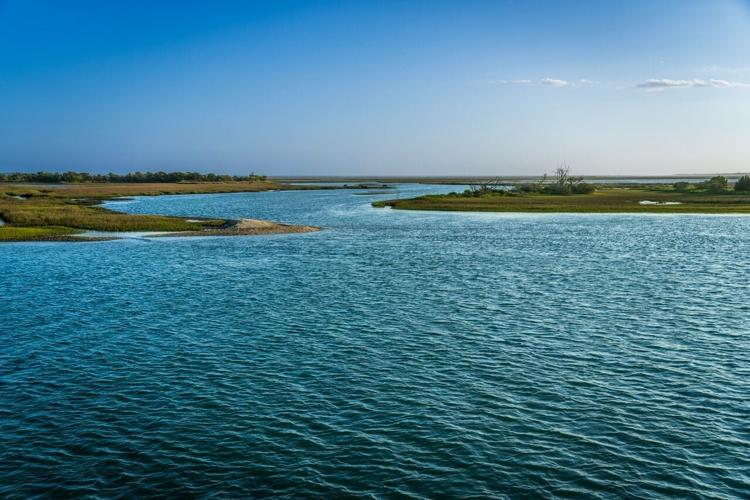
(Photo by Mark Stebnicki via Pexels)
"So then I thought the vomit and feces might have belonged to an ichthyosaur, but it wasn't that simple. There were many other marine animals to consider, and the composition of their vomit differs."
Knaust explained that he could distinguish vomit from feces due to the higher amount of undigested food remains in the vomit specimens, their scattered and irregular shape, and their distinctive mineralogy.
He identified bivalve shells and serpulid shells as well as belemnites, the hard parts of squid-like cephalopods.
The mix pointed to an animal specialized to eat hard-shelled and exoskeleton prey on the seafloor.
The culprit also had to be large enough to allow it to vomit clumps up to 10 centimeters (3.9 inches) or more in size.
Knaust believes one of the coprolites found near the vomit and ichthyosaur bone came from a crocodile.
However, Jurassic sharks and crocodiles hunted fish rather than eating shellfish from the seafloor; and Knaust didn't find any evidence of fish skeletons in the fossilized vomit.
He said: "The plesiosaur most closely matches the size and feeding profile of the vomit producer."
He explained that plesiosaurs could measure anything up to 13 meters (42.6 feet) in length and were some of the most successful marine reptiles to have ever lived.
They survived for more than 140 million years through several extinction events.
The cryptoclidid plesiosaurs, which Knaust holds responsible for the vomit, grew up to eight meters (26.2 feet) long and lived between the Middle Jurassic to the Early Cretaceous , around 174 to 100.5 million years ago.
Plesiosaur skeletons have been found all over the world, but the U.K. is a particular hotspot.
Knaust, who often searches for fossils on England's Jurassic Coast, believes that plesiosaurs could have displayed the same behavior around Britain, as well as other coastlines.
In Jurassic time, he said the location of the well where the fossils were collected and the outcrops of rock along coastal cliffs in southern England belonged to the same narrow sea, similar to the North Sea today.
Knaust added: "The plesiosaur is such a fascinating animal.
"These findings add to other kinds of evidence that help us to understand their abilities and behavior.
"And this is still just the beginning. There's so much more we can learn from picking through what extinct animals threw up after dinner."
(0) comments
Welcome to the discussion.
Log In
Keep it Clean. Please avoid obscene, vulgar, lewd, racist or sexually-oriented language.
PLEASE TURN OFF YOUR CAPS LOCK.
Don't Threaten. Threats of harming another person will not be tolerated.
Be Truthful. Don't knowingly lie about anyone or anything.
Be Nice. No racism, sexism or any sort of -ism that is degrading to another person.
Be Proactive. Use the 'Report' link on each comment to let us know of abusive posts.
Share with Us. We'd love to hear eyewitness accounts, the history behind an article.