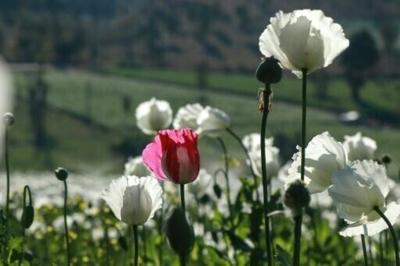
Myanmar's opium poppy cultivation has hit a decade-record level, the United Nations said Wednesday, with early indications its heroin output is now being trafficked to Western markets.
War-ravaged Myanmar is a hive of black market activity ranging from illegal mining to internet scamming and the manufacture of illicit drugs like methamphetamine and heroin.
The nation has long ranked among the world's top opium poppy producers, claiming the top spot after a 2022 Taliban government crackdown crushed the trade in Afghanistan.
Analysts say illicit activities are key income sources funding the civil war which has racked Myanmar since the military snatched power in a 2021 coup.
This year, opium poppies were farmed on more than 53,000 hectares (131,000 acres) of Myanmar's soil, a UN Office on Drugs and Crime (UNODC) report said, recording the largest territory since 2015.
The agency's yearly Myanmar Opium Survey said after the Afghanistan crackdown "there are emerging signs that heroin trafficked from Southeast Asia reaches markets traditionally not supplied from the region".
It cited a cumulative 60-kilogram (132-pound) haul of suspected Myanmar-origin heroin seized from airline passengers travelling from Thailand to the European Union in 2024 and early 2025.
While the scale is "not yet significant, the changed environment could encourage more cultivation and production of opium in Myanmar", it said.





Opium poppies were farmed extensively across Myanmar well before the country's civil war.
But monitors say the conflict has supercharged black markets -- with a weak central government, industrial infrastructure destroyed by fighting and soaring poverty spiking desperation.
Myanmar's junta has waged offensives this year ahead of an election slated to start on December 28 -- a vote dismissed by many observers as a ploy to disguise continuing military rule.
The UNODC report said while instability drives farmers towards tending opium poppy, "intensifying conflict and insecurity make it more difficult for them to care for their fields".
"Conflict acts as a two-way for the drug economy," said Inshik Sim, lead analyst at the UNODC, at a press conference in Bangkok, noting that opium poppy cultivation was one way both farmers and armed groups could make money during the war.
"But at the same time, conflict itself can disrupt... cultivation," he added, citing factors such as labour shortages and limited access to fertilizer.
While opium poppy farms had expanded in size by 17 percent from 2024, the report noted that this year's yield was largely static at around 1,000 tonnes.
jts-sjc/sco/jm


(0) comments
Welcome to the discussion.
Log In
Keep it Clean. Please avoid obscene, vulgar, lewd, racist or sexually-oriented language.
PLEASE TURN OFF YOUR CAPS LOCK.
Don't Threaten. Threats of harming another person will not be tolerated.
Be Truthful. Don't knowingly lie about anyone or anything.
Be Nice. No racism, sexism or any sort of -ism that is degrading to another person.
Be Proactive. Use the 'Report' link on each comment to let us know of abusive posts.
Share with Us. We'd love to hear eyewitness accounts, the history behind an article.