

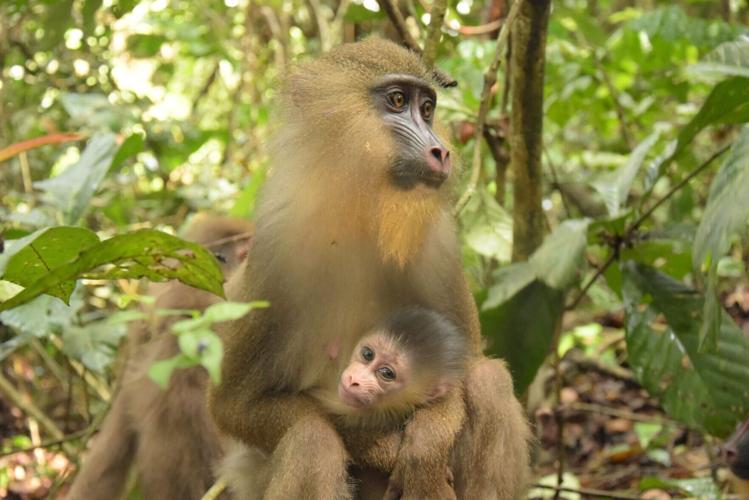








A female mandrill with her three-week-old infant in the Gabonese rainforest. (Berta Roura-Torres via SWNS)
By Stephen Beech
Pregnant monkeys are more likely to miscarry when also nursing an infant, reveals new research.
Infant tantrums also increased the risk of mandrills losing an unborn baby, according to the findings of the 11-year observational study.
But females who experienced fetal loss tended to conceive again sooner and produced more surviving offspring overall, compared with mothers whose babies died soon after birth.
Scientists explained that pregnancy and nursing are “physically demanding” tasks, so female mammals must allocate their resources carefully to maximize their reproductive success.
When a pregnant female is simultaneously nursing an infant, it creates a “trade-off” between the needs of their current offspring and their developing fetus.
To investigate how females adapt to the conflicting physiological demands, an international research team observed the behavior and reproductive lives of a wild population of mandrill monkeys in Gabon.

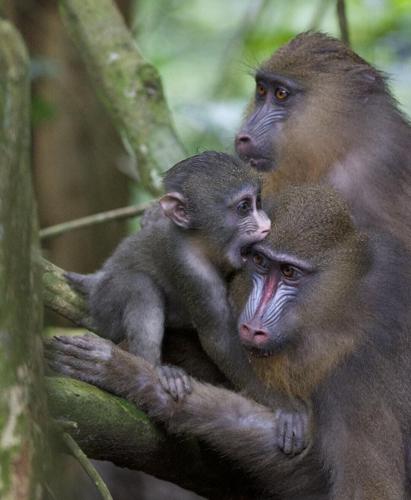
A mandrill mother with her dependent infant nibbling at her eyebrow, while her older daughter looks on from behindÂa snapshot of the competing demands of motherhood. (Michel Halbwax via SWNS)
Mandrills breed seasonally and females usually conceive every other year, but can sometimes become pregnant again while still caring for an infant.
Pregnant female mandrills have visible swellings, enabling the research team to record both successful and failed pregnancies.
During the 11-year study, they observed 356 pregnancies across 117 females, involving 52 instances of fetal loss.
Fetal loss was more common in females that were simultaneously caring for an infant, according to the findigs published in the journal PLOS Biology.





Females were also more likely to experience fetal loss when their infant threw more “tantrums” — characterized by distinctive distress vocalizations, or when there were more alpha male takeovers in their social group during the pregnancy.

Dr. Charpentier, founder and co-director of the Mandrillus Project, and Dr. Roura-Torres, former PhD in the project and author of the study, observe mandrills in the dense rainforest of southern Gabon. (Alice Baniel via SWNS)
However, females who experienced fetal loss tended to conceive again sooner, and produced more surviving offspring overall, compared with females whose infants died soon after birth.
In the long term, females that lost a pregnancy produced a similar number of surviving offspring as females that had not.
The research team says their findings suggest that fetal loss may be a physiological response to the extra energetic demands of simultaneous pregnancy and nursing, enabling mothers to focus on the survival of their current offspring.
It may also reduce the physical costs to the mother when she is unable to sustain a pregnancy, enabling her to reproduce again sooner once her current offspring has reached independence.
The researchers say the correlation between alpha male changeover and fetal loss could represent an adaptation to the increased risk of infanticide by new alpha males, or may reflect increased stress for females during times of social upheaval.

A female mandrill nurses her infant while resting, surrounded by lush vegetation. (Berta Roura-Torres via SWNS)
Study first author Nikolaos Smit said: “We combined 11 years of reproductive histories with non-invasive observations of pregnancy and detailed behavioral observations of mothers and infants.
“This unique combination of long-term demographic and behavioral data allowed us to uncover links between infant behavior, maternal investment, and subsequent reproduction that would otherwise be difficult to detect.”
Smit, from the University of Turku, Finland, added: “Females who conceive while caring for a dependent infant are more likely to experience fetal loss, especially when this infant has been showing more tantrum behavior.”
Senior author Marie Charpentier said: “Fetal loss is usually seen as a reproductive failure.
“Our findings suggest that, when females are already investing heavily in a dependent infant, it may instead be a way of adjusting investment between current and future offspring.”
(0) comments
Welcome to the discussion.
Log In
Keep it Clean. Please avoid obscene, vulgar, lewd, racist or sexually-oriented language.
PLEASE TURN OFF YOUR CAPS LOCK.
Don't Threaten. Threats of harming another person will not be tolerated.
Be Truthful. Don't knowingly lie about anyone or anything.
Be Nice. No racism, sexism or any sort of -ism that is degrading to another person.
Be Proactive. Use the 'Report' link on each comment to let us know of abusive posts.
Share with Us. We'd love to hear eyewitness accounts, the history behind an article.