


(Smithsonian’s National Museum of Natural History / Frontiers in Marine Science via SWNS)
By Stephen Beech
Probiotics could save the Caribbean's at-risk coral, suggests new research.
Probiotics slow the spread of a deadly disease decimating iconic reefs throughout the holiday hotspot, say scientists.
Field tests in the United States identified the best available treatment to combat stony coral tissue loss disease (SCTLD) without having to resort to antibiotics.
Probiotics are live bacteria and yeasts promoted as having various health benefits.
Scientists with the Smithsonian’s National Museum of Natural History have now discovered that a bacterial probiotic helps slow the spread of SCTLD in already infected wild corals in Florida.
Their findings, published in the journal Frontiers in Marine Science, reveal that applying the probiotic treatment across entire coral colonies helped prevent tissue loss.
They say the new treatment provides a viable alternative to antibiotics, which only offer temporary protection and also run the risk of creating resistant strains of SCTLD.
Study co-leader Dr. Valerie Paul, head scientist at the Smithsonian Marine Station at Fort Pierce, Florida, said: “The goal of using the probiotics is to get the corals to take up this beneficial bacterium and incorporate it into their natural microbiome.

(Smithsonian’s National Museum of Natural History / Frontiers in Marine Science via SWNS)
“The probiotics then will provide a more lasting protection.”
SCTLD emerged in Florida in 2014 and has rapidly spread south throughout the Caribbean.
Unlike other disease-causing organisms, which usually target specific species, SCTLD infects more than 30 different types of stony corals, including boulder-shaped brain corals and limb-like pillar corals.
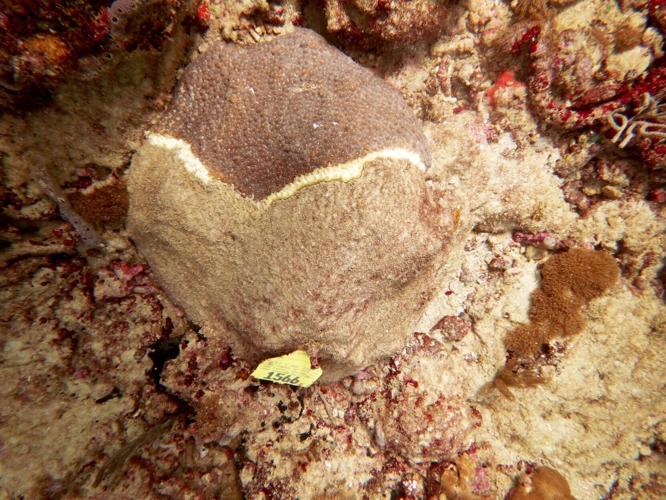
As it spreads, the disease causes the corals’ soft tissue to slough off, leaving behind white patches of exposed skeleton.
The disease can devastate an entire coral colony in just weeks, according to the research team.
Scientists have yet to identify the exact cause of SCTLD, but it appears to be linked to harmful bacteria.
To date, the most common treatment for SCTLD was applying paste that contains the antibiotic amoxicillin to diseased corals.
But while the amoxicillin balm can temporarily stem the spread of SCTLD, it needs to be frequently reapplied to the corals’ lesions.
That not only takes time and resources, but also increases the risk that the microbes causing SCTLD could develop resistance to amoxicillin and other antibiotics.
Dr. Paul said, “Antibiotics do not stop future outbreaks.
“The disease can quickly come back, even on the same coral colonies that have been treated.”
Dr. Paul and her colleagues have spent more than six years investigating whether probiotics could combat the disease.
She explained that, like humans, corals host communities known as microbiomes that are bustling with bacteria.
Some of those tiny organisms, which can be found in both coral tissue and the protective mucus that corals secrete, produce antioxidants and vitamins to keep their coral hosts healthy.





The researchers first looked at the microbiomes of corals that are impervious to SCTLD.
Their aim was to harvest probiotics from the disease-resistant species and use them to strengthen the microbiomes of susceptible corals.
The team tested more than 200 strains of bacteria from disease-resistant corals.
In 2023, they published a study about the probiotic Pseudoalteromonas sp. McH1-7 from the great star coral, which produces several different antibacterial compounds.
They found McH1-7 was an "ideal candidate" to combat SCTLD.

(Smithsonian’s National Museum of Natural History / Frontiers in Marine Science via SWNS)
Dr. Paul and her colleagues initially tested McH1-7 in the lab on live pieces of M. cavernosa.
They discovered that the probiotic reliably prevented the spread of SCTLD.
In 2020, the team conducted field tests on a shallow reef near Fort Lauderdale.
They focused on 40 M. cavernosa colonies that displayed signs of SCTLD.
Some of the corals received a paste containing McH1-7 that was applied directly onto disease lesions.
Other corals were treated with a solution of seawater containing McH1-7.
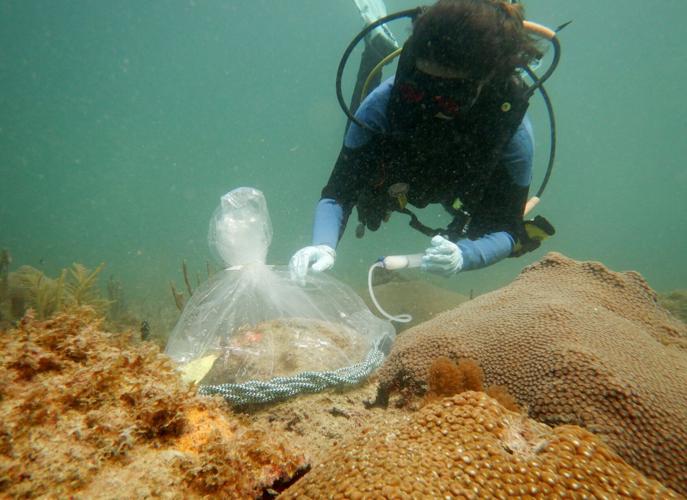
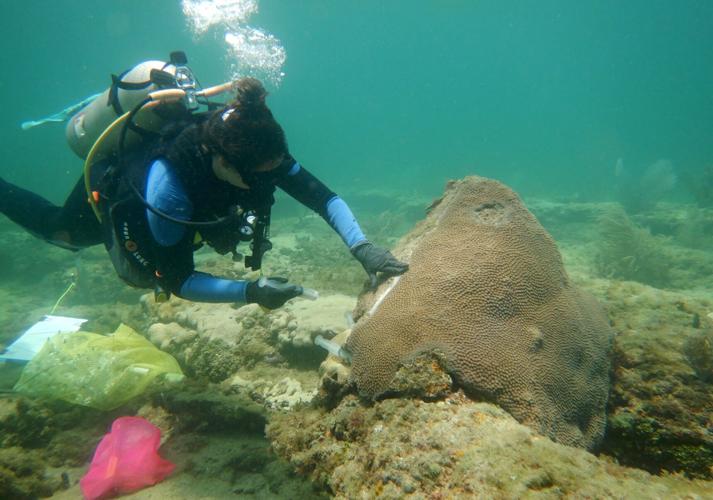
The team covered the colonies treated with the solution using weighted plastic bags and administered the probiotics inside the bag to cover the entire colony.
Dr. Paul said, “This created a little mini-aquarium that kept the probiotics around each coral colony."
The team found, after more than two years of monitoring the colony, that the McH1-7 probiotic successfully slowed the spread of SCTLD.
The samples revealed that the probiotic was effective without dominating the corals’ natural microbes.
In contrast, corals treated with the probiotic paste lost more tissue than the untreated control corals.
Dr. Paul showed that applying the probiotic directly to the lesions was the least effective way to control SCTLD.
While the probiotic appears to be an effective treatment for SCTLD among Florida’s northern reefs, she says more work is needed to calibrate the treatment for other regions.
Dr. Paul and her colleagues have conducted similar tests on reefs in the Florida Keys.
But she said preliminary results were mixed, probably due to regional differences in the disease itself.
But Dr. Paul says that probiotics could become a "crucial" tool for combating SCTLD across the Caribbean.
She added: “Corals are naturally rich with bacteria and it’s not surprising that the bacterial composition is important for their health.
“We’re trying to figure out which bacteria can make these vibrant microbiomes even stronger.”

(0) comments
Welcome to the discussion.
Log In
Keep it Clean. Please avoid obscene, vulgar, lewd, racist or sexually-oriented language.
PLEASE TURN OFF YOUR CAPS LOCK.
Don't Threaten. Threats of harming another person will not be tolerated.
Be Truthful. Don't knowingly lie about anyone or anything.
Be Nice. No racism, sexism or any sort of -ism that is degrading to another person.
Be Proactive. Use the 'Report' link on each comment to let us know of abusive posts.
Share with Us. We'd love to hear eyewitness accounts, the history behind an article.