

(STATE COLLEGE, PENN.) In early September 2026, a lawmaker in the Dominican Republic introduced a bill that would require all public schools in the Caribbean nation to offer courses in Haitian Creole. It was met with a swift and fierce public backlash.
Since then, Dominican and Haitian media outlets and pundits have debated the merits and challenges the proposal will undoubtedly face if it comes to a vote, let alone is implemented. As it stands, the level of political and social opposition means the proposal has little chance of progressing.
Much of the criticism has revolved around issues of Dominican national sovereignty, since Haiti and the Dominican Republic share an island. Though the two nations have been separate and independent since the 19th century, Dominican nationalists often foreground a 22-year period from 1822 to 1844 when Haitian troops occupied the Dominican Republic. In fact, the Independence Day that is celebrated every Feb. 27 in the Dominican Republic celebrates its independence from Haiti in 1844, not from Spain, its one-time colonial power.
Some nationalist Dominican groups feel that requiring students to study Haitian Creole is one step closer to an unwanted “unification” of the island that they believe has been planned since this occupation. Haitian immigration to the Dominican Republic is often characterized as an ongoing peaceful invasion – a nationalistic narrative that has been perpetuated by Dominican politicians for over 50 years.
The growing size of the Haitian immigrant population in the Dominican Republic – estimates range from 500,000 to several million people – often feeds these nationalistic fears. In certain industries, particularly agriculture and construction, Haitians form the overwhelming majority of the workforce.
The backlash notwithstanding, the Creole language is an indelible part of the Dominican Republic, and has been maintained in the country by migrants for hundreds of years. However, Creole has been systematically excluded from public spaces where you might expect it, like on signage or in public spaces, such as hospitals, where migrants might need an interpreter.
Creole and the Haitian diaspora
Haitians have moved to the neighboring Dominican Republic in large numbers over the last century, forming the largest diaspora in the Caribbean and representing almost half of the entire immigrant population in the region.
This immigration increased substantially after the 2021 assassination of Haiti’s President Jovenel Moïse, an event that further plunged the country into a period of economic instability and gang violence.
All that makes Haitian Creole the second-most widely spoken language in the Dominican Republic, after Spanish. Haitian Creole, or Kreyòl, is the national language of Haiti, alongside French, and is the only language spoken by the entire population.
Though it is often derogatorily dismissed as a “dialect” of French, or as “broken French”, Creole is a fully constituted language with its own language academy, orthography and grammar. It has been an official language of Haiti since 1987.
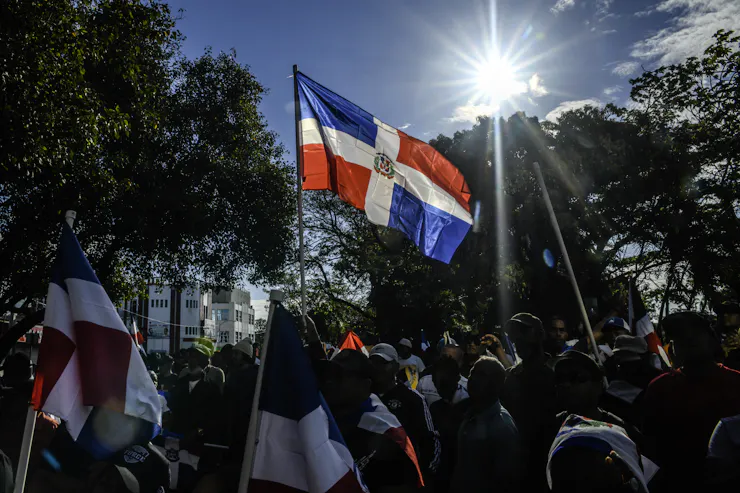
My own research shows that many Dominicans of Haitian descent grow up speaking Creole at home as a first language, particularly in the border region and in Haitian enclaves throughout the country. In these communities, it is common for Haitians and Dominicans to live alongside one another, work together and live in mixed-marriage households where children learn both Creole and Spanish.
A multicultural reality
Because of the widespread presence of Creole in the country, calls to teach the language in Dominican schools have been made before, though they have been resolutely rejected.
In 2017, for instance, the president of the national teachers union – the Asociación Dominicana de Profesores – publicly stated that it would be a mistake to teach Creole in schools, as it would cause Dominicans to start “acting and thinking like Haitians.”
These anti-Haitian attitudes reflect the overtly racial overtones of the immigration debate. Scholars and intellectuals have long argued that the rejection and hatred of Haitians by some sections of Dominican society are actually a rejection of the Blackness that Haitian identity and culture represents. These anti-Black attitudes allow politicians to scapegoat Haitians for problems within Dominican society.
But for Julio César Beltré, the legislative deputy who proposed the bill, the measure is common sense. As a native of the Azua province near the Dominican-Haitian border, he says that he sees the need for Creole language skills daily in his hometown, and argues that knowledge of Creole would offer a “practical advantage” to Dominicans in the business, work and social spaces that they share with Haitians.
“Learning a neighboring language,” he added, “doesn’t mean adopting an identity or a political position. It’s just a tool of communication.”






Since introducing the bill, Beltré has made the rounds on popular Dominican morning shows and news programs to discuss the legislation and address the criticism it has received. One of the most surprising aspects of the proposal, for many, is that Beltré is a member of the country’s ruling party, the Partido Revolucionario Moderno (PRM), which in recent years has made its name on its strict and brutal approach to Haitian immigration.

In July, the government announced it had deported more than 226,000 Haitians in the first half of the year alone. The party has been criticized internationally for human rights abuses against Haitian immigrants. On Sept. 14, Dominican President Luis Abinader – of PRM – said that the proposal does not reflect the party’s position, and that he does not support the proposal “in the slightest.”
Support on the street
While most headlines have focused on the backlash to the bill, there are many Dominican voices coming out in support. With the expanding Haitian population in the Dominican Republic, the next logical step in many citizens’ minds is a national education policy.
News outlet El Avance took to the streets to interview Dominican passersby about the proposal, and many stated that they support the bill. “We share borders,” said one person. “We have to know what our neighbors are saying.” Jonatan Familia, host of the extremely popular news program De Último Minuto, said he thinks teaching Creole would add to the educational system and benefit Dominican students.
The public relations secretary for the national teachers union has also publicly supported the initiative, a complete reversal of the group’s response a decade ago.
Overcoming the language barrier
Despite the backlash now, Dominican organizations have developed and offered Creole language courses for decades. In the 1980s and 1990s, Radio Enriquillo – a regional radio broadcast of the Catholic church – offered Creole lessons throughout the southern region of the country.
Some schools and institutions actively teach the language – at least 15, by my count. The nation’s preeminent public university, the Universidad Autónoma de Santo Domingo, has offered Creole courses at its main campus in the nation’s capital for more than a decade. In addition to these semester-long courses for students, they also offer nine-week courses on Saturdays, which are open to the general public. More recently, several of their satellite campuses throughout the country have begun teaching the language.
The Dominican government also offers Creole language training for some public servants. The INESDYC, the academic training arm of the Ministry of Foreign Relations, offers three different levels of Creole courses as well as a conversation course for its future diplomats. Meanwhile, Western Union – whose financial services allow Haitian migrants to send remittances to Haiti – has in recent years begun offering introductory Creole courses for staff members.
The limitations that the language barrier imposes between Haitians and Dominicans have been recognized by public, private and religious institutions alike, which have all sought to remedy it in their own piecemeal ways.
Though it is widely expected that this bill will be defeated on a floor vote, it has clearly spurred a heated national conversation around educational policy for Haitian Creole. It remains to be seen whether or not this newest initiative will lead to a shift in national policy, but evidence shows that public opinion may be slowly turning in its favor.
This article is republished from The Conversation, a nonprofit, independent news organization bringing you facts and trustworthy analysis to help you make sense of our complex world. It was written by: Kendall Medford, Penn State
Read more:
- Haitians looking to escape violence and chaos face hostility in neighboring Dominican Republic
- Jean‑Jacques Dessalines: Reassessing the Haitian revolutionary leader’s legacy
- 21 years after disaster helped bring peace to Aceh – has botched Indonesian response to floods reignited calls for independence?
Kendall Medford has received a Foreign Language and Area Studies fellowship from the US Department of Education to conduct research on Haitian Creole.

(0) comments
Welcome to the discussion.
Log In
Keep it Clean. Please avoid obscene, vulgar, lewd, racist or sexually-oriented language.
PLEASE TURN OFF YOUR CAPS LOCK.
Don't Threaten. Threats of harming another person will not be tolerated.
Be Truthful. Don't knowingly lie about anyone or anything.
Be Nice. No racism, sexism or any sort of -ism that is degrading to another person.
Be Proactive. Use the 'Report' link on each comment to let us know of abusive posts.
Share with Us. We'd love to hear eyewitness accounts, the history behind an article.