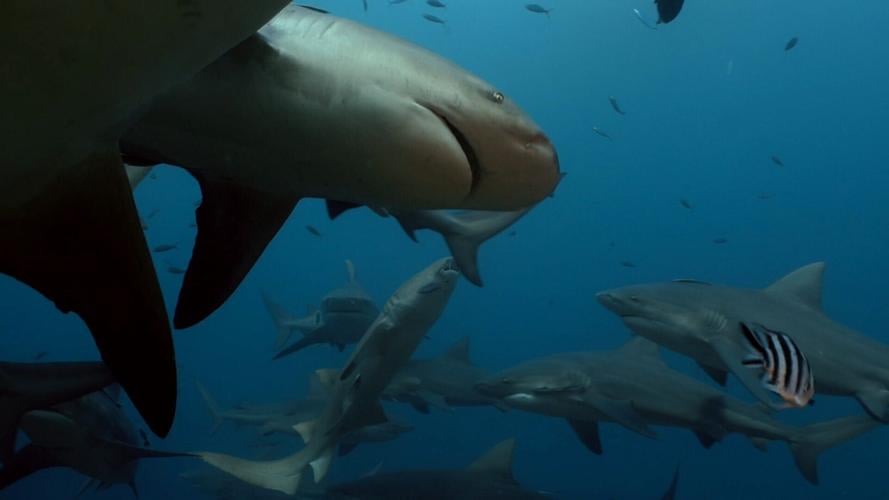








Bull sharks at Shark Reef Marine Reserve. (Natasha D. Marosi via SWNS)
By Stephen Beech
Sharks prefer to hang out with their relatives, suggests a new study.
Family ties shape the social lives of the aggressive predators, say scientists.
They found that bull sharks have a slight preference for spending time with relatives.
The research team used genetic data and six years of observations at Shark Reef Marine Reserve in Fiji, where adult bull sharks regularly gather.

New research shows that sharks prefer to hang out with their relatives, suggests a new study. (Natasha D. Marosi via SWNS)
The results, published in the journal Ecology and Evolution, show most of the sharks are not closely related — but individuals are slightly more likely to associate and socialize with relatives than unrelated sharks.
The researchers — from the University of Exeter, Lancaster University and Fiji Shark Lab — coined the term "kinfluence" to describe the influence of kinship on social structure and social behavior.
Study lead author Natasha Marosi said: "Large sharks are often seen as solitary, but our previous research showed that bull sharks actively choose their social partners.
"That study found that the attributes of sex, age and size influenced the social partner choices of individual sharks.

Researchers found that bull sharks have a slight preference for spending time with relatives. (Natasha D. Marosi via SWNS)
"This new study reveals another dimension of their social lives: the 'kinfluence' effect we have uncovered — while not as strong as the previous identified factors — is nonetheless extraordinary."






Marosi, a Ph.D. candidate at the University of Exeter and founder of Fiji Shark Lab, added: "To discover that some of these large, apex predators choose to socialize with their relatives is truly exciting, it's something never found before in an adult population of sharks."
Sharks' social preferences were measured in two ways, by proximity-based "associations" — being within one body length of each other — and directed social interactions such as parallel swimming, "lead-follow" swim configuration and "joining" — when one shark actively joins another to swim in synchronization.
The results show family ties may contribute to both aspects, especially between pairs of male sharks.
Evolutionary theory suggests animals favor their relatives which benefits both parties and helps ensure shared genes are passed on to future generations.

A research team used genetic data and six years of observations at Shark Reef Marine Reserve in Fiji, where adult bull sharks regularly gather. (Natasha D. Marosi via SWNS)
Marosi says a variety of "recognition mechanisms" are at work during the early stages of a shark's life when full and half-siblings and cousins may spend their formative years in the same rivers and estuaries.
They may then identify those relatives later in life.
Family ties could play an even greater role in bull shark social structure — but detecting the relationships is challenging.
Young bull sharks experience high mortality rates in river and coastal habitats, largely due to illegal fishing, resulting in relatively few family members reaching adulthood.
Andrew Griffiths, from the University of Exeter, said: "The results are fascinating, especially as sharks are still widely perceived as fearsome and solitary animals."
He added: "It suggests preferences for associating with kin are very subtle and vary according to the type of behavior measured and operate alongside social preferences based on sex, size and age to shape a complex and dynamic social network.
"This paints these animals in a completely new light."

(0) comments
Welcome to the discussion.
Log In
Keep it Clean. Please avoid obscene, vulgar, lewd, racist or sexually-oriented language.
PLEASE TURN OFF YOUR CAPS LOCK.
Don't Threaten. Threats of harming another person will not be tolerated.
Be Truthful. Don't knowingly lie about anyone or anything.
Be Nice. No racism, sexism or any sort of -ism that is degrading to another person.
Be Proactive. Use the 'Report' link on each comment to let us know of abusive posts.
Share with Us. We'd love to hear eyewitness accounts, the history behind an article.