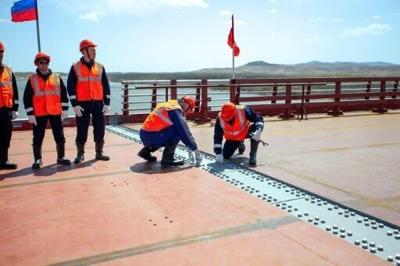
Russia and North Korea held a ceremony Tuesday to mark the joining of the first road bridge connecting the countries, set to open for traffic this summer, Moscow said.
Ties between the two heavily sanctioned countries have surged amid Russia's war on Ukraine, with Moscow and Pyongyang deepening economic, political, cultural and military links.
South Korea warned last week that Chinese and Russian support was helping revive the North Korean economy, which has struggled for years under sweeping international sanctions, almost complete international isolation and huge military investment.
Moscow's foreign ministry said the opening of the bridge would "become a truly landmark stage in Russian–Korean relations. Its significance goes far beyond a purely engineering task".
The bridge, which crosses the Tumen river that marks the border between the two countries, will be able to handle up to 300 vehicles and 2,850 people a day, Russia's transport ministry said.
Russia and North Korea inked a defence treaty in 2024 that calls for military support in the case of either country being attacked.
Pyongyang that year sent thousands of troops to Russia to support its war on Ukraine. They were deployed to the western Kursk region to held fend off a months-long counter-offensive by Kyiv's troops.




Several senior Russian officials have visited North Korea recently, including the interior minister, currently in the country.
Russia's foreign ministry said the bridge would help "develop trade, economic and humanitarian exchanges" between Russia's Far East and North Korea.
North Korea does not publish official data on the size of its economy.
Its nominal gross domestic product was equivalent to about $30 billion in 2024, according to Seoul's official estimate -- a tiny fraction of the South Korean economy, one of the most developed in the world.
North Korea has long faced shortages. A famine in the mid-1990s killed hundreds of thousands of people, and reports indicate that the Covid-19 pandemic also pushed many into extreme hunger.
bur/rmb

(0) comments
Welcome to the discussion.
Log In
Keep it Clean. Please avoid obscene, vulgar, lewd, racist or sexually-oriented language.
PLEASE TURN OFF YOUR CAPS LOCK.
Don't Threaten. Threats of harming another person will not be tolerated.
Be Truthful. Don't knowingly lie about anyone or anything.
Be Nice. No racism, sexism or any sort of -ism that is degrading to another person.
Be Proactive. Use the 'Report' link on each comment to let us know of abusive posts.
Share with Us. We'd love to hear eyewitness accounts, the history behind an article.