






(Photo by SHVETS production via Pexel)
By Stephen Beech
Half of parents still track their adult children's whereabouts, reveals new location tracking research.
But one in four moms and dads say location tracking their grown-up sons and daughters actually increases their anxiety.
Built-in smartphone apps and location-sharing features allow "helicopter" parents to see where their children are at any moment.
But while technology can provide reassurance, new research suggests some moms and dads may be crossing a line as their children reach adulthood by failing to cut the apron strings.
Half of parents report tracking the location of their adult child aged 18 to 25 at least occasionally, according to the American study.
But the University of Michigan Health C.S. Mott Children's Hospital National Poll showed that doing so made one in four of those moms and dads more anxious than reassured.
Poll co-director Sarah Clark said: "As children become young adults, there may be questions about whether and when parental location tracking is appropriate.

"Our findings suggest that families are split on where that boundary should be."
The research showed that location tracking is more common among parents of young adults ages 18 to 20 than among parents of those aged 21 to 25.
Parents are also more likely to track daughters than sons, according to the report based on a survey of 1,542 American parents.
But for many families, tracking is not just used occasionally but is a constant presence.
More than two-thirds of parents who track their adult offspring say the feature is always on.
Fewer than a third use tracking only in certain situations.
Even among parents who routinely have access to their child's location, certain circumstances are more likely to prompt them to check.
These included when their young adult is out late at night, in an unfamiliar place, using a rideshare or taxi service or spending time with someone the parent doesn't know.
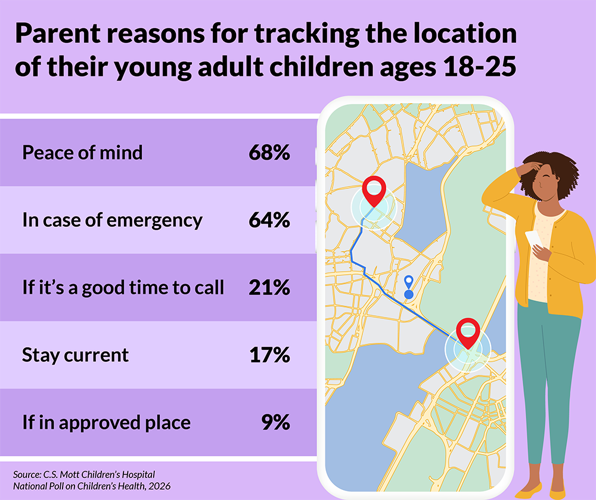
The most common reason parents give for tracking is peace of mind.
Most say they use location-sharing features to feel reassured about their child's safety or to be prepared in case of an emergency, while around one in five say it helps them know when it's a good time to call.

(Photo by Kampus Production via Pexels)
Smaller percentages say they use it to stay informed about what their child is doing or to make sure they are in places the parent approves of.
But one in nine moms and dads who track their child's location (11%) say they don't have a specific reason for doing so.
Research scientist Clark said: "For some parents, location tracking reduces uncertainty and provides a greater sense of security.






"But constant access to information can also fuel anxiety.
"When parents can check their child's location at any time, it may become harder to resist checking, especially when they're already worried."
Nearly all parents who track their adult son or daughter say their child knows they are being tracked.
But fewer than half say they gave their child the option to decline location sharing.
Among parents who don't track their young adult child, two-thirds say tracking feels like an invasion of privacy.
Around half also believe it may interfere with the development of independence and personal responsibility.
Clark said: "For some families, tracking may be viewed as the default rather than a decision that's discussed together.
"When there aren't conversations about whether or how tracking happens, it may feel intrusive.
"As digital tools continue to evolve, families may benefit from thoughtful discussions about how to balance safety, privacy and independence."
While there are certain situations when location sharing may serve as a valuable safety tool, Clark says parents should remember that young adults can use smartphone safety features without relying on parental oversight.
Many already share their location with friends when traveling, meeting new people or getting home late at night.
Clark says that type of peer-based location sharing can help support safety while allowing young adults to decide when and with whom they share their whereabouts.

(Photo by Joshua Woroniecki via Pexels)
One unexpected finding from the survey was that tracking often goes both ways.
Around half of parents say their child tracks their location.
In 90% of those cases, the parent is also tracking the young adult child.
Clark says that dynamic may give parents a useful perspective.
She said: "Parents can reflect on how it feels to have their own location visible to someone else and use that insight to guide conversations with their young adult child."
Clark says establishing a shared understanding around expectations, boundaries and the purpose of tracking may help reduce conflict and strengthen trust as young adults become more independent.
She added: "Parents who use location tracking think they are keeping their child safe.
"But they might be interfering with that young adult learning to keep themselves safe.
"At its worst, constant location tracking can prompt parents to take over management of their young adult child's daily life, with parents asking why their child isn't at work, at a doctor's appointment or in class.
"With that type of hovering, the young adult has less ownership of their own schedule and obligations and less responsibility to figure out how to be a successful adult."

(0) comments
Welcome to the discussion.
Log In
Keep it Clean. Please avoid obscene, vulgar, lewd, racist or sexually-oriented language.
PLEASE TURN OFF YOUR CAPS LOCK.
Don't Threaten. Threats of harming another person will not be tolerated.
Be Truthful. Don't knowingly lie about anyone or anything.
Be Nice. No racism, sexism or any sort of -ism that is degrading to another person.
Be Proactive. Use the 'Report' link on each comment to let us know of abusive posts.
Share with Us. We'd love to hear eyewitness accounts, the history behind an article.