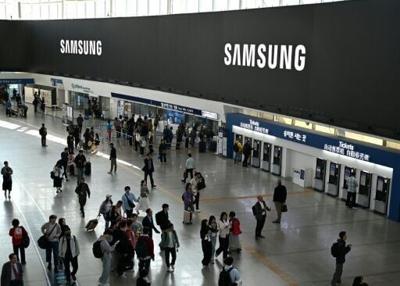

Samsung Electronics said on Thursday its quarterly operating profit had jumped 750 percent year-on-year to a record 57.2 trillion won ($38.4 billion) on the back of strong sales of chips crucial for artificial intelligence.
The South Korean technology giant has emerged as a key player -- along with rival SK hynix -- in the supply of high-performing chips in demand from companies racing to keep up with the fast-evolving AI industry.
Their strong performance has come as the South Korean government has pledged to make the country one of the world's top three AI powers alongside the United States and China.
Samsung said in its earnings report on Thursday it had "achieved record quarterly revenue and operating profit through AI technology innovations and proactive market response".
It had already said this month that it expected profit to reach a quarterly record.
Net profit was 47.1 trillion won, beating forecasts by a Bloomberg survey of analysts. Sales hit 133.9 trillion won, an all-time quarterly high.
Its chips division also beat expectations with a huge rise in profit to 53.7 trillion won, accounting for the bulk of the unit's total.






The company said its memory arm "surpassed its quarterly sales record by addressing high-value-added AI demand despite limited supply availability, with industry-wide memory price increases also a contributing factor".
It added that it expected "strong memory demand to continue" through the second quarter as the buildout of AI infrastructure continues apace.
South Korea's benchmark Kospi stock index opened at a fresh high of over 6,700 on Thursday following strong earnings figures from Samsung and US technology giants.
Samsung's shares have risen by around 300 percent over the past year as the AI boom boosts South Korean growth and pushes the stock market to new records.
The company has seen strong orders from major technology firms for high-bandwidth memory -- a type of chip that is used in data centres and AI "accelerators", which are useful in carrying out demanding tasks and computation.
That is also pushing up the cost of less flashy chips used in consumer electronics -- threatening higher prices for phones, laptops and other devices worldwide.
sjh-mjw/abs

(0) comments
Welcome to the discussion.
Log In
Keep it Clean. Please avoid obscene, vulgar, lewd, racist or sexually-oriented language.
PLEASE TURN OFF YOUR CAPS LOCK.
Don't Threaten. Threats of harming another person will not be tolerated.
Be Truthful. Don't knowingly lie about anyone or anything.
Be Nice. No racism, sexism or any sort of -ism that is degrading to another person.
Be Proactive. Use the 'Report' link on each comment to let us know of abusive posts.
Share with Us. We'd love to hear eyewitness accounts, the history behind an article.