
(NASA/ESA/CSA/STScI/J. Nichols via SWNS)
By Dean Murray
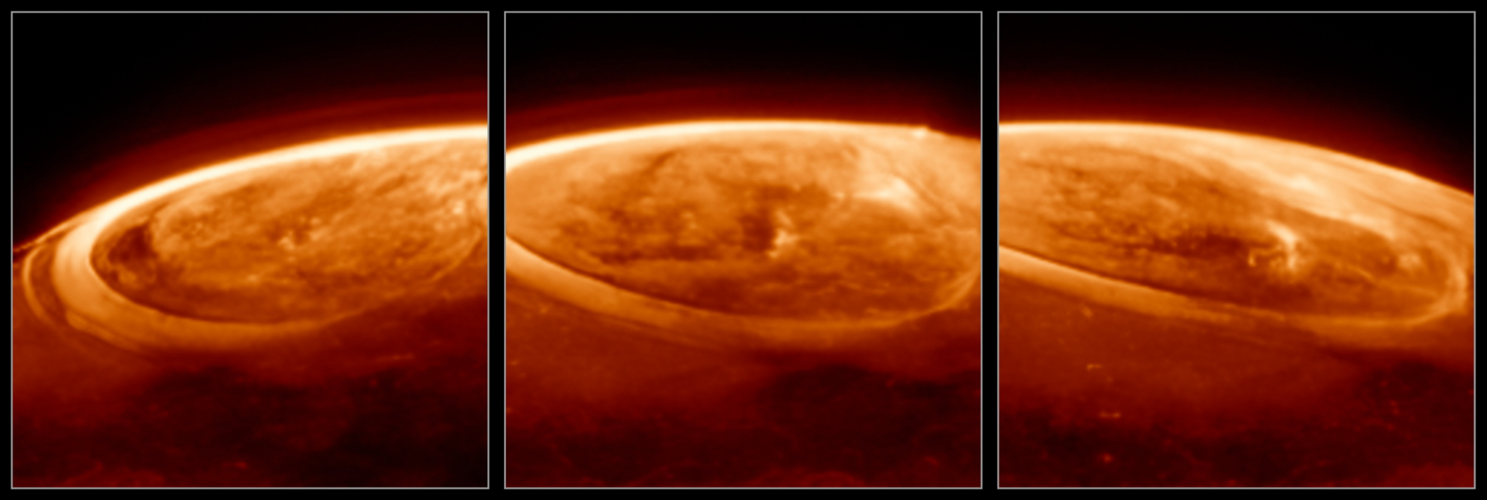
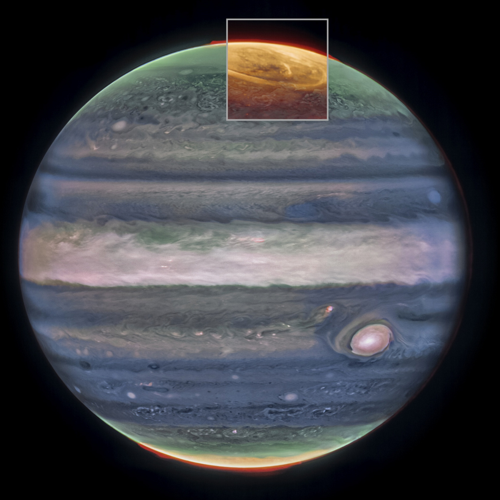
Scientists have observed vast auroras on another planet.
The dancing lights observed on Jupiter are hundreds of times brighter than those seen on Earth.
NASA’s James Webb Space Telescope captured new details of the phenomenon on our solar system’s largest planet.
New data was captured with Webb’s NIRCam (Near-Infrared Camera) in December 2023 by a team of scientists led by Jonathan Nichols from the University of Leicester. The results were published Monday, May 12 in the journal Nature Communications.







(NASA/ESA/CSA/STScI/UPV/U.Leic.. via SWNS)
Jonathan Nichols said: "What a Christmas present it was – it just blew me away.
"We wanted to see how quickly the auroras change, expecting them to fade in and out ponderously, perhaps over a quarter of an hour or so.
"Instead, we observed the whole auroral region fizzing and popping with light, sometimes varying by the second."
The team studied emissions from the trihydrogen cation (H3+), which can be created in auroras. They found that this emission is far more variable than previously believed. The observations will help develop scientists’ understanding of how Jupiter’s upper atmosphere is heated and cooled.
Auroras are created when high-energy particles enter a planet’s atmosphere near its magnetic poles and collide with atoms or molecules of gas. On Earth, these are known as the Northern and Southern lights.

(0) comments
Welcome to the discussion.
Log In
Keep it Clean. Please avoid obscene, vulgar, lewd, racist or sexually-oriented language.
PLEASE TURN OFF YOUR CAPS LOCK.
Don't Threaten. Threats of harming another person will not be tolerated.
Be Truthful. Don't knowingly lie about anyone or anything.
Be Nice. No racism, sexism or any sort of -ism that is degrading to another person.
Be Proactive. Use the 'Report' link on each comment to let us know of abusive posts.
Share with Us. We'd love to hear eyewitness accounts, the history behind an article.