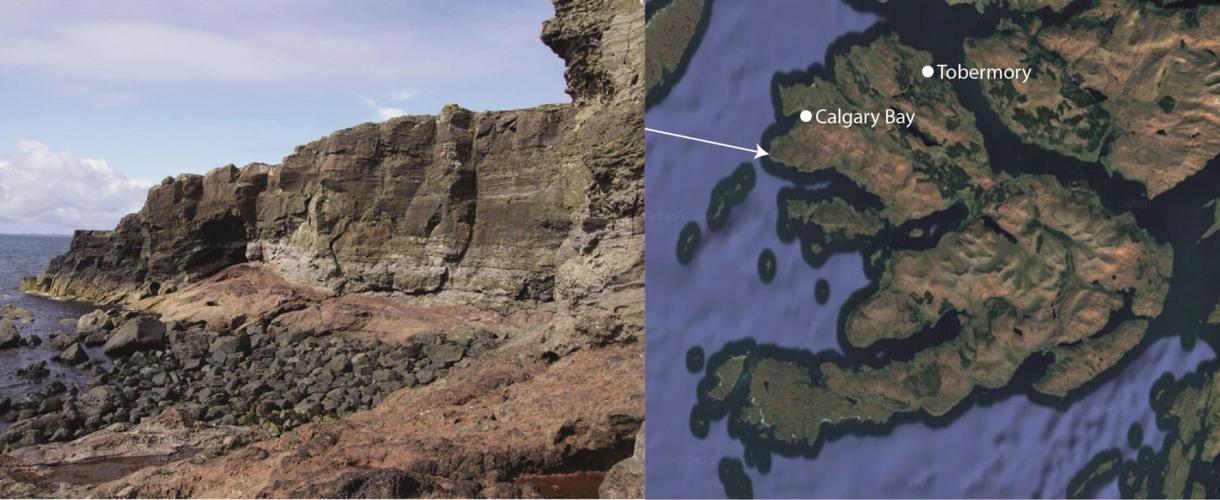


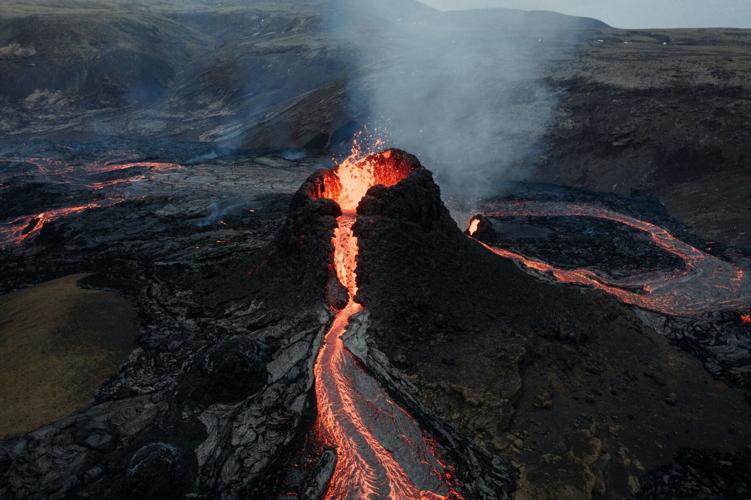

The Isle of Mull fissures. (University of Aberdeen via SWNS)
By Elizabeth Hunter
Scotland's dramatic volcanic landscape once rivalled the fiery activity of modern-day Hawaii, scientists have discovered.
Geologists from the University of Aberdeen have confirmed that cracks in the Earth, called volcanic fissures, helped create many of the Inner Hebrides.
Scientists have long understood that islands such as Skye, Mull, Eigg, Canna and Staffa, as well as parts of the mainland, were formed from lava flows.
But the way the lava came to the surface has been debated by scientists for over 100 years.

chris robert
In contrast to the calm, picturesque scenery of today, 60 million years ago, the west coast of Scotland was erupting with lava fountains and other volcanic events.
The new discovery by geoscientists from the University of Aberdeen provides the strongest evidence yet that some of Scotland’s most iconic islands were born not from a single large volcano, but from a network of erupting fissures, just like those found in Hawaii and Iceland.
The research, published in The Journal of the Geological Society, settles the century-old debate over how the lava fields of the Inner Hebrides islands were formed.







University of Aberdeen's Dr. Jessica Pugsley. (University of Aberdeen via SWNS)
The team has, for the first time, uncovered physical proof of an ancient volcanic fissure that fed lava into the surrounding landscape.
The site, a 5km-long stretch near Calgary Bay on the Isle of Mull, reveals preserved deposits from one of these fissures, where magma once erupted in spectacular displays.
Dr. Jessica Pugsley from the University of Aberdeen, who led the project, said: “For over 100 years, scientists have debated whether the lava flows on Skye and Mull came from a single volcano or from many fissures like those we see in Iceland and Hawaii today.
“Finding a preserved fissure is a bit like discovering a dinosaur fossil with skin - it tells us far more than lava alone can. Typically, a very small fraction of a lava field contains these fissures, so it’s an extraordinarily significant find.”

Ása Steinarsdóttir
The volcanic activity occurred as the Atlantic Ocean began to form, ripping apart ancient land and allowing magma to surge up through the crust. This zone of volcanic remnants is called the British Paleogene Volcanic Province and reaches from the west of Scotland over to parts of Northern Ireland, including the famous Giants Causeway.
The preserved fissure found by the Aberdeen team through fieldwork aided by 3D drone modelling technology shows exactly where lava once fountained out of the Earth, before being buried by later eruptions and finally revealed by millions of years of erosion.
“To be able to stand and walk on a feature that played such a key role in shaping Scotland’s geography - and to realise it erupted like Iceland and Hawaii’s volcanoes do today - is pretty incredible,” says Dr. Pugsley.
(0) comments
Welcome to the discussion.
Log In
Keep it Clean. Please avoid obscene, vulgar, lewd, racist or sexually-oriented language.
PLEASE TURN OFF YOUR CAPS LOCK.
Don't Threaten. Threats of harming another person will not be tolerated.
Be Truthful. Don't knowingly lie about anyone or anything.
Be Nice. No racism, sexism or any sort of -ism that is degrading to another person.
Be Proactive. Use the 'Report' link on each comment to let us know of abusive posts.
Share with Us. We'd love to hear eyewitness accounts, the history behind an article.